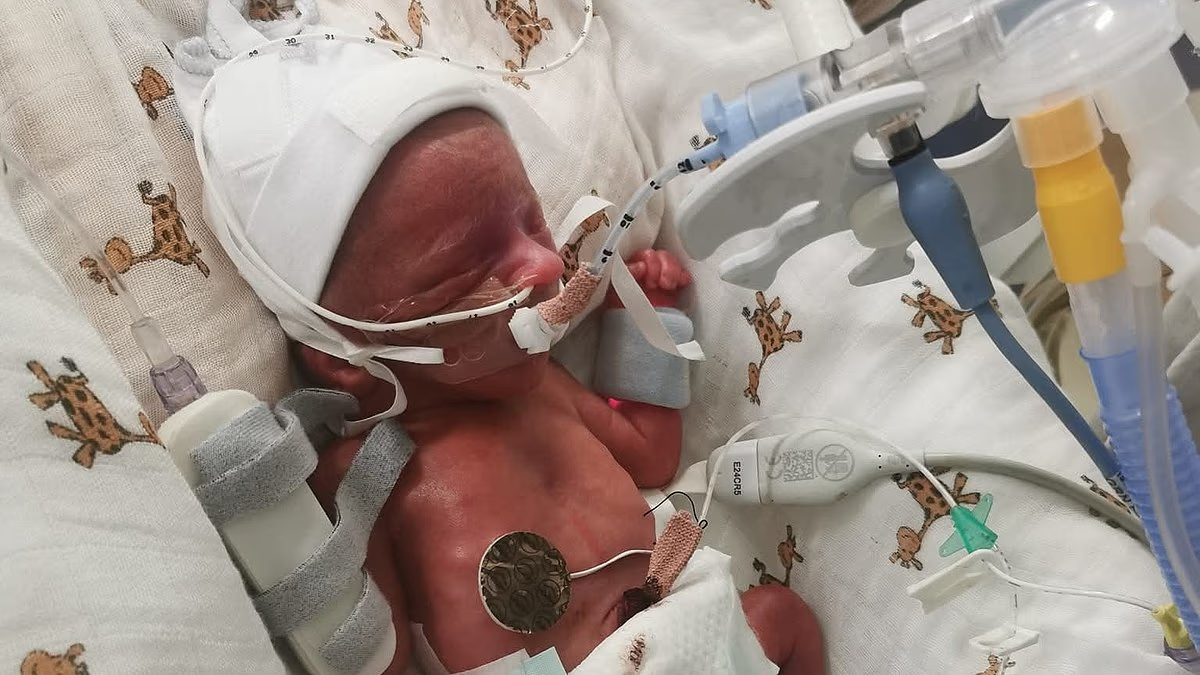

A resilient toddler who came close to dying after being born prematurely has enjoyed her first family holiday, thanks to an urgent technology upgrade.
Juniper Rayner, two, has spent more than half her life in hospital while facing complex health problems, including severe bowel complications, epilepsy and recurring infections. She has been in and out of hospital for the past 27 months.
Born at just 25 weeks—more than three months early—and weighing only 1lb 8oz, Juniper has continued to defy the odds.
Because of her medical needs, the youngster from Stoke Golding, Leicestershire, depends on a central line that delivers essential nutrition directly into her bloodstream near her heart.
Any split in the line could cause dangerous bleeding, meaning her parents must respond immediately.
A temperature above 38C also requires an immediate trip to hospital because of the serious risk of sepsis.
Juniper has also undergone surgery for her bowel problems and now has an ileostomy, which allows waste to pass from her body into a bag through a valve in her stomach.
Her parents must therefore remain in close contact with medical staff while adapting to the demanding care she needs.

Juniper Rayner, two, was born more than three months prematurely at 25 weeks and weighing just 1lb 8oz

Juniper is pictured with her mother, Lottie Scarborough, father Jamie Rayner, and two sibilings Forest and Willow

Juniper meets Amie the pink elephant, her favourite character from Haven’s ‘Seaside Squad’
Despite those challenges, Juniper’s parents, Jamie Rayner, 40, and Lottie Scarborough, 38, decided to take her and her siblings, Forest, eight, and Willow, seven, on holiday. The trip nearly turned into a medical emergency.
The family were staying in a caravan at Haven’s holiday park in Cleethorpes, Lincolnshire, when Juniper’s complex needs created an unexpected problem.
Her parents need to be able to summon help at any time if she experiences a potentially life-threatening complication.
However, there was no Wi-Fi or mobile phone reception near their caravan—until Haven joined forces with Vodafone to provide the family with a solution.
Juniper’s mother, Ms Scarborough, a paediatric nurse, said: ‘We were so excited to get away on holiday. But when we arrived at Haven in Cleethorpes, we discovered we had no Wi-Fi and no 5G.’
‘We panicked a bit because we need to be in contact in case of an emergency—and that can happen at any time.’
‘Then, on the first day, Juniper and I spent an hour and a half walking around the only part of the park where we could get a signal while waiting for the hospital to call us back and help with problems involving her ileostomy.’
After hearing about the family’s predicament, staff at Haven and Vodafone acted quickly.
Within hours, a Wi-Fi router was delivered by courier to the caravan, restoring the family’s connection to vital medical support and allowing them to enjoy their break with greater peace of mind.
Ms Scarborough said: ‘It was such a relief. We can’t thank Haven and Vodafone enough for coming to our rescue.
‘This little holiday means so much to all of us and it would have been awful if we’d had to give up and go home.’
The holiday park operator also ensured Amie the pink elephant – Juniper’s favourite character from its ‘Seaside Squad’ – paid her and her two siblings a visit.
Juniper’s father, Mr Rayner, who is a special needs teacher, revealed how his daughter fought to cling on to life and spent 11 weeks in hospital after she was born.
The two-year-old was delivered by emergency Caesarean when her mother suffered from life-threatening pre-eclampsia.
Mr Rayner said: ‘Juniper was no bigger than our hand when she was born. She looked so tiny and helpless.
‘It was a desperate time. Her organs were not fully developed and doctors in the paediatric intensive care unit at Coventry and Warwickshire Hospital did everything they could to keep her alive.

Due to her complex medical needs, the two-year-old’s parents need to be able to call for help if she suffers a potentially life-threatening emergency – which ‘can happen at any time’

Juniper’s most recent major hospital stay lasted two months, after severe problems with her digestive system left her unable to tolerate normal feeding
‘Her lungs were like paper and they collapsed. Then she suffered a bleed on the brain, because the tissue in the skull was so thin that just moving her to feed her caused blood vessels to rupture.’
Her early days were marked by more serious complications. She suffered infections affecting her tummy and lungs, and the brain bleed later contributed to epilepsy.
After 11 weeks she was finally allowed home – but only because Ms Scarborough is a paediatric nurse.
Even then she needed daily oxygen for the first year of her life.
Within a week she was back in hospital with an infection and has since endured 15 hospital admissions and spent almost half her young life in hospital.
Her most recent major stay lasted two months, after severe problems with her digestive system left her unable to tolerate normal feeding.
Doctors diagnosed a condition known as pseudo-obstruction, in which the gut behaves as though it is blocked even when there is no physical blockage.
She underwent surgery to have an ileostomy formed and a feeding tube inserted into her stomach.
Despite everything she has endured, her parents have a remarkable reason to celebrate.
‘She was classed as developmentally delayed, but we’re actually just caught up to all of her milestones for being two,’ they said.
Juniper’s daily care is an extraordinary operation for a family with three young children.
Every night, she receives parenteral nutrition, known as PN, through a central line leading into a major blood vessel close to the heart.
The procedure must be carried out using strict sterile precautions to reduce the risk of infection.
Her parents connect her to the nutrition each evening and disconnect her in the morning, carefully preparing equipment and keeping everything clean.
The line has split before, leaving Juniper with a life-threatening bleed and forcing her parents to clamp it.
For Jamie and Lottie, both of whom must be ready to manage the equipment, there is little opportunity simply to switch off.
Even leaving the house requires military-style preparation. For their first family holiday, they needed a drip stand, trolley, changing table and enough medical equipment to fill the boot of a large estate car.
Juniper’s specialist nutrition also had to be transported in a cool box because, at home, it is stored in a medical fridge.
Changing her dressings can take around 45 minutes and is painful for the toddler.
Her parents have to remove medical dressings stuck to her skin, while keeping her hands away from the sterile equipment.
To help her cope, they use children’s programmes online such as Bluey and Miss Rachel to distract her.
Mr Rayner said: ‘She gets more screen time than we want her to have but it helps distract her – hence the need to be able to stream the shows.’
Juniper’s medical needs have affected every member of the family.
Her older brother and sister have had holidays and days out cancelled, while some weekends have meant travelling to hospital in Birmingham.
Ms Scarborough has given up work to care for Juniper. The family are managing on one salary, but life is financially tighter and the constant demands have taken a toll on their freedom.
She said: ‘Some days are hard. Neither of us have any real freedom anymore.
‘I have had to give up playing hockey and Jamie can no longer go to the gym… but we are just blessed to have Juniper in our lives.’


