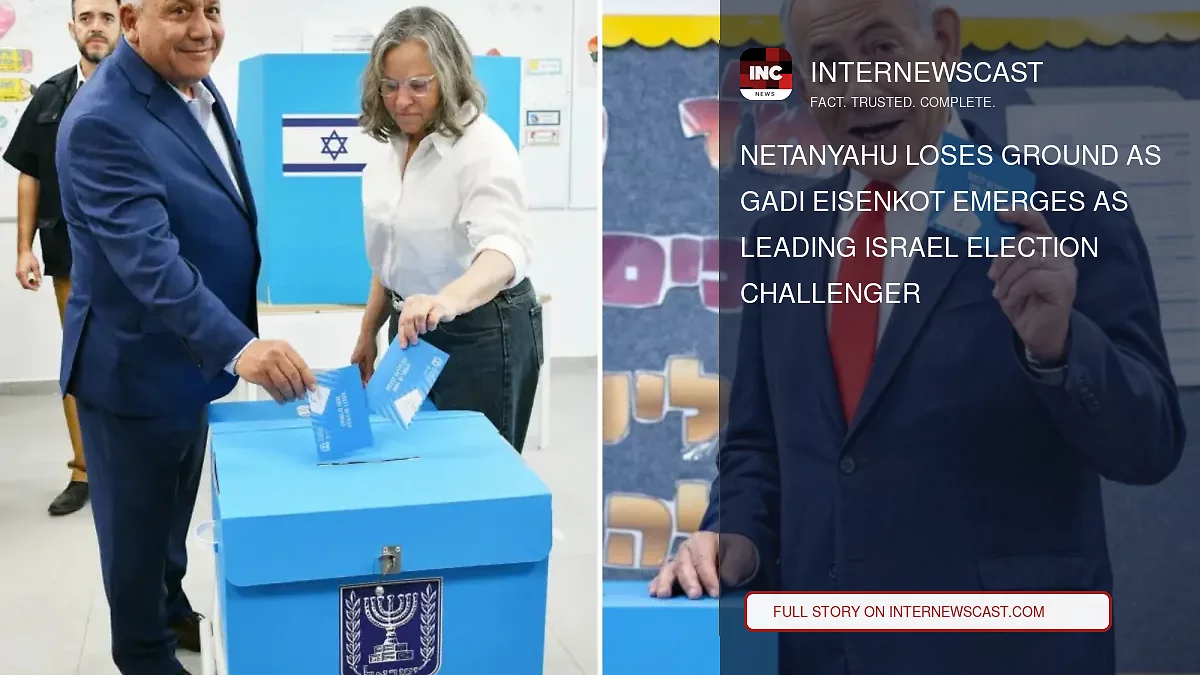

TEL AVIV — Prime Minister Benjamin Netanyahu appeared to have lost substantial support to opposition leader Gadi Eisenkot in Tuesday’s Israeli election, according to exit polls. However, neither political bloc was projected to win the 61 seats required for a clear majority.
Follow live updates on Israel’s elections for the latest news, results and more
The election’s biggest development was the surge by Israeli Arabs, who account for roughly 25% of the country’s population.
They were projected to win 17 seats, a dramatic increase from their previous representation.
Netanyahu’s Likud party was projected to take 25 seats, while his broader right-wing alliance was on track for 50, according to the Kan 11 exit poll released after voting ended. That would represent a sharp decline from the bloc’s current 32 seats.
Even after that setback, Likud was still projected to receive more votes than any other individual party, according to all major exit polls.
The opposition “Change” bloc, meanwhile, was projected to win between 52 and 53 seats.
Opposition parties currently control 50 seats in the 120-member Knesset.
“If these are the final results, they would mark a victory,” Eisenkot said in a statement.
“Netanyahu’s bloc suffered a tough defeat,” fellow opposition leader Yair Lapid said. “This is a total collapse and the public told them to go home.”
With at least 38 parties competing for seats in the Knesset, smaller factions — particularly Israel’s Arab parties — could determine the country’s next government as Netanyahu’s and Eisenkot’s blocs compete to reach a majority.
CONTINUE READING: Alexander’s Brother’s Wife Draws Criticism for Inappropriate Gesture in Court Appearance
Here’s the latest on the 2026 Israel Legislative Elections — the first since the Oct. 7 attacks
Both sides appeared to fall short of the 61 seats needed to elect a prime minister and form a government.
Arab parties held only 10 Knesset seats before the election, while Arab voter turnout on Tuesday was higher than in the 2022 election.
That could make them kingmakers — provided Eisenkot is willing to break a campaign promise and cooperate with them.
“When you have Arabs at 17, you can’t disregard them,” Israeli journalist Attila Somfalvi said at the Israel Press Club’s election-night press center in Tel Aviv.
Retired Israeli Air Force Maj. Gen. Nimrod Sheffer, a candidate for the left-wing Democrats party, which was projected to win between nine and 10 seats, said Tuesday that the anti-Netanyahu coalition had met with Arab leaders. The discussions focused on potentially forming a government together if the election results favored the opposition.
Counting the ballots will take time because Israel conducts its elections using traditional, paper-based procedures.
Official results are expected to provide a clearer picture on Wednesday, but it could take three weeks to a month for the winning parties to negotiate a coalition and establish a government.
“There are no results yet, and like we heard, it’s not a sprint, it’s a marathon,” Dr. Michal Hatuel-Radoshitzky, an Israeli foreign-policy and national-security analyst, told The Post.
“Everyone’s very eager for the headlines, but it looks like there will be a change,” he added. “And if the polls are right, it looks like the Arab vote is what’s going to be the game changer here.”
Regardless of the final result, the exit polls are evident that Israelis want to see a change, said Mati Gi;l, a candidate in the Together coalition.
“As opposition candidates, we see that as the Israeli public, especially the Israeli Zionist Jewish public, overwhelmingly accepting the opposition’s claim that this government should not continue in its leadership of Israel, and we should change course for Israel,” Gil added.
It will eventually fall on Israeli President Isaac Herzog to select a party leader he believes will win the majority of support in Knesset.
Herzog has three chances to tap a worthy candidate, but should the Knesset fail to rally around his pick, a new round of elections would be held.
Netanyahu will remain the country’s acting prime minister until a new premier is elected.


