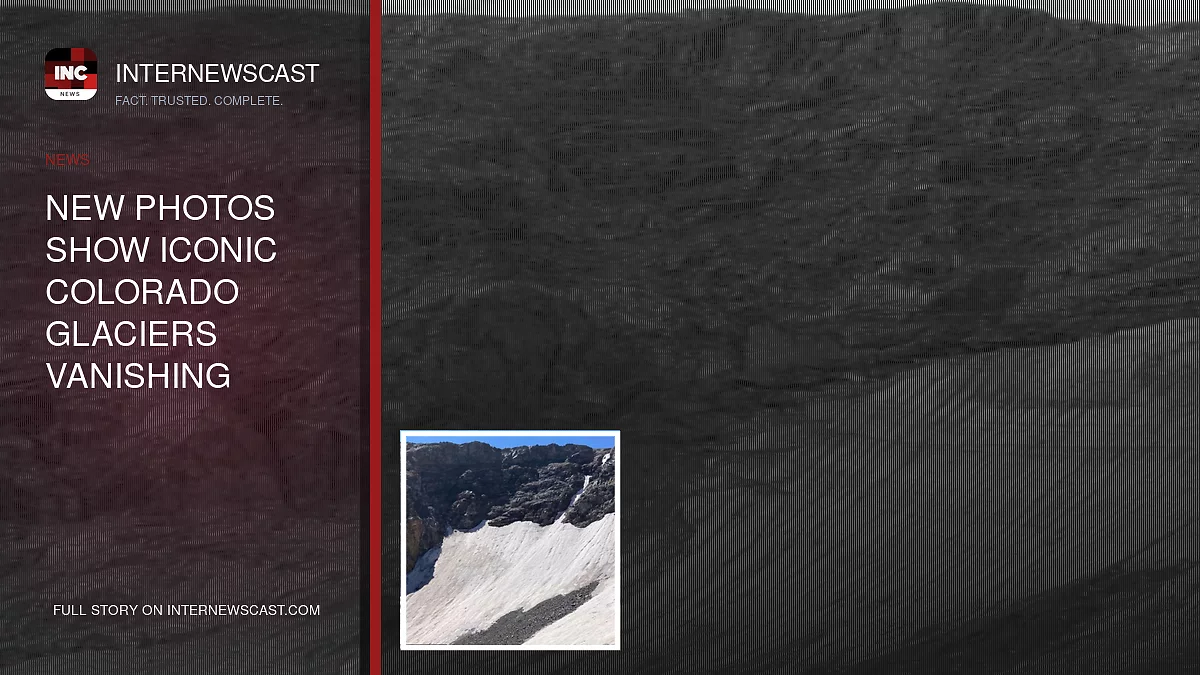

Some of Colorado’s most recognizable glaciers are disappearing at an alarming pace, with new photographs showing that one ice field has nearly vanished in just two years.
St. Vrain Glacier in Boulder County has thinned dramatically over the past year. Across the Rocky Mountains, intense climate change and a sharp decline in snowfall have exposed ice that would normally be replenished by winter accumulation.
Colorado has endured its lowest snowpack on record alongside summer temperatures that shattered previous highs, conditions that have accelerated glacier melt.
The Colorado Climate Center reported that Colorado was, on average, 6.1 degrees hotter during the past 12 months in 2026 than it was across the entire 20th century.
The combination of low snowfall and extreme heat is also placing pressure on water supplies and contributing to rising sea levels.
The Seattle Times reported that several other well-known Colorado glaciers also suffered major losses this year. Andrews Glacier shrank by more than 12 feet, Arapaho Glacier lost 10 feet and Isabella Glacier declined by 6.5 feet.
St. Mary’s Glacier, a semi-permanent snowfield once popular with hikers and skiers, has melted completely for the first time in at least 100 years.
Dan McGrath, a glaciologist at Colorado State University, told the Seattle Times that the pace of thinning has doubled compared with the previous five years.
‘It is not like we’re never going to see St. Mary’s snowfield again. Following big winters, it will exist in the summer. But I think it’s safe to say that these glaciers — and I’m using that term broadly here to encompass all these snowfields — they’re on a one-way street toward disappearing,’ McGrath told the Colorado Sun.


St. Vrain Glacier in Boulder County, Colorado, has thinned sharply over the past year as intense climate change exposes ice across the Rocky Mountains. The photograph on the left shows the glacier on September 1, 2024, while the image on the right was taken on September 6, 2026.

The Seattle Times reported that other iconic Colorado glaciers also lost substantial amounts of ice this year. Andrews Glacier thinned by more than 12 feet, Arapaho Glacier lost 10 feet and Isabella Glacier (pictured) lost 6.5 feet.

St. Mary’s Glacier, a semi-permanent snowfield, has melted completely for the first time in at least a century after years as a popular hiking and skiing destination.
‘There may be winters where there’s a couple good winters in a row and we rebuild a little bit of this snow that may consolidate to ice over time, but that’s becoming increasingly unlikely given the warming climate that we’re in,’ McGrath told the outlet.
DISCOVER MORE: Conan O’Brien’s ‘Baby Momma’ Reveals How They Could Reunite After Viral Subway Chat
The effects of climate change are being recorded in glacier regions around the world. More than 7 trillion tons of ice have disappeared globally since 2000, according to the Associated Press.
Earlier in August, more than 1,300 people were killed when a massive section of rock and glacier collapsed near the border between Nepal and China.
Glaciers in Switzerland recorded their second-largest percentage decline on record, losing 5.5 percent of their total ice volume this year.
McGrath said the rapid thinning of Colorado’s glaciers reflects a much broader environmental crisis.
‘What we’re witnessing is the loss of that part of Colorado’s identity. And it’s not just Colorado. Obviously we see it in the Alps and we’re seeing it in other mountain ranges in the western US, the European Alps and globally. There are very clear, consistent patterns across these ranges,’ McGrath told the AP.
Research from the University of Northern British Columbia found that glaciers lost between 2 percent and 39 percent of their ice regionally from 2000 to 2023, while global ice loss reached roughly 5 percent.

The Colorado Climate Center reported that Colorado was, on average, 6.1 degrees hotter during the past 12 months in 2026 than it was throughout the 20th century.

According to University of Northern British Columbia research, Professor Dr. Brian Menounos (pictured) and other scientists found: ‘Between 2000 and 2023, glaciers lost between two and 39 per cent of their ice regionally and about five per cent globally’
Menounos’s data also found glaciers in Western Canada and the US lost about 23 per cent of their total volume during that same period.
‘This past decade has showed us that these glaciers are out of balance with the climate here in Colorado, in the western U.S., and they’re thinning at a rate that could lead to their demise in the next 20 years,’ McGrath told the Seattle Times.
Menounos stated in his research that glaciers could reform if carbon pollution declines and temperatures drop to encourage year-round snowfall but that a dramatic change could take up to several hundreds of years.
Our News Outlet has reached out to Dan McGrath and Dr Brian Menounos for comments.


