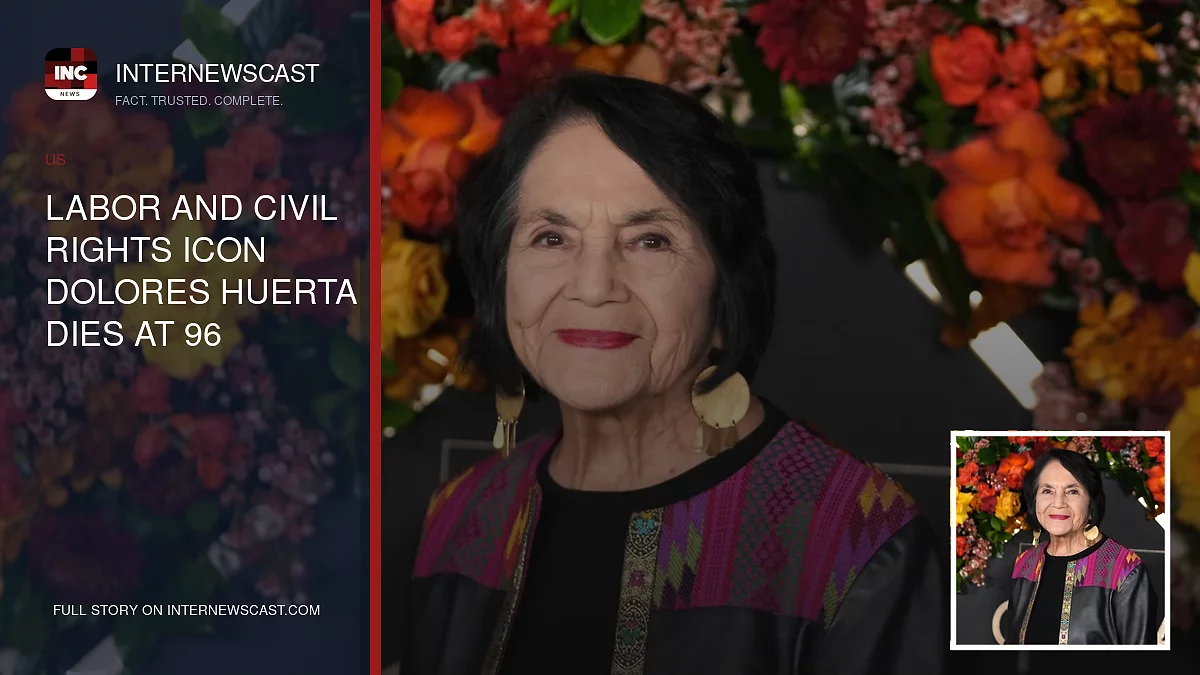

Dolores Huerta, the pioneering labor organizer and civil rights champion who co-founded the organization that became the United Farm Workers with Cesar Chavez, has died at 96, her family announced in a social media post.
According to her family’s statement, issued through her Bakersfield, California-based foundation, Huerta died Wednesday at her home.
“This is, as you can imagine, an extraordinarily painful moment for our family,” her relatives said. “We ask for privacy as we mourn this profound loss. We also know that people around the world are grieving alongside us.”
California Gov. Gavin Newsom, who counted Huerta as a close friend, directed that flags be lowered to half-staff in her memory.
“Dolores represented the best of us,” Newsom said in a statement. “California — and the United States — would not be what we are today without her resolute spirit, her passion for justice and fairness, and her commitment to those overlooked and forgotten.”
Los Angeles Mayor Karen Bass said Huerta’s life demonstrated “what ordinary people can accomplish when they organize.”
“Dolores showed us that regardless of the odds or the barriers, we can create a better future for ourselves, our communities, our city and our country,” Bass said in a statement. “She never, ever stopped working. She fought for civil rights every day, well into her nineties. People who loved her worried about her, but the force of her commitment never faded.”
Former House Speaker Nancy Pelosi, who represents San Francisco in Congress, remembered Huerta as a cherished friend whose leadership was defined by courage and determination.
“We all answered her call of ‘Sí se puede,’” Pelosi said, invoking Huerta’s famous Spanish-language phrase, meaning “Yes, it can be done.” The slogan inspired generations to see the strength of collective action.
Even in her later years, Huerta maintained a demanding schedule, traveling to protests and speaking across the country about racial justice, poverty, LGBTQ+ rights and women’s equality through her foundation.
Her decades of activism established Huerta as one of the nation’s most influential labor leaders, feminist advocates and civil rights figures.
Presley Ann/Getty Images 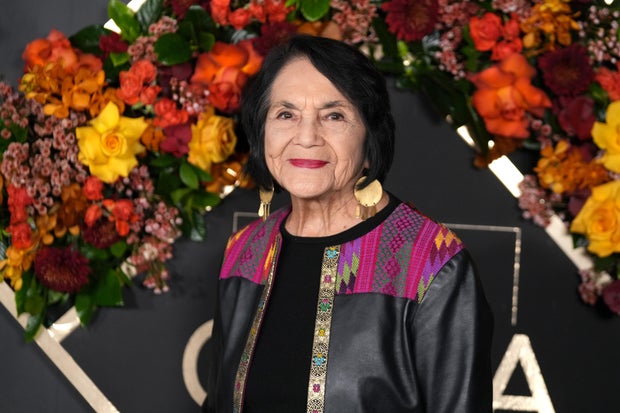
Among her many honors was the Presidential Medal of Freedom, the highest civilian award in the United States. When then-President Barack Obama presented the medal in 2012, he hailed Huerta as a tireless leader and joked that he had borrowed her signature slogan for his 2008 campaign.
Earlier this year, Huerta stunned many in the Latino community by revealing that Chavez had sexually abused her in the 1960s, resulting in the birth of two children. She had kept the revelation private for six decades, including long after Chavez’s death.
Beginning in the early 1970s, Huerta was in a relationship with Richard Chavez, Cesar’s brother. The couple had four children together. Huerta also had seven children from two previous marriages.
Huerta said she remained silent because she feared that speaking publicly could damage the work she had spent her life building and undermine gains made on behalf of farmworkers.
In a 2026 interview with Latino USA, she reflected on why she had carried the secret for so long: “It was my personal pain, it was my personal problem and, you know, I think it was worth it because it was my cross to bear. I’ll say it that way.”
Homegrown activism
Born Dolores Clara Fernandez in 1930 in Dawson, New Mexico, Huerta was the daughter of a miner and union activist who later served in the state Legislature. Her parents divorced when she was 3, and her mother moved with Huerta and her brothers to California.
Growing up among Mexican, Filipino, African American, Japanese and Chinese working families, Huerta drew important lessons from her mother, who ran a restaurant and hotel. She learned the value of independence, compassion and standing up for others.
Huerta began her career as an energetic elementary school teacher in California’s agricultural San Joaquin Valley. But the poverty she saw among her students eventually convinced her that organizing farmworkers could create broader change.
“I couldn’t stand seeing kids come to class hungry and needing shoes,” she said in a 2017 PBS Independent Lens documentary about her life. “I thought I could do more by organizing farmworkers than by trying to teach their hungry children.”
Cathy Murphy/Getty Images 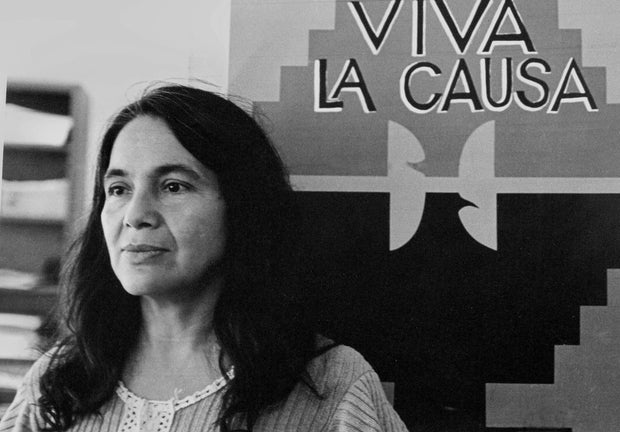
Her first major organizing work came through a civil rights group in Stockton, where she met Chavez. Sharing a desire to improve conditions for farmworkers, they founded the National Farm Workers Association in 1962. The organization later became the United Farm Workers of America, with Huerta serving for years as one of its central leaders and negotiators.
YOU MIGHT ALSO LIKE: Father Dies in Tragic Accident at Sausage Factory
She joined Filipino grape workers on the picket line during what became the five-year Delano Grape Strike. Working alongside Chavez, she negotiated contracts and collective bargaining agreements with major growers, helping secure the first health and benefit programs for farm laborers.
Chavez, who died in 1993, described Huerta as fearless, deeply devoted to the movement and formidable at the negotiating table.
On the campaign trail
Huerta met New York Sen. Robert Kennedy during his 1968 visit to Delano and later volunteered for his presidential campaign, registering Mexican American voters in California. She stood onstage with Kennedy after his California primary victory, and he publicly thanked her shortly before he was assassinated.
The killing devastated Huerta, but it did not end her organizing on behalf of farmworkers.
She was arrested 22 times during union demonstrations. In 1988, Huerta suffered serious injuries while protesting Republican presidential candidate George H.W. Bush’s opposition to the UFW grape boycott during a visit to San Francisco.
As she was caught in a crowd, a police officer struck her with a baton. The attack left her with three broken ribs and a pulverized spleen, and she needed more than a dozen blood transfusions. She later reached a settlement with the city over her claims.
Mike Maloney/San Francisco Chronicle via Getty Images 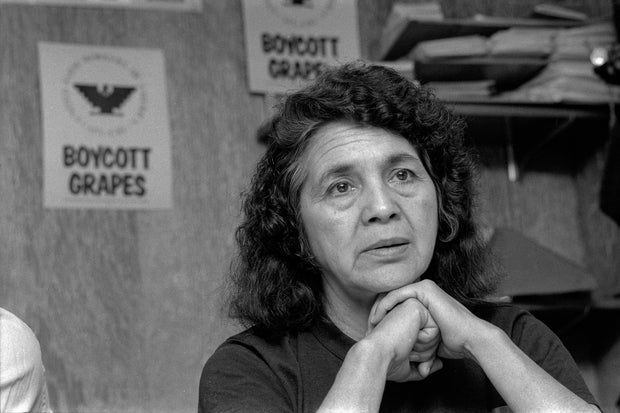
After a lengthy recovery, Huerta broadened her activism, traveling throughout the country to advocate for women’s rights and urge more Latinas to seek elected office.
She also campaigned for Democratic presidents Bill Clinton, Barack Obama and Joe Biden.
Fueled by courage
Emilio Huerta, one of Dolores Huerta’s 13 children, once said his mother’s courage was among the strongest forces behind her lifelong activism.
“To dedicate your life to building a dream of a union for farmworkers, to take on agriculture, which to this day is still a powerhouse … that took a lot of guts,” he said.
Huerta became a skilled political lobbyist, winning financial assistance for unemployed people and disability insurance for California farmworkers. She challenged the use of dangerous pesticides, advocated amnesty for undocumented immigrants and opposed federal guest-worker programs.
By leading national boycotts of grapes and lettuce in the early 1970s, she helped generate the economic and political pressure that pushed California to pass the nation’s first state law recognizing farmworkers’ right to collective bargaining.
Her achievements brought numerous awards. She became the first Latina inducted into the National Women’s Hall of Fame and received nine honorary degrees from universities across the United States.
Sarah Reingewirtz/MediaNews Group/Los Angeles Daily News via Getty Images 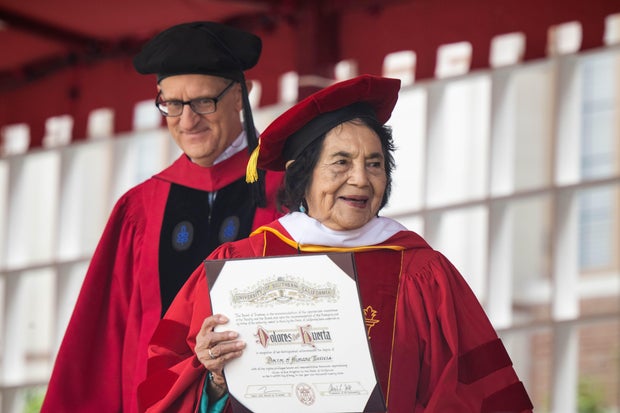
Schools in California, Texas and Colorado bear her name, while murals and streets across the country celebrate her image and legacy. Yet Huerta’s political positions occasionally drew criticism from fellow progressives.
During the 2016 Democratic presidential primary, Huerta endorsed Hillary Clinton rather than Vermont Sen. Bernie Sanders. Actor Rosario Dawson, a Sanders supporter who portrayed Huerta in a 2014 film about Cesar Chavez, accused her of becoming “an instrument of the establishment.”
Dawson and Huerta later repaired their relationship.
Guitarist Carlos Santana eventually helped oversee a documentary about Huerta’s life after the two bonded during a late-night conversation about music in Hawaii. Santana, an admirer of Miles Davis, learned that Huerta shared his enthusiasm for bebop icon Charlie Parker.
Still, it was Huerta’s leadership in the labor movement that resonated across the United States and beyond, turning her name into a lasting symbol of civil rights.
In the 2025 documentary “Seeds of Change: The Life and Legacy of Dolores Huerta,” she revisited her many decades of activism. She also discussed how the women’s movement of the 1970s gave her confidence that she belonged onstage alongside other prominent labor leaders.
“I hope that my legacy will be one of an organizer that organized to fight injustice,” she said in the film. “We want to give our children an inheritance of justice, right, not jewels or property or money because they’ll just fight over it. So the main thing to do is to give them this love for justice — and that is the greatest gift I think that any of us can have.”