


New York City Mayor Zohran Mamdani discusses Israeli Prime Minister Benjamin Netanyahu in a still from handout video released July 21, 2026. (Reuters)
Britain’s decision to adopt a sweeping set of measures aimed at tackling antisemitism in schools is highlighting the differences between the U.K.’s approach and New York City Mayor Zohran Mamdani’s recently released strategy, prompting questions about why the British plan is more detailed than the proposal from America’s largest Jewish city.
The U.K. government accepted all 27 recommendations from an independent review of antisemitism in schools and colleges across England. The recommendations include urging institutions to adopt the International Holocaust Remembrance Alliance definition of antisemitism, providing specialized training for teachers, improving reporting systems and creating independent oversight.
Mamdani’s 33-page strategy, which covers issues beyond education, does not adopt a formal definition of antisemitism. It also does not directly address the connection between anti-Zionism and antisemitism or set numerical targets for evaluating its success.
Dov Forman, a British Jewish author and Holocaust educator who recently graduated from university, said Mamdani could draw lessons from Britain’s more focused plan for schools.
The British review came after a BBC report from Yavneh College, a Jewish secondary school near London, where students detailed the ways antisemitism had entered their everyday lives. Their testimony underscored the urgency behind the government’s recommendations.
Education is one of the clearest areas of overlap between the two strategies. Mamdani’s plan proposes expanding Holocaust education, including student visits to the Museum of Jewish Heritage, while improving the way public schools handle antisemitic discrimination. Britain’s recommendations address many of the same issues but place heavier emphasis on helping teachers identify antisemitism, ensuring schools respond properly to incidents and strengthening protections for Jewish pupils.
The review, led by former senior education official Sir David Bell, found that almost three in five Jewish people ages 16 to 19 had either experienced or witnessed antisemitism. It determined that antisemitism is a distinct form of racism requiring a tailored response and called for clearer guidance separating legitimate political debate from harassment, intimidation and antisemitic speech.
Forman described the British recommendations as “the bare minimum,” while acknowledging that the government was at least confronting the issue directly.
“The least [Mamdani] could do is look at what has happened in the U.K. and adopt similar measures, such as adopting the IHRA definition, which is the agreed definition across the world and where there is a consensus of what antisemitism actually is,” Forman told News Outlet.
“The basic way to solve antisemitism is to actually agree on what it is and to understand that targeting a Jew deliberately because of what is going on in Israel, for example, is antisemitic, as the IHRA definition says,” he added.

Former Conservative cabinet minister Michael Gove, Reform UK Deputy Leader Richard Tice and Chief Rabbi Ephraim Mirvis lead a march against antisemitism in central London on September 7, 2025. (Carlos Jasso/AFP via Getty Images)
Forman cautioned that most of the British recommendations remain voluntary and said their impact would depend on whether schools and other institutions follow through.
“I do think some of them will be enforced and listened to. I do worry, though, that the government says things and does not actually take it seriously enough.”
Education Secretary Lucy Powell said the government would create an implementation group. Bell was also commissioned to conduct an independent review of the government’s progress after a year.
Ambassador Rabbi Yehuda Kaploun, the U.S. special envoy to monitor and combat antisemitism, welcomed Britain’s decision but stressed that accepting the recommendations was only the first step.

“I welcome the U.K.’s announcement that it has accepted all 27 recommendations,” Kaploun wrote on X. “Now, the challenge lies in implementation and enforcement.”
Forman also argued that British officials should consider whether their statements about Israel undermine their stated commitment to protecting Jewish communities.
“It is very rich of the government to say that schools should adopt the IHRA definition of antisemitism and that Jews should not be demonized for what is going on in the Middle East, and then for them to get up in the dispatch box in the House of Commons every week and blame Israel,” he said.
“Stop talking and start acting,” Forman added, urging the government to confront Islamist extremism and the Muslim Brotherhood while more clearly identifying the sources of antisemitism.

Antisemitic hate displayed during an anti-Israel protest in London. Antisemitism in the U.K. has reached record levels since the Hamas terror attacks on October 7. (Campaign Against Antisemitism on X)
The U.K. has faced criticism for moving too slowly to combat antisemitism. Jewish residents have reported physical attacks, threats and harassment, making the detailed British plan—and its contrast with New York City’s strategy—especially significant.
Rabbi Chaim Steinmetz, senior rabbi of Congregation Kehilath Jeshurun on Manhattan’s Upper East Side, described Mamdani’s strategy as a “paper tiger.” He said its $36 million price tag masks the limited amount directed toward physical security.
“It’s a million dollars in security in a city with a million Jews. It’s a dollar a Jew,” Steinmetz told News Outlet.
The strategy allocates $1 million for physical security at vulnerable nonprofit organizations, including synagogues and other houses of worship, along with $6.4 million in grants through the city’s Partners Against the Hate initiative.
Steinmetz said much of the funding would go toward cultural centers and broadly defined community programs instead of urgent security requirements.
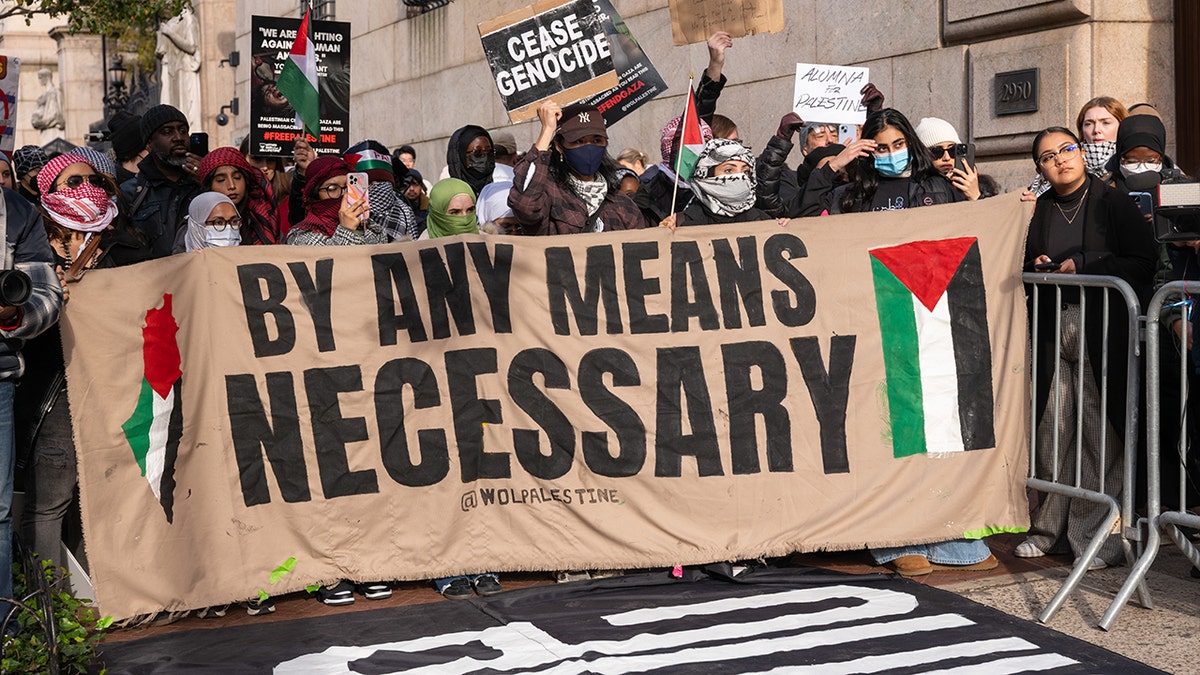
Students at Columbia University take part in an anti-Israel protest. (Spencer Platt/Getty Images)
UJA-Federation of New York, the Jewish Community Relations Council of New York, the American Jewish Committee’s New York office and the New York Board of Rabbis issued a joint statement saying Mamdani’s plan overlooks a major source of contemporary antisemitism.
The organizations argued that rhetoric demonizing or denying Israel’s legitimacy can cause Jewish New Yorkers to be viewed as suspicious, excluded or unsafe. They said any credible strategy must address that relationship.
“How can you have a strategy to keep New York Jews safe when you can’t even name what the danger is?” Steinmetz asked.
Soon after taking office, Mamdani revoked an executive order from former Mayor Eric Adams that directed city agencies to use the IHRA definition of antisemitism. The definition offers examples of when criticism of Israel may become antisemitic while noting that criticism comparable to criticism of any other country is not inherently antisemitic.

Britain’s opposition Conservative Party leader Kemi Badenoch speaks at a Campaign Against Antisemitism rally opposite Downing Street in central London on May 10, 2026. (Justin Tallis/AFP via Getty Images)
News Outlet asked Mamdani’s office why the city strategy leaves out the IHRA definition and measurable benchmarks, and whether the administration would consider protections modeled on Britain’s recommendations. The mayor’s office had not responded by publication time.
Britain’s recommendations were also accepted only recently, meaning their real-world impact has yet to be determined.
Britain has identified the problem, proposed detailed steps and created a mechanism for assessing progress. In New York City, Jewish leaders continue to question whether City Hall has properly defined the threat its strategy is meant to address.