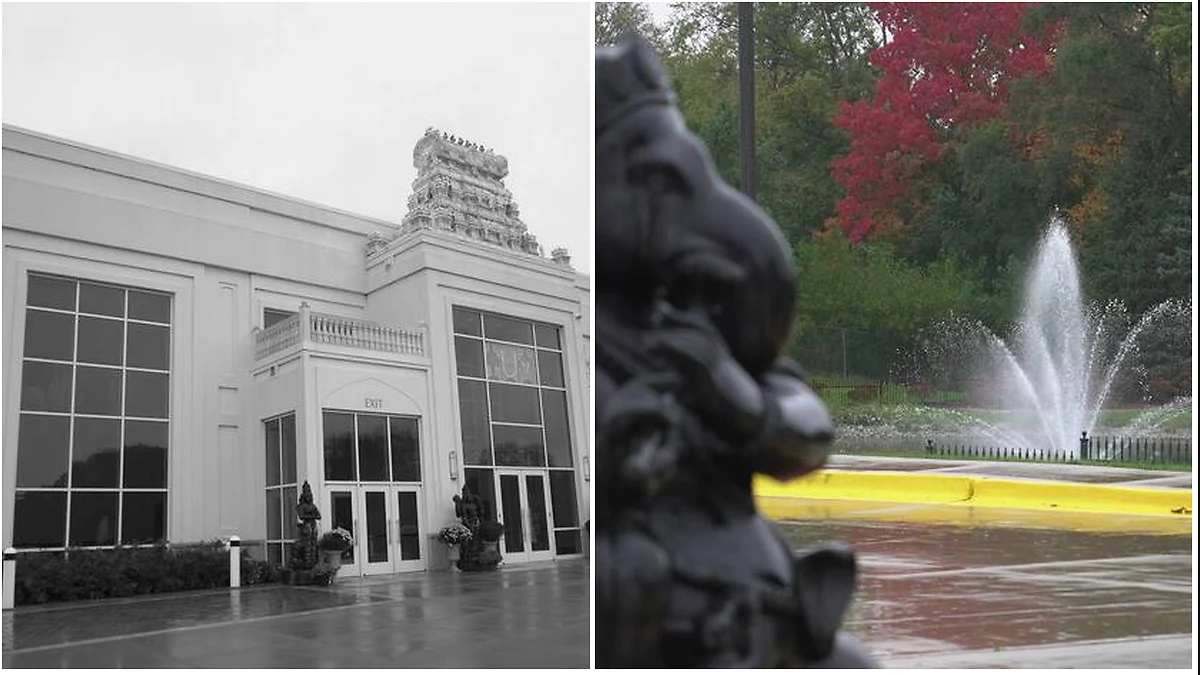

CHICAGO – A foiled mass shooting plot at a Hindu temple outside Chicago has intensified anxiety among the region’s South Asian residents, casting a shadow over a season usually marked by worship, family and celebration.
Members of the targeted temple and others across the community say they are determined to preserve their traditions and observe the holidays without fear. At the same time, they are demanding stronger action against the hatred directed at South Asians.
Prosecutors allege that on Oct. 11, as worshippers gathered at Hindu temples to begin Navaratri, Alexandros Paporakis went to the Sri Venkateswara Swami (Balaji) Temple in Aurora, Illinois. He remained in the parking lot but left before firing because his rifle malfunctioned, prosecutors said.
Paporakis, 19, was arrested later that day near his home in Palatine, Illinois, roughly 40 miles (64 kilometers) from the temple. Authorities were alerted by a co-worker at Taco Bell, who reported that Paporakis had spoken of plans to “kill Indian people,” prosecutors said.
He faces felony charges of making a terrorist threat and unlawfully possessing a firearm. Paporakis is scheduled to appear in court Friday morning.
“A lot of us are just really appalled and just kind of disgusted,” said Asha Rao, executive director of The Chicago Kasam, a nonprofit that connects South Asians in the region. “This is supposed to be a very peaceful time for our community, for all of us to come together and get time with our loved ones, our family, our friends, and be able to celebrate in a safe way.”
Safety concerns infiltrate joyful period
Navaratri is a nine-night festival honoring the goddess Durga and ends with Dussehra, also known as Vijayadashami. About three weeks later comes Diwali, the major Hindu festival. Avatans Kumar, a freelance columnist who occasionally worships at the targeted temple, said the nine-night fast is often followed by a large 10th-day celebration featuring outdoor fairs and gatherings of relatives and friends.
This year, however, conversations about those events have focused heavily on security and how to protect worshippers.
“People are more vigilant now,” Kumar said. “People are looking for any signs of disturbance, keeping eyes and ears open.”
Rao said some community members were “more hesitant” to leave home and attend celebrations. But she said the threat had also strengthened their determination to observe the holiday and refuse to be intimidated.
She urged South Asians to “recognize how far we’ve come, all the great things that are happening in our community, the friends and the people,” she said. “That’s what it means to curate resilience in community in times like this.”
Calls for prosecution and attention to hateful language
South Asian leaders at the local and congressional levels are calling on law enforcement to determine whether the alleged plot qualifies as a hate crime and, if so, to bring additional charges against Paporakis. Prosecutors say he identified as a white supremacist and neo-Nazi and used slurs and other hateful language against Indians and additional minority groups.
U.S. Rep. Raja Krishnamoorthi, a Democrat whose district includes the temple, previously told The Associated Press that he was “calling on the FBI to investigate and prosecute this particular matter as a hate crime.”
The alleged plot has also revived memories of anti-South Asian hostility. Stop AAPI Hate, which gathers reports of hate incidents targeting Asian Americans and Pacific Islanders, said the use of anti-South Asian slurs online increased 109% between 2023 and 2025. Nearly half of South Asian adults reported experiencing a hate act based on their race, ethnicity or nationality last year, the organization said.
Illinois’ South Asian population grew from more than 242,000 people in 2010 to over 337,000 in 2020, accounting for about 2.5% of the state’s population, according to the South Asian American Policy and Research Institute. Community members said bullying and race-based harassment have nevertheless remained familiar experiences.
Following Paporakis’ arrest, authorities said they found weapons, ammunition, a gas canister bearing a slur aimed at South Asians and multiple items displaying Nazi symbols at his home. Officials also said he had written an extensive note describing fantasies of mass murder and a desire to kill as many non-white people as possible.
Rishab Chatty, who heads the Chicago chapter of Hindus for Human Rights, said anti-Hindu and anti-South Asian hostility was once “thought to be something that namely existed in chat rooms and in school lunch cafeterias.” Now, he said, it is “becoming more and more violent.”
“A lot of folks within my community are really questioning what it means to belong in a country that exercises hate and violence against them,” he said.
___
Mayes-Osterman is a corps member with The Associated Press/Report for America Statehouse News Initiative. Report for America is a nonprofit national service program that places journalists in local newsrooms to cover issues that often receive too little attention.