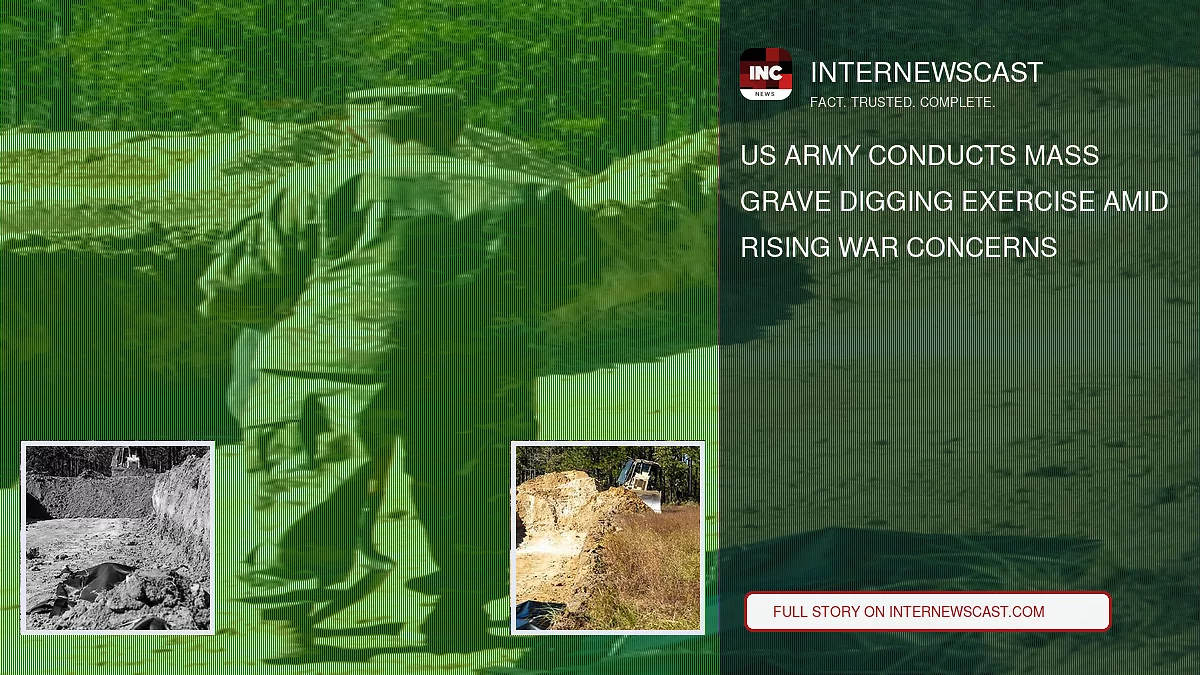

The US Army has conducted its first large-scale training in decades on digging mass graves for fallen troops, as concerns grow over the prospect of a wider conflict with Iran.
The exercise examined whether heavy equipment could be used to bury remains temporarily while preserving them for identification and eventual repatriation to the United States.
Images from the drill show an Army D6 bulldozer moving earth to create long, deep trenches.
Operators kept the bulldozer blade 18 inches above the trench floor so that loose soil would drop into the excavation rather than being compacted against it.
To determine whether the weight of the soil might damage remains, the team placed model skeletons and sealed water containers at the bottom of a trench before covering them.
Crews completed one trench in an hour and 15 minutes. Based on that performance, planners estimated that an engineering company equipped with eight bulldozers and four military excavators could excavate and refill burial trenches for as many as 2,400 bodies in a single day if operating around the clock.
The US Army said in a statement: ‘The exercise served as a critical test of concept to validate the feasibility of battlefield temporary interment, an operational reality the US Army has not executed at scale since the Korean War.’ Nearly 37,000 US personnel were killed in the conflict between 1950 and 1953.
The training took place as America’s senior Middle East commander, Admiral Brad Cooper, was reportedly briefing President Donald Trump on possible options for resuming military action against Iran.

The drill assessed whether heavy equipment could protect remains until they were identified and returned to the US. The bulldozer used to dig the trenches is shown alongside model skeletons placed in body bags.
Trump is considering whether to renew attacks on Iran. The reported meeting included cabinet officials and discussions about maintaining the US blockade in the region.
Participants included soldiers from the 3rd Corps Sustainment Command and the 20th Engineer Brigade at Fort Bragg, North Carolina, as well as military chaplains and other religious support specialists.
The exercise was held on October 22, but details only became public later, prompting questions about its purpose amid growing fears of a potential war.
Sgt 1st Class Delbert Ruede, the senior fatality management NCO for the 3rd CSC, said in a statement: ‘This exercise allowed us to take a critical look at how we respect, honor, and systematically manage our fallen in a high-intensity conflict.
‘If we went to war tomorrow, we would be making this up as we went along. What we are doing here is taking a scientific, field-tested approach so that we can maintain positive control and respectfully care for our fallen.’
The drill also revealed that the Army’s existing burial guidelines do not fully account for the dimensions of its modern construction equipment.
The guidance required a seven-foot gap between trenches, but that space was two feet too narrow to allow bulldozers to pass without disturbing the burial area.
Crews widened the trenches to 15 feet and maintained nine feet of undisturbed ground between them, creating sufficient space for the machinery to operate.

The exercise was designed to assess whether temporary battlefield interment could be carried out at scale, something the Army has not done since the Korean War. A soldier is shown measuring one of the trenches.
YOU MAY ALSO READ: AI Stock Sell-Off Sparks Fears of Wider Market Crash
When the teams reopened the trench, both the model skeletons and the water containers remained intact, indicating that the method could help preserve remains for later examination.
Engineers cautioned that ground conditions would influence the operation, with sand, frozen soil, clay and mud each creating different obstacles.
1st Lt Connor Thompson, an engineer officer with the 27th Engineer Battalion, said: ‘Giving our operators hands-on experience with this specific task provides real data instead of relying on assumptions.’
The results will be used to revise Army guidance and ensure that future burial layouts are compatible with modern engineering vehicles.
Another exercise planned for next spring will examine the procedure in both daylight and blackout conditions, including the use of night-vision equipment.
Army chaplains and religious affairs personnel also practiced supporting temporary battlefield burials for the first time in more than two decades.
During most of the past 20 years, troops killed in counterinsurgency missions were rapidly transported to the US through established military mortuary systems.
This drill focused on how the Army could honor fallen service members during a major conflict, when intense combat might delay their return home and make individual funeral services impossible.
Lt Col Ruska, chaplain for the 3rd Corps Sustainment Command, said: ‘In a high-intensity, contested combat environment, fatality management teams cannot stop a 24-hour interment operation for individualized religious gravesite services.’
Chaplains said clear protocols would be needed to provide religious support during mass burials without interrupting teams working continuously.
Before excavation began, Maj Warwick Fuller, chaplain for the 20th Engineer Brigade, led a prayer to consecrate the site.
Ruska said combat conditions might prevent the immediate confirmation of a service member’s identity or faith. Chaplains therefore consulted representatives of smaller religious communities in the military about how such cases should be handled.

The team placed model skeletons and sealed water containers at the bottom of a trench before covering them, testing whether the weight of the soil could damage human remains.
They concluded that consecrating the site before burial could reassure families that their loved ones had been treated with dignity, even when individual memorial services could not be held.
Master Sgts. Amelia Alston and Lakesha Copeland coordinated efforts to integrate religious affairs specialists into the operation, including logistics, troop support and the respectful handling of remains.
Once the simulated remains had been placed in the trenches, Maj. Cornelius Muasa and Capt. David Chacko delivered committal prayers as engineers began covering them with soil.
The exercise also drew attention to the burden placed on personnel responsible for caring for the dead. Army planning estimates suggest that religious support teams dealing with mass casualties could face physical, emotional and spiritual exhaustion after four to six hours.
The findings reinforced the importance of rotating personnel regularly so teams can continue supporting troops during extended burial operations.


