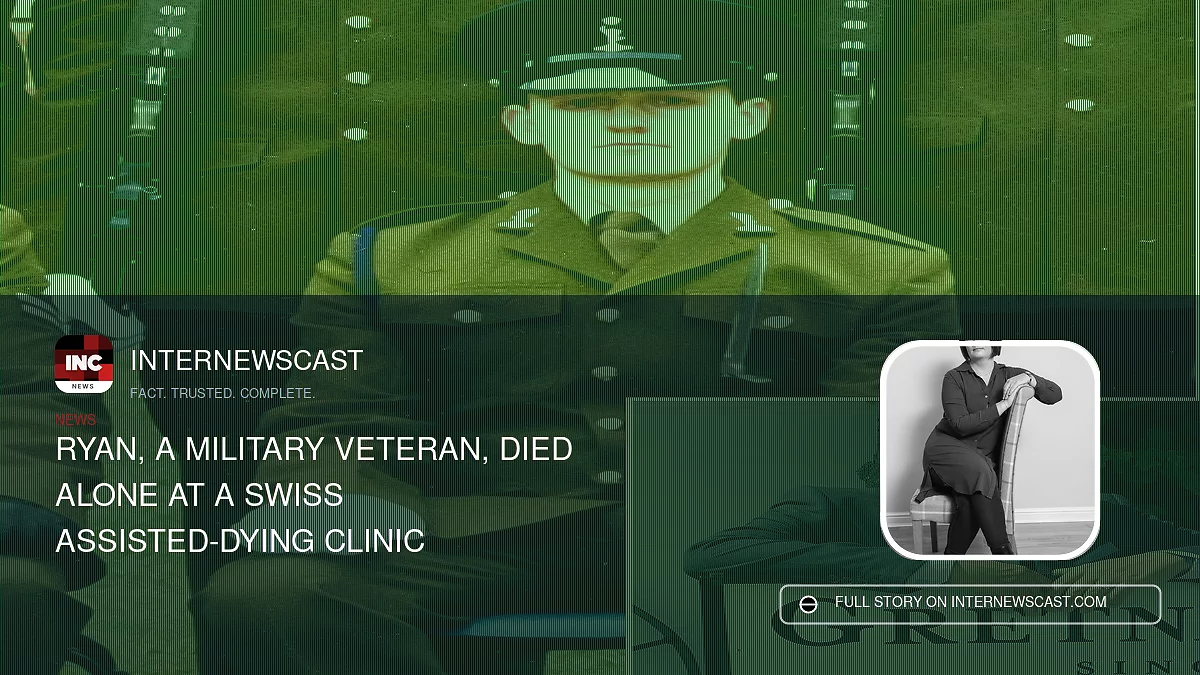

Former Royal Engineer Ryan Wallace planned his death with the precision of a soldier. Over the course of ten months, he sorted clothes for charity shops, used up his aftershave — leaving a small amount in each bottle so his future widow could still recognise his scent — had his Bosnia service medal framed and compiled a detailed list of his online accounts and passwords.
Ryan, 47, even ordered an ornamental urn for his ashes. “It arrived before he left for Switzerland,” says Marianne, his widow. “He wanted to put it in the garden. I said, ‘No, Ryan, please, no,’ but he wanted to make things easier for me.
“At one point I found him looking at puppies. He thought I should get one to keep me company after he was gone. I said, ‘I don’t want a puppy, Ryan. I want you, alive.’”
Yet when the moment came, although Ryan was not terminally ill, Marianne felt she had no choice but to respect his decision to die.
On August 15 this summer, Marianne, 38, drove her husband to the airport. They sobbed as they said goodbye.
Three days later, after completing the necessary paperwork, the former soldier died by assisted suicide at a Swiss clinic.
Marianne was not told until the following day, although she says she “pretty much knew” when the voluntary assisted death had taken place.
“I knew his phone would be wiped once he was gone because that is the clinic’s procedure.

Marianne Wallace says her husband Ryan repeatedly sought help for what he believed was a painful physical reaction to medication
“I had access to his email account, and on Tuesday an email arrived from Find My iPhone saying his phone had been disabled. It was not until the following afternoon that the clinic emailed to confirm he had died.”
A week later, Ryan’s ashes arrived at their home in Falkirk, delivered by Royal Mail.
More than two months later, the ashes remain on a side table in the immaculate living room.
There has been no funeral yet, military or otherwise, although some of Ryan’s former army colleagues have contacted Marianne since learning of his death. “I’m thinking about a small celebration of his life, followed by placing his ashes in the garden. Ryan designed the Zen garden himself. He loved his plants,” she says.
Her grief remains raw, as does her anger. What happened is almost impossible to comprehend. Ryan served his country, yet died alone in another country, in circumstances that are far from straightforward.
Marianne believes her husband’s final battle — the one he felt he could not win — was against the NHS. For six years, she says, he pleaded for help with what he believed was an excruciating physical reaction to prescribed medication.
Doctors had prescribed the medication while trying to treat a number of mental health conditions, including complex PTSD developed after his service in Bosnia with a UN peacekeeping squad.
Instead, Marianne says, the treatment left Ryan in unbearable pain.
“After he was prescribed the two medications together in 2020, he began vomiting blood,” she says. “He was in agony. He could not eat, had trouble swallowing and said it felt as though his eyeballs were burning.
“From that point until his death, we could not get any answers. I believe we were gaslit.
“Ryan felt they were treating him like a hypochondriac, although they never used that word. They said he had ‘health anxiety’. I simply do not think they believed him.
“Even when he said he wanted to die — and was making plans to do so — he was not taken seriously. Once, a psychiatric nurse told him, ‘You’re very chatty for someone who is suicidal.’ Ryan came home and tried to take his own life that day. I had to break down the spare-room door to reach him.”
The extensive collection of medical notes Marianne has kept presents a troubling account of Ryan’s contact with healthcare professionals. In the years before his death, he saw a confusing succession of psychiatrists and doctors and was diagnosed with conditions ranging from bipolar disorder and ADHD to complex personality disorder and autism. But Marianne says the physical pain accompanying his mental distress was what ultimately made him feel unable to continue living.
Desperate for answers, Ryan and Marianne spent £60,000 on private consultations. “We put it on zero-per-cent credit cards and tried to keep up with everything,” she says.
Several years ago, Marianne was horrified when Ryan told her he had registered with three separate assisted-dying clinics in Switzerland.

Ryan joined the Royal Engineers in 1999 and served for five-and-a-half years, including postings in Germany and Bosnia, where he experienced trauma that stayed with him
Last December, he paid a deposit to the Athanasios Clinic in Basel, one of the Swiss assisted-suicide clinics that does not require applicants to have a terminal diagnosis. The final bill, paid before his death, came to £15,000.
In the end, Marianne says, Ryan lost hope in both the NHS and life itself. Heartbreakingly, he made clear that he believed he was doing it for her. “He told me he had decided the only way forward for us was to end his life so that I could live mine,” she says.
His death is another painful example of the growing number of British people travelling to Switzerland to die despite not having a terminal illness.
In March this year, Our News Outlet reported on Wendy Duffy, a physically healthy 56-year-old who died at a similar Swiss clinic after deciding she no longer wanted to live following the death of her only child.
There are similarities between Wendy’s story and Ryan’s, but one important distinction: Wendy went to considerable lengths to keep her plans private until the final hour.
Ryan’s departure was not secretive.
He told his wife and family, and his three sisters travelled to be with Marianne after she drove him to the airport. He also informed his doctors in the UK.
Several clinicians knew the precise date on which he intended to die.
Our News Outlet has seen emails Marianne sent to the chief executive of the hospital trust involved in Ryan’s care, pleading for help even as he prepared to leave.
Marianne says Ryan’s GP saw him only days before his flight. “She said she would have sectioned him if she could, but he was of sound mind.” On the day he was due to die, the GP called Marianne to ask whether he had gone through with it. “She was crying. She said, ‘This should never have been allowed to happen to Ryan.’
“She felt she had failed him, but she was actually one of the few people in the NHS who did not fail Ryan. She tried. She simply came into his life too late, and there was only so much she could do. He kept being referred back to mental health services, which were responsible for the biggest problems.”
Marianne, who is now calling for a public inquiry into her husband’s treatment, says Ryan travelled to Switzerland knowing that any of the medical professionals involved could alert police. “Doctors warned him that the police might be waiting at the check-in desk to stop him. He told me that if that happened, he would take his own life by whatever means were available to him.”
No police intervention took place. The question remains: could, or should, someone have stopped Ryan from boarding the plane?
The law is complicated. Suicide itself is not illegal, but assisting someone to die is a criminal offence in England and Wales. In Scotland, anyone who assists a death could face a charge of culpable homicide.
YOU MAY ALSO READ: Katie Zacharia Promotes Natural Hair, Fitness in Halloween Dress-Up
It is less clear whether medical professionals have a legal duty to intervene when they know an assisted suicide is being planned.
A spokesman for NHS Forth Valley said there were no plans to commission a Serious Adverse Event Review. The case, he said, had already been considered internally and independently reviewed by the public services ombudsman.
“We take all complaints about patient care extremely seriously, and our thoughts remain with Mr Wallace’s family at this difficult time,” the spokesman said.

The couple married in 2019
What cannot be disputed is the profound sadness of a man who was willing to risk his life for his country ending his own life in these circumstances.
Ryan’s life was never simple. He was born in Northern Ireland during the Troubles and raised in a Protestant family in Strabane, County Tyrone, a predominantly Catholic town.
Marianne believes his childhood left deep scars. “One of his clearest memories was of his mother being caught in a pub bombing. He remembered his father removing shrapnel from her legs.”
Ryan joined the Royal Engineers in 1999 and served for five-and-a-half years, including deployments to Germany and Bosnia. His experiences in Bosnia would have a lasting and traumatic effect.
“He told me about finding himself in a minefield, and another time when he walked into a room full of men pointing guns at him.”
When Ryan and Marianne met in 2009, he was working as a security guard at the shopping centre where her mother also worked. It was immediately apparent to Marianne that he was struggling with his mental health. He suffered from anxiety, was forgetful and experienced mood swings. But she loved the person beneath those difficulties.
“He made me laugh. He was kind and funny. He always said he could talk to me in a way he could not talk to anyone else.”
They married at Gretna in 2019 and soon bought their home. By then, Marianne, who worked for the Scottish Prison Service, was the main breadwinner because Ryan’s anxiety had forced him to stop working. He had received a bipolar diagnosis, and PTSD was confirmed later.
“He suffered from terrible night terrors. He would act out army manoeuvres in the bedroom, doing a ‘roll and drop’ over the side of the bed, or crawling along the floor.
“He became so distressed that he sometimes hurt me. One night he was flailing around and accidentally punched me in the backside. I joked that there was not even a bruise, proving how big my bum was, but he was devastated.”
In 2020, as Ryan’s anxiety intensified, he was prescribed sodium valproate, which is used to treat several disorders by calming excessive brain activity, and lamotrigine, a drug used to treat epilepsy and stabilise mood in people with bipolar disorder.
There is no general prohibition on taking the two medications together, but clinical guidance advises care with titration — the gradual adjustment of doses while monitoring their effects.
Marianne’s central allegation, which the medics involved reject, is that this process was not followed.
“Those two pills changed our lives,” she says. “The physical reaction was immediate. The next day he was vomiting blood. He developed all sorts of strange symptoms — headaches and burning eyes. He could not eat and felt pain down both sides of his throat. He was in agony.”
Ryan became convinced he had Stevens-Johnson syndrome, a recognised and extremely painful reaction to some medications and drug combinations. “The only symptom he did not have was a rash.”
His records describe an increasingly strained relationship with his psychiatric team as he challenged his treatment. He also became more distressed, believing doctors thought his physical symptoms were “all in his head”.
“I saw for myself that they were not,” Marianne says. “I saw the blood.”
In 2024, by which time Ryan was consulting private physicians as well as mental health specialists, he paid £12,000 for a private operation to treat acid reflux. “They agreed he needed it on the NHS, but there was no urgency to carry it out.”
He was devastated when the pain continued. “One day he asked me to boil all his medication so he could end his life because he was in so much pain. I was crying. I told him, ‘That is never going to happen, Ryan. Never.’”
Marianne cannot say exactly when Ryan began seriously considering “the Switzerland option”, but by December last year he had paid his deposit. His medical records contain repeated references to his plans.
“I do not think anyone truly took it seriously,” Marianne says. “I was repeatedly told there was no immediate risk of suicide.”

Ryan left a letter for Marianne on his laptop
And yet, that is what happened.
After Ryan reached Switzerland, he and Marianne spoke several times by phone and video call. Their final conversation was on Monday night. “I was crying and telling him, ‘You can still change your mind.’ Two of his sisters said goodbye, but the third could not.”
Marianne does not blame the Swiss clinic, although she describes its communication with her as startlingly blunt. “I had to email to ask whether Ryan had gone through with it,” she says. “Even then, it took a full day and a half to receive a reply.”
The clinic later told her that the delay was consistent with Ryan’s wishes.
When she finally received confirmation, she says: “I just cried and cried. I felt I had let him down. In reality, the system let him down. I believe the NHS failed him.”
Marianne knew Ryan had left a letter for her on his laptop before flying to Switzerland. She could not bring herself to read it until a few weeks ago.
The letter still brings her to tears. “Thank you for being my wife, my soulmate, my best friend, my reason. Thank you for seeing me when I was invisible to everyone else. Thank you for staying when leaving would have been easier,” Ryan wrote.
True to his organised nature, he also left detailed instructions.
“Sell the car. Cancel the subscriptions. Let our families help you move forward. When the grief hits you — and it will — do not bottle it up. Cry, scream, break things, then breathe. Plant cherry blossoms where the stones sit.”
Marianne has not yet felt ready to return to work. In a few weeks, however, she will collect a puppy after choosing one from a litter of cockapoos.
“I need something to make the house feel less silent,” she says. “Ryan was right about that.”
■ For confidential support call the Samaritans on 116 123 or go to samaritans.org


