

RATING: 7 / 10
- Poses a range of compelling, difficult questions
- Sebastian Stan and Renate Reinsve bring depth to challenging roles
- Its departures from the real case make some of its arguments feel misleading
“Fjord” was an unexpected winner of the Palme d’Or, the top honor at the Cannes Film Festival. It was not the best-reviewed entry in competition, nor was it considered Cristian Mungiu’s most celebrated film. Many critics expected the anti-Putin thriller “Minotaur” or the Thomas Mann biopic “Fatherland” to emerge as the jury’s safer consensus choices. Instead, Park Chan-wook’s jury awarded the prize to a film that seems almost designed to reject consensus. Wherever viewers land politically, “Fjord” is built to provoke, unsettle, and anger them — although different audiences will find different reasons to be furious.
Mungiu has said the story draws on several cases involving conservative immigrant families who clashed with Norway’s Child Welfare Services. Its closest real-world parallel is the case of the Bodnariu family. In the film, that family becomes the fictional Gheorghius: Mihai (Sebastian Stan) is Romanian, Lisbet (Renate Reinsve) is Norwegian, and the couple has just moved from Romania to Norway with their five children. Their liberal neighbors initially offer a warm welcome. Noora (Henrikke Lund-Olsen), an impulsive lesbian who lives next door, forms a friendship with the eldest daughter, Elia Gheorghiu (Vanessa Ceban). Then Elia arrives at school with bruises. When social workers ask whether her father has hit her, she says yes — and the children are swiftly taken from their parents.
The result is a tightly wound courtroom drama that refuses to provide a simple account of what actually happened. It recalls the ambiguity of the 2023 Palme d’Or winner “Anatomy of a Fall,” though its subject matter is considerably more combustible. As one of the most-liked reviews on Letterboxd puts it, this is “Anatomy of a slap on the butt.” Nearly every adult character is understandable and, at the same time, difficult to tolerate; only the children escape that moral crossfire. “Fjord” asks liberals to extend empathy toward religious homophobes who defend some form of corporal punishment, while challenging conservatives to confront the devastation caused when governments separate immigrant families from ethnic minorities. The post-screening conversations may be genuinely illuminating. Online, they will probably be unbearable.
The cast brings nuance to deeply divisive material
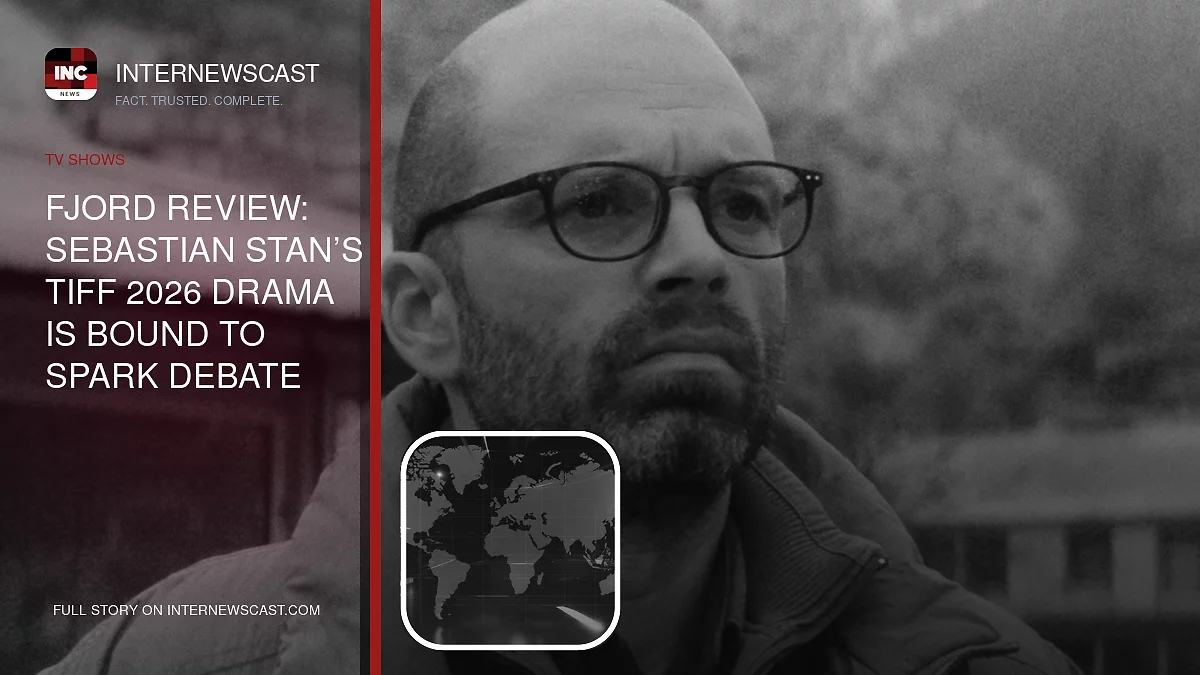
Sebastian Stan has used his Marvel Cinematic Universe profile to pursue a string of genuinely demanding parts. Mihai does not call for the same extreme physical transformation as Donald Trump in “The Apprentice” or Edward in “A Different Man,” but Stan is stripped of his usual glamour to play the balding family patriarch. A simmering anger lurks beneath Mihai’s measured exterior, making him unsettling even in quiet moments. His decision to enlist extremist groups in the family’s defense will alienate many viewers, yet Stan also conveys a man who sincerely believes every word he says. That apparent honesty — complicated by the language barriers he faces in English and Norwegian — can work against Mihai in court while making his claims feel authentic.
Renate Reinsve gives Lisbet far more complexity than the familiar submissive tradwife archetype. She is conservative and deeply religious, but she is not passive. Lisbet works in a nursing home and tries to live her Christian principles in ways that even a secular society can appreciate. The question of how openly she can express those beliefs at work, however, becomes another source of conflict. After authorities remove her children, they tell her that she can regain custody if she acknowledges that Mihai abused her. The problem is that, as far as Lisbet is concerned, there is nothing to confess.
While Mihai turns the custody battle into a broader political campaign, Lisbet wants to keep the dispute private and turns to her neighbor Mia (Lisa Carlehed) for legal help. Mia delivers what comes closest to a clear statement of the film’s position: In a multicultural society, people must sometimes live alongside neighbors whose values they find repugnant. That tolerance has limits, of course; harmful conduct is not the same as an unpopular belief. Still, the prosecution appears preoccupied not only with what the Gheorghius may have done, but also with what they believe.
How faithfully does the movie portray the real case?
I am not familiar enough with Norwegian society to determine whether Mungiu’s portrayal of the country’s welfare system is accurate or relies on caricature. Because “Fjord” takes inspiration from a real case, however, the difficult questions surrounding that case are legitimate material for cultural debate. Several people who attended the Q&A following the TIFF premiere reportedly came away less enthusiastic after hearing Mungiu argue that left-wing “cancel culture” helped fuel the rise of right-wing extremism. I disagree with that assessment, but I do not think the film itself is making quite that argument, so it has little effect on my view of the movie. It was also intriguing to see “Fjord” on the same day as “Club Kid,” a film with nearly opposite tones and characters that likewise examines the collision between imperfect parenting and an aggressive legal system.
Research after the screening did reveal one detail that weakened my confidence in the film. The most explosive development in the legal case — the moment that prompted a collective gasp in the theater — is entirely fictional. Films inspired by true events do not need to reproduce history exactly; some liberties are inevitable, and extreme inaccuracies can even become absurd. But a movie making social commentary should be commenting on something grounded in reality. Inventing a shocking “wait, did that really happen?” scenario for a realistic political drama feels less like insight than provocation for its own sake, and it made me question the film’s broader approach.
Even so, “Fjord” deserves a defense against viewers who have dismissed it, often without seeing it, as a “MAGA movie.” The ending makes that reading difficult to sustain. Mihai and Lisbet may not be guilty of the most serious accusations against them, but the film is clear that other aspects of their worldview are damaging their children. Noora, the character I found easiest to empathize with throughout, becomes the emotional center of the devastating final scene. The film left me with an uncomfortable, tangled mix of reactions — hardly a pleasant experience, but one too substantial to brush aside.
“Fjord” premiered at the 2026 Cannes Film Festival, and Looper screened it at the 2026 Toronto International Film Festival. The movie is now playing in theaters across the United States.


