
A growing sense of danger is hanging over the Middle East as tensions between Washington and Tehran rise once again.
After months of restraint, Donald Trump appears to be preparing for the possibility of launching another wave of strikes against Iran.
The United States has assembled one of its largest naval forces in the region in decades, with a major concentration of firepower now positioned in and around the Arabian Sea.
Two of America’s most powerful aircraft carriers, the USS George Washington and USS George W Bush, are already operating nearby. They are supported by a heavily armed flotilla of 17 warships, including the USS Boxer amphibious readiness group.
A third carrier strike group, headed by the $4.5billion (£3.3billion) USS Theodore Roosevelt, is also moving towards the Middle East from the Philippine Sea alongside the 13th Marine Expeditionary Unit amphibious force.
The group is expected to reach the region within days, taking the number of American sailors and Marines deployed there to more than 20,000.
Together, the three carriers can deploy roughly 150 aircraft, including F-35 stealth fighters and F/A-18 Super Hornets.
The US Navy last operated three carrier strike groups in the Middle East in April, marking the first such deployment since 2003.
The latest military build-up has intensified speculation that an offensive could begin after America’s midterm elections conclude on Tuesday. Trump has previously indicated that he would not order an attack before then.
A series of increasingly forceful statements from the US president in recent days has added to fears that he may be preparing to renew the conflict, a move that could plunge the region back into turmoil.

Donald Trump has massed troops in the Middle East amid concerns he will launch a fresh attack on Iran after the US midterms conclude next week

America has deployed a third carrier group, led by the USS Theodore Roosevelt (pictured)
The situation appeared to become more serious on Friday, when Trump suggested that his confrontation with Iran could soon reach a decisive moment.
‘It’s going to get wrapped up soon,’ he told KCMO, a Kansas City radio station, without explaining what that outcome might involve.
‘We need a guarantee there’ll never be a nuclear weapon,’ the president added.
Washington’s claims that Tehran is pursuing nuclear weapons have been challenged, with previous US intelligence assessments, including those by the CIA, concluding that Iran did not possess such arms.
Even so, Trump is reportedly still considering renewed air strikes against Iran, which has so far weathered earlier attacks.
‘Do I finish it off, which would be very easy to do, or do I make a deal? It’s getting to be decision time,’ the 80-year-old billionaire told Fox News earlier this week.
At a rally in Florida last week, Trump also told supporters that the US might carry out ‘another little Epic Fury’, referring to its previous bombing campaign.
The Wall Street Journal reported that Washington’s Gulf partners had been advised to prepare for a ‘short, intense military campaign’—one of the clearest indications yet that a new offensive could be under consideration.
A White House official said: ‘We do not comment on sensitive military plans that may or may not exist. President Trump keeps all options on the table to ensure that Iran can never have a nuclear weapon.’
One possible target is the Pickaxe Mountain nuclear facility, a highly protected underground site in central Iran.

Among the main targets Washington could seek to attack include the Pickaxe Mountain nuclear facility hidden in central Iran (pictured in June 2026)
The secret installation was hit by the US in 2025, when B-2 stealth bombers launched bunker-busting munitions after flying from Whiteman Air Force Base across the Atlantic.
Trump has suggested that Pickaxe Mountain remains under close American surveillance. Speaking to Fox News last week, he said: ‘We can read the badge on somebody’s shirt from space, okay? We know exactly what’s going on at Pickaxe Mountain. We know the other three [nuclear sites] are obliterated.’
The expanded naval presence, combined with advanced fighter aircraft, would also give the US the ability to fire large numbers of cruise missiles at targets across Iran.
Iran’s power infrastructure could be among the potential targets, with attacks on the electricity grid capable of plunging major cities into darkness.
Trump previously threatened to strike Iran’s most important power stations, saying the US would begin with ‘the biggest one first’ during the early stages of the war.
That threat was never carried out, but it could be revived if the bombing campaign resumes after the midterm elections.
Iran’s biggest energy facility is the Damavand Combined Cycle Power Plant, located on the outskirts of Tehran province.
The facility, also known as the Pakdasht plant, has an output of approximately 2,900 megawatts—enough to supply several major urban areas.
Other significant power stations include the Kerman plant in southeastern Iran, which has a capacity of around 1,910 megawatts, and the Ramin facility in Khuzestan, capable of producing approximately 1,890 megawatts.

Iranian missiles ‘Zolfaghar’ on display at the Azadi square in Tehran, Iran

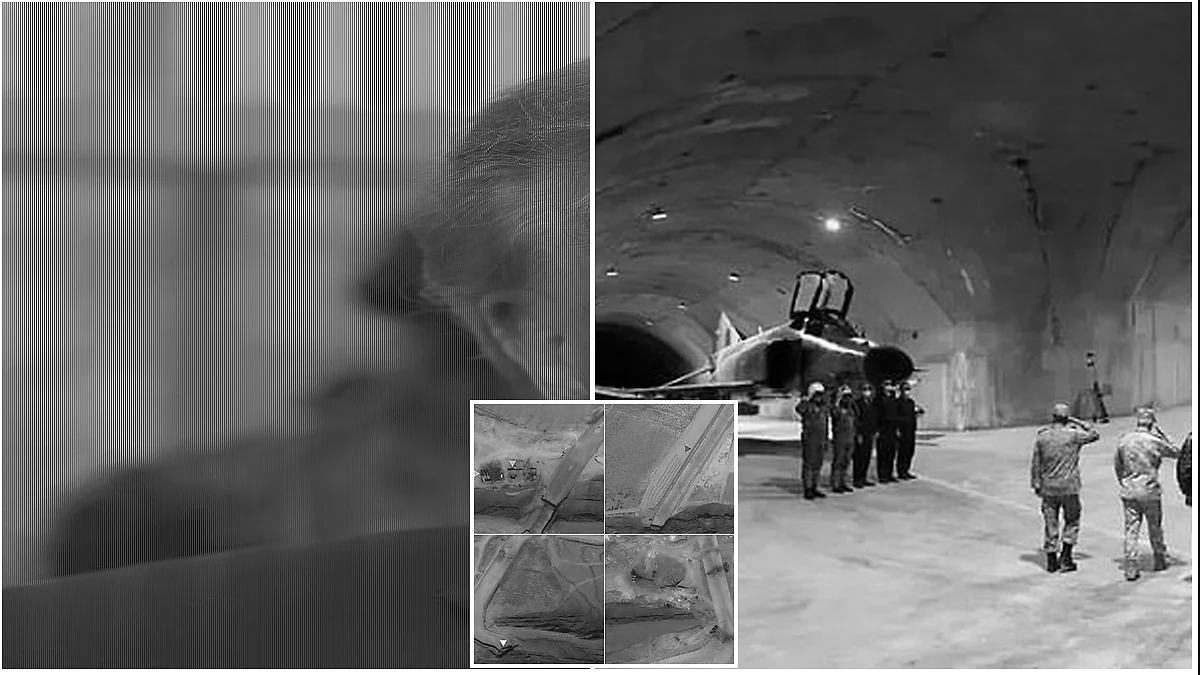
America previously struck Iran’s remote ‘Eagle 44’ underground air force base in March

An image taken from inside the remote underground air base, located deep in the mountains
Potential targets could also include military installations, drone and missile production sites, and weapons storage depots.
The US previously attacked Iran’s remote Eagle 44 air base, an underground complex concealed in the mountains of southern Iran, at the end of March.
The strikes left large craters around the entrances to aircraft shelters hidden beneath a mountain ridge. Several runways were also damaged, temporarily putting them out of service.
Reports last week suggested that Iran had since completed substantial repairs, including restoring the damaged runways.
Eagle 44, along with the remaining elements of Iran’s air force and drone fleet, could potentially be used in limited attacks on American forces. That could make the base a priority for US planners.
Any American air campaign would also likely receive support from Israel. Israeli Prime Minister Benjamin Netanyahu had reportedly wanted to restart strikes on Iran before the country’s elections, but the military opposed the plan.
Tehran has repeatedly warned that it would respond by attacking targets throughout the region, including US bases and military and civilian infrastructure in the Gulf states.
The US military has recently moved additional Patriot missile-defence systems into the region after its supplies were reduced during the opening phase of the conflict.

Iranians drive past billboards featuring Iran’s Supreme Leader Ayatollah Mojtaba Khamenei on a street in Tehran, Iran, on October 28
Several C-17 transport aircraft have also reportedly flown into the Middle East and Israel. Open-source intelligence analysts have linked those flights to the movement of Patriot batteries.
Officials familiar with the deployments told the Wall Street Journal that the US had also moved personnel away from bases considered vulnerable to Iranian retaliation.
Earlier this month, Washington removed its B-1, B-2 and B-52 bombers from RAF Fairford in Gloucestershire after authorities foiled an alleged Iranian sabotage plot.
As Trump weighs his next move, he has reportedly received an unusually detailed face-to-face briefing from one of the US military’s senior commanders.
Admiral Brad Cooper, the head of Central Command, which oversees American military operations across the Middle East, briefed Trump on Thursday about the conflict and possible courses of action, according to the Wall Street Journal.
The admiral is also reported to have held a separate senior-level meeting with General Dan Caine, chairman of the Joint Chiefs of Staff, and Vice President JD Vance.
The involvement of senior political and military leaders has added to speculation that the administration is preparing for another round of attacks on Tehran.
Two US officials told CNN that American forces could begin a new and potentially extensive operation against Iran within 96 hours of receiving an order from Trump.
The next campaign would reportedly be broader than previous strikes aimed at radars, missile launchers and other systems that Iran could quickly rebuild.
‘It will be a big effort,’ one official told CNN.

The US Army is reportedly delivering Patriot missiles systems into the Middle East
Meanwhile, US soldiers at home have been rehearsing the grim task of preparing mass burial sites in case a major conflict produces large numbers of casualties.
During an exercise at Fort Bragg, North Carolina, last week, Army engineers dug trenches that could be used as temporary burial grounds during wartime.
The US military has not had to prepare mass graves on this scale since the Korean War. In more recent conflicts in Iraq and Afghanistan, American air superiority allowed fallen service members to be transported quickly out of combat zones.
The exercise reflects a renewed effort to restore procedures that have not been required for generations.
Soldiers built several basic trenches, each designed to hold 20 bodies, with the plots completed in a little more than an hour.
‘This exercise allowed us to take a critical look at how we respect, honor, and systematically manage our fallen in a high-intensity conflict,’ said Sgt 1st Class Delbert Ruede.
‘If we went to war tomorrow, we would be making this up as we went along. What we are doing here is taking a scientific, field-tested approach so that we can maintain positive control and respectfully care for our fallen.’
Although military preparations point toward the possibility of US strikes, diplomatic efforts to prevent a wider war are still underway.
Qatari officials have spent recent weeks serving as intermediaries between Washington and Tehran as the two sides explore the possibility of a peace agreement.
Diplomats from the oil-rich Gulf state reportedly delivered a US draft proposal on Friday aimed at bringing the fighting to an end.
A source familiar with the discussions told CBS News that the document followed an earlier draft submitted by mediators the previous Sunday.

Aircraft fly over USS George HW Bush aircraft carrier, which is staged in the Middle East
Iran was expected to respond to the latest diplomatic initiative over the weekend, as negotiators sought to prevent a return to open warfare.
Talks have accelerated in recent days, with the US vice president reportedly helping to drive the push for renewed negotiations.
Iran has continued to promote its own plan for ending the conflict, saying it would reopen the Strait of Hormuz within seven days and establish a framework for a permanent ceasefire.
Trump rejected that proposal last month.
Iranian Foreign Minister Abbas Aragachi wrote on social media earlier this week that Tehran ‘continues to give diplomacy a chance to succeed’.
He also warned that any ‘Israel-instigated military misadventure’ in the Gulf could have a ‘devastating impact’ on international markets.
Gulf governments have urged both Washington and Tehran to step back. The United Arab Emirates’ Foreign Ministry called on the parties to ‘exercise wisdom and pursue political solutions to help contain tensions’.
The conflict has already cost an estimated $47.1billion, according to Pentagon figures, while global oil prices have surged.
The US is also believed to have used roughly half of its Tomahawk cruise missile inventory, half of its Patriot interceptors and nearly all of its long-range Army Tactical Missile Systems and precision-strike missiles.


