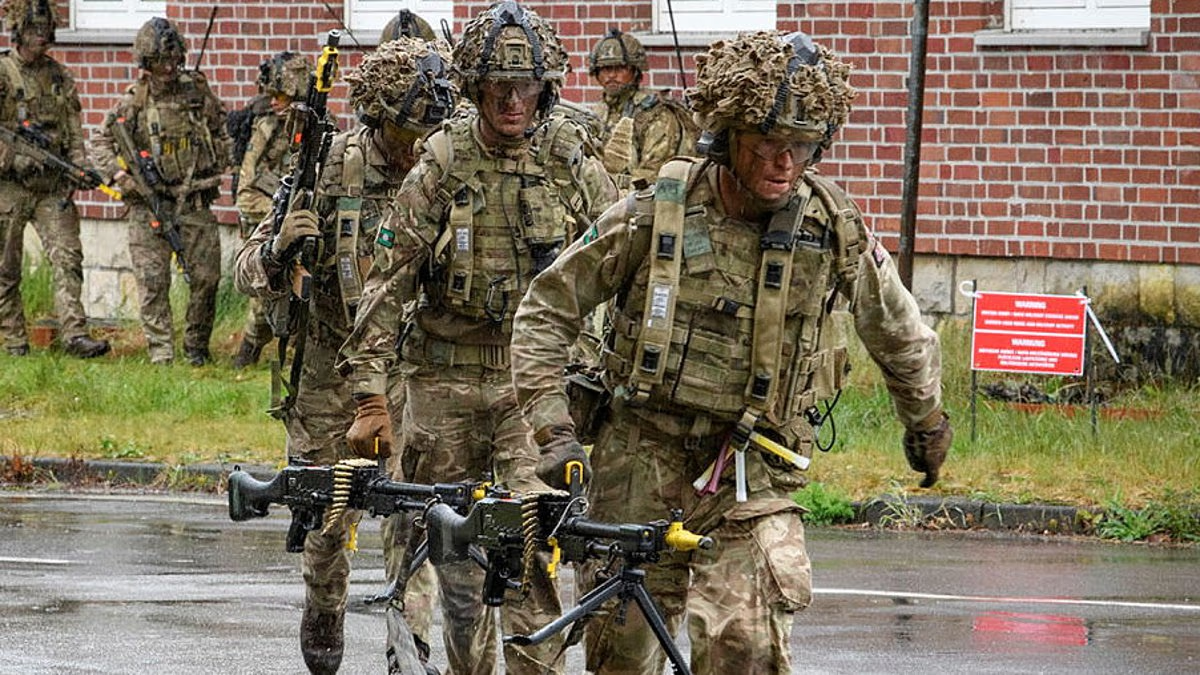

Hundreds of British troops will deploy to Poland for exercises aimed at preparing for a potential mission to help rebuild Ukraine’s armed forces.
Around 300 soldiers from the British Army’s 7 Brigade are travelling to Poland to practise how they could support Ukraine if the war ends.
The exercise is the first of its kind for the Multinational Force Ukraine (MNF-U), a UK- and France-led formation serving as the military arm of the Coalition of the Willing.
About 2,800 personnel from 11 countries will participate in Exercise Koalicja, which runs from November 9 to 22. The drills will examine how troops could move, protect and supply a force tasked with helping rebuild Ukraine’s military after the fighting stops.
Defence chiefs have stressed that the multinational force is not intended to be an “offensive” formation. However, with the conflict still raging, it remains uncertain whether—or when—the coalition would actually deploy.
British commanders say they must nevertheless prepare for the possibility of entering Ukraine if hostilities end and political leaders ask them to proceed.
Lieutenant General Tom Bateman, the British officer commanding the MNF-U, said: “This exercise will demonstrate that the Multinational Force-Ukraine is a real, capable and readily deployable force. It reflects the serious commitment of Coalition of the Willing nations to Ukraine’s long-term stability and security.
“The MNF-U will become more prepared each day to support Ukraine once the fighting ends, helping ensure that the Armed Forces of Ukraine are in the strongest possible position to deter future aggression.”

Around 300 soldiers from the British Army’s 7 Brigade are heading to Poland to practise how they could support Ukraine if the war ends (file image)

The troops are rehearsing how they could help Ukraine rebuild. Pictured: An injured woman in Sloviansk, Ukraine, walks away following a Russian air strike on November 2
France and the UK established the force jointly earlier this year. Its headquarters is in Paris, although it is due to relocate to the UK before the end of the year.
Military personnel from 11 nations—including France, Belgium, Estonia, Germany, Lithuania, the Netherlands, Poland, Spain, Sweden and Turkey—are taking part in the training.
The exercise will test the force’s command-and-control systems, practise the movement of personnel, equipment and supplies, and assess how its various components can work together as a single multinational formation.
Soldiers from the British Army’s 7 Brigade, known as the “Desert Rats”, will rehearse logistical operations. RAF Typhoon fighter jets and a Voyager refuelling aircraft will also fly overhead, simulating how they could help secure commercial air routes if Ukrainian airspace reopens.
Other participating units will practise training Ukrainian recruits and establishing command centres. In Turkey, sailors have been working on mine-clearance procedures for a possible operation in the Black Sea.
Defence Secretary Wes Streeting said: “This exercise shows that the UK is stepping up alongside France and our allies to prepare for the day peace returns to Ukraine. This is not a hypothetical plan—it is a real force ready to support Ukraine when the fighting ends.
“By leading this effort with our allies, we are protecting the UK and Europe for the long term while delivering on our commitment to keep the country safe. Ukraine’s security is our security, and we will stand with them for as long as it takes.”

Russia continues to target Ukraine with missiles and drones. Pictured: A building in Lyman burns after a Kremlin drone strike on October 23
Lieutenant General Bateman added that the MNF-U was “not a NATO force… nor is the MNF-U a peacekeeping or ceasefire-monitoring mission”.
“Its purpose is to provide reassurance and support the regeneration of Ukraine’s Armed Forces, strengthening their ability to deter and, if necessary, defend against future Russian aggression,” he said.
The exercise comes amid warnings that Russia could seek to challenge the initiative, while Western officials insist the task force is prepared to protect itself against threats across the full spectrum.
“Clearly, we will protect our force against any aggression. The principles of self-defence and securing the force will remain in place,” one official told journalists.
The official added: “Russia may choose to oppose and challenge the MNF-U in a range of different areas. One possible arena is the information domain. However, we will be able to respond as necessary to protect our forces and fulfil our mandate.”
An analysis by the Institute for the Study of War indicates that Russian forces lost ground for a second consecutive month.
The assessment says Vladimir Putin’s troops lost 167.14 square kilometres of territory in Ukraine during October 2026.
Meanwhile, reported Russian casualties reached their highest monthly level since the invasion began, with 54,400 troops killed or wounded.
It was the fourth month in a row in which Russian personnel losses exceeded 40,000, underscoring the intensifying brutality of the conflict.
In an update issued on Monday, Ukraine’s military said Russia had suffered 1,592,770 casualties since the invasion began in February 2022. Western officials said over the summer that Russia’s total losses had passed 1.5 million, including 500,000 troops killed.


