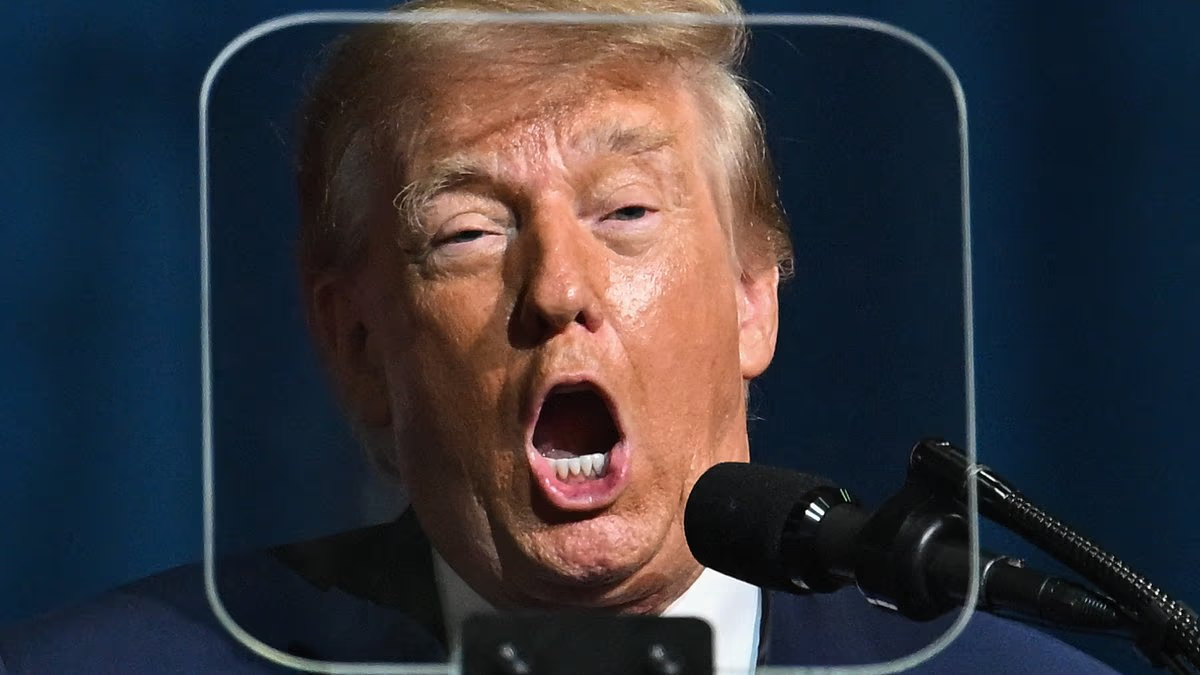

For Donald Trump, the election represents his last major test at the ballot box—and a public verdict on the opening half of his second term.
By the close of Tuesday, more than 100 million Americans are expected to have voted in House and Senate contests nationwide, deciding whether Democrats can seize control of both chambers of Congress.
Some forecasts have predicted Republicans will be overwhelmed by a “blue wave” or even a “blue tsunami.” Others remain cautious, warning that polling errors could once again defy expectations.
Conversations with voters across the country point to a broad set of concerns. The cost of living, gasoline and diesel prices, and growing discontent over the war with Iran have emerged as leading issues among voters of both parties.
Much of the anger is directed at Trump. His approval rating has fallen to a record-low 36 percent in the average of recent polls, while more than 60 percent of voters say they disapprove of his performance.
The President responded with an intense final month of campaigning, staging 25 rallies in vulnerable states throughout October in an effort to energize Republican turnout.
Yet his visibility and combative rhetoric may also drive away independent voters. One analyst described that potential backlash as a “red undertow” working against the GOP.
Several Republican candidates have therefore attempted a delicate balancing act: embracing elements of Trump’s platform while seeking distance from him over the Iran war.

President Trump held two dozen rallies in October, but it remains unclear whether the effort will save Republican candidates.
If Democrats capture both the House and Senate, Trump could spend the final two years of his presidency unable to advance much of his agenda while facing congressional investigations into his conduct and that of his family.
Midterm elections take place halfway through a presidential term. All 435 House seats are contested, along with 35 of the Senate’s 100 seats and three dozen governorships.
Republicans currently hold a narrow 218-214 advantage in the House. Two seats are vacant, while one independent member caucuses with the GOP.
Democrats therefore need to flip only three Republican-held seats to take control. Virtually every major forecast considers them strong favorites to do so. The central question is how large their majority will be, giving Hakeem Jeffries—who would become Speaker—greater authority to contain the party’s democratic socialist wing.
As of Friday, prediction market Kalshi gave Democrats roughly a 93 percent chance of winning the House and a 71 percent probability of taking the Senate.
With a Democratic House appearing increasingly likely, attention has focused on the Senate, where Republicans hold a 53-47 majority.
A 50-50 Senate after November 3 would allow Republicans to remain in control, with Vice President JD Vance casting the deciding vote. The party would also retain control of the committees Democrats hope to use to investigate Trump.

President Trump campaigned alongside Ashley Hinson, the Republican Senate candidate in Iowa.
To win outright, Democrats must gain four Senate seats, giving them a 51-seat majority.
Of the 35 seats being contested, Republicans are defending 22 and Democrats 13.
The clearest Democratic route is to hold Michigan and then win four of the following states: North Carolina, Ohio, Alaska, Iowa, Maine, Texas, Kansas and South Carolina.
A Republican victory in Michigan would deliver a major blow to Democrats, making the state a central battleground in the campaign’s final days.
The seat became open after Democratic Senator Gary Peters decided not to seek reelection.
Abdul El-Sayed, 42, the Democratic nominee and a potential first Muslim senator in US history, has become a prime target for Republican attacks.
Trump has singled him out repeatedly, labeling him a “jihadist,” while Republican candidate Mike Rogers, 63, has sought to connect him to the Muslim Brotherhood.
El-Sayed, a former public health official, has rejected any association with the group and disavowed it. He has also faced criticism over his links to controversial Twitch streamer Hasan Piker.

Michigan Democratic Senate candidate Abdul El-Sayed has become a central Republican target as Democrats fight to retain the seat.
The Cook Report, an influential election forecaster, had rated the contest a toss-up and said no state was causing Democrats more “heartburn” than Michigan.
Late Monday, however, the publication revised its assessment to “Lean D” as part of a forecast projecting Democratic gains of between three and six Senate seats.
Democrats are meanwhile increasingly confident about North Carolina. Former governor Roy Cooper leads former Republican Party chairman and Trump ally Michael Whatley by eight points in polling averages, prompting Republican groups to move advertising money to other states.
If North Carolina turns Democratic, the party would need three additional victories in states the Cook Report rates as toss-ups: Ohio, Maine, Iowa, Texas and Kansas. South Carolina, which has not elected a Democratic senator since 1998, also remains in contention.
Although economic anxiety is widespread, the individual races are being shaped by distinct local issues, candidate profiles and political dynamics.
In Texas, a state Democrats have repeatedly hoped to turn blue, James Talarico, 37, has placed his Christian faith at the heart of his campaign.
Some religious conservatives have accused him of misleading voters and criticized earlier remarks in which he described Jesus as “non-binary” and referred to “six genders.”
Trump has mocked him as “Talafreako,” falsely claimed he is a vegan and promoted Republican nominee Ken Paxton, whose campaign has been clouded by marital and corruption scandals.

Texas Democrat James Talarico is seeking to turn the state blue, while President Trump has derided him as “Talafreako.”
In Alaska, Democrat Mary Peltola leads incumbent Republican Dan Sullivan in polling. But the contest has become increasingly contentious after the Justice Department intensified a criminal investigation into claims that Democrats recruited another candidate to confuse voters.
Sullivan appears on the ballot as “Dan S. Sullivan,” alongside the descriptions “Republican” and “Incumbent.” A previously little-known challenger is listed as “Daniel J. Sullivan Jr.” without a party affiliation.
Democrats were struggling in Maine in July, when their original nominee, Graham Platner, withdrew after an allegation of sexual assault, which he has denied.
His replacement, Troy Jackson, a former logger, has since moved to a three-point lead over Republican Susan Collins, who is seeking a sixth term.

A supporter of Democratic Senate candidate James Talarico holds a campaign sign at a rally in Dallas, Texas.
YOU MIGHT ALSO LIKE: Missing Utah Teen Kylie Arellano Found Safe in Oregon After 500 Days

Voters line up at a polling station in Austin, Texas.
In Ohio, Jon Husted was appointed to fill JD Vance’s Senate seat after Vance became vice president. Husted is now trailing former Democratic Governor Sherrod Brown in polling.
The contest has become one of the most expensive races of the cycle. By mid-October, Brown had raised more than $68 million, compared with $20 million for Husted, while outside groups have spent hundreds of millions more.
Husted, a former college football player, even received an unusual compliment from Trump about his build. At a rally, the President said: “His a** is like a pile of muscle.”
Ohio’s gubernatorial race has also drawn national attention, with Trump ally Vivek Ramaswamy running against Democratic physician Amy Acton.
Ramaswamy released what was described as the most controversial advertisement of the midterm campaign. It featured Acton’s estranged mother calling her a “liar” and suggesting she had mental health problems.
Donna Arthur lost custody of her children after her husband—the children’s stepfather—was indicted for raping Acton.
Despite the backlash, Trump endorsed Ramaswamy and said the advertisement was like “hitting pay dirt.”

President Trump chose not to visit Kansas and Iowa over the weekend, opting instead to hold “tele-rallies.”

A billboard criticizing President Donald Trump in Toledo, Ohio.
In Iowa, Republican Ashley Hinson, a former television journalist and close Trump ally, sought to establish some independence in the campaign’s closing days. She said she would be a “thorn” in the President’s side if he failed to act in Iowa’s interests. Hinson is locked in a tie with Democrat Josh Turek, a two-time Paralympic basketball gold medalist.
Kansas is one of the most surprising Senate contests to have entered the battleground map, despite Trump winning the state by landslides in three presidential elections.
Like Talarico in Texas, Democratic candidate Adam Hamilton has made his religious background central to his campaign. Hamilton pastors the state’s largest megachurch and has accused Republican incumbent Roger Marshall, a physician, of suing patients and living outside Kansas.
Marshall has responded by highlighting a historic abuse scandal involving Hamilton’s church and airing an advertisement accusing him of “protecting a pedophile.”
Soaring diesel costs are a dominant issue in Kansas, where farmers are struggling with higher expenses during the harvest season as the Iran war drives prices upward.
Democrats are also nurturing late hopes in deep-red South Carolina, a state Trump carried by 18 points in 2024.
A poll conducted shortly before Election Day showed Darline Graham, the sister of the late Republican Senator Lindsey Graham, tied with Democrat Annie Andrews, a pediatrician and gun-control advocate.
Trump visited South Carolina twice in eight days in an effort to shore up the Republican campaign. He attacked Andrews as “Tranny Annie” over past comments about transgender issues and portrayed her as a “radical lunatic” who would “take your guns.”

Democratic pediatrician Annie Andrews is running close to Republican Darline Graham in the South Carolina Senate contest.
Entering the final days, Democratic Senate candidates led the polling averages by 3.6 points in Alaska, three points in Ohio, 2.5 points in Texas and 2.4 points in Maine.
Polling analyst Nate Silver cautioned that each of those leads was within what he described as a “normal-sized polling error” capable of putting the races back in Republican hands.
National generic-ballot polling, which asks voters which party they prefer to control the House, gives Democrats an advantage of roughly eight points.
That margin would translate into a 24-seat Democratic gain and a 239-196 House majority, according to a model developed by Alan Abramowitz, professor emeritus of political science at Emory University.
The same projection forecasts a six-seat Democratic Senate gain, producing a 53-47 advantage in the upper chamber.
Accounting for the model’s margin of error, Abramowitz found a two-thirds chance that Democrats would gain between 15 and 33 House seats and between three and nine Senate seats.
The model also assigned a one-in-six probability to Democrats gaining three or fewer Senate seats—a result that would leave Republicans in control.
Abramowitz concluded that there remains a “realistic chance that Democrats could fall short of the 51 seats they need to control the Senate.”

More than 100 million ballots are expected after months of campaigning.
Historically, the party occupying the White House tends to lose ground in midterm elections.
In 2006, a so-called “blue wave” delivered Democrats 31 additional House seats and ushered in Nancy Pelosi’s first period as Speaker.
Four years later, President Barack Obama described his party’s losses as a “shellacking” after Republicans captured more than 60 House seats.
In 2018, with Trump in the White House, Republicans lost 40 House seats.
Still, the historical pattern is not absolute. During Trump’s first term, Republicans bucked the trend by expanding their Senate majority by two seats.
Trump’s standing is weaker this time, however. A recent poll put his net approval rating on the economy at minus 33, while his rating on inflation stood at a deeply negative minus 48.
Republicans and their allies have responded by spending heavily to limit their losses.
Elon Musk alone has contributed about $366 million to support Republican candidates, according to campaign finance records.
The SpaceX chief, who voted early in Texas, said: “The Democrats intend to cement one-party rule forever and make ‘democracy’ meaningless.”
By October 12, the two parties and outside groups had spent a record $3.8 billion on political advertising, with spending continuing to rise during the final stretch.
According to AdImpact, the largest advertising expenditures were concentrated in the Senate contests in Texas, Ohio and Michigan.
IN CASE YOU MISSED IT: Leaked Filing in Oklahoma Teen Noah Presgrove Case Alleges Lover Plotted His Killing


