
Michigan Democrats spent the last weekend before the midterms showing how quickly a unity rally can turn into a political bloodletting.
Representative Haley Stevens, who lost her party’s Senate primary to Abdul El-Sayed, endorsed Republican candidate Mike Rogers on Sunday.
What was intended as a display of Democratic solidarity instead collapsed into a bitter dispute over Israel, ideology and the question of who had driven whom out.
Republicans had every reason to celebrate before stepping aside to watch. When a rival party provides both the fuel and the matches, staying out of the way is usually the wisest strategy.
The episode made for compelling political drama. It also risked creating a deeply distorted picture of the broader election.
Alongside allegations of Democratic ballot manipulation in Alaska, the Michigan rupture gave Republicans something they rarely enjoy during this campaign: a news cycle implying that Democrats are the party in crisis. Yet beyond those headlines is the possibility of a Republican defeat so broad that Washington—and the country—has scarcely begun to consider what could follow.
The New York Times/Siena surveys released Sunday night hit Republican leaders with the impact of a thousand pianos crashing through headquarters ceilings.
Democratic Senate contenders held leads of seven points in Texas, six in Maine, and five in both Ohio and Kansas. Alaska leaned Democratic, while Iowa was effectively deadlocked. In Michigan, El-Sayed was ahead of Rogers by 11 points, though the poll could not measure the full impact of Sunday’s breakdown.


Representative Haley Stevens (above, right), who lost her party’s Senate primary to Abdul El-Sayed, endorsed his Republican rival, Mike Rogers (above, left), on Sunday.

A New York Times poll found El-Sayed 11 points ahead of Rogers, although it could not capture the full consequences of Sunday’s Democratic rupture.
Democrats eye historic election gains
The polling in the governors’ contests was just as striking. Democrats held meaningful leads in Michigan, Iowa and Ohio, while Texas Governor Greg Abbott was essentially tied with his Democratic challenger.
Polls can miss the mark, and Republicans know better than most what it feels like to be underestimated. Still, none of my Republican sources—not counting the professional optimists posting online—disputes that the surveys are pointing in the same general direction.
As regular readers know, I do not predict election results or cheer for either party. My concern is the American public. I have been reporting that a generational Democratic wave is within the realm of possibility. Yet the lack of serious discussion about that outcome has left the country unprepared for its potential consequences.
Consider the most dramatic version of that scenario: Democrats building a 60-seat Senate caucus, enough to overcome the filibuster and advance major—and potentially contentious—legislation without Republican support.
To reach that threshold, Democrats would need to retain every seat they currently hold while capturing Republican-held seats in North Carolina, Ohio, Maine, Alaska, Texas, Iowa, Kansas, South Carolina, Mississippi, Florida, Montana and Louisiana. Because Nebraska candidate Dan Osborn is running as an independent, he would also need to caucus with Democrats for the party to reach 60 seats.
That is an extreme scenario and represents the Democrats’ upper limit, requiring nearly every close contest to break in their favor. It is not a prediction. But even a 57- or 58-seat majority could encourage Republicans such as Alaska’s Lisa Murkowski and Indiana’s Todd Young to work with Democrats on legislation where their interests overlap.
In the House, the most expansive possibility would be a Democratic gain of 45 seats, resulting in a 260-175 majority.
A wave of that size would not stop at Congress. Governorships and state legislative chambers could change hands as well, giving Democrats influence far beyond the committee rooms where Trump administration officials might soon be testifying under oath.
The president could face investigations into his administration, family and political allies on a scale that would make his first term appear like a practice exercise. Defense Secretary Pete Hegseth, meanwhile, could be caught between Democrats weighing impeachment proceedings and a White House looking for someone to blame.

Defense Secretary Pete Hegseth could be caught between Democrats weighing impeachment and a White House searching for scapegoats.

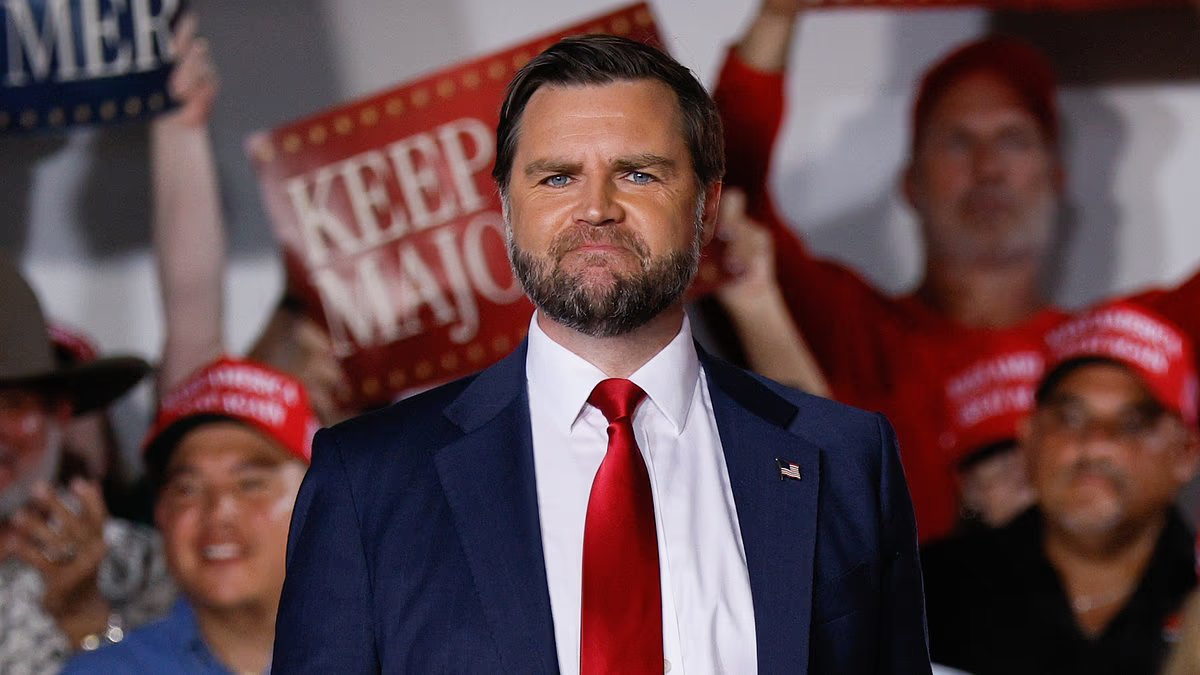
A potential presidential campaign by Vice President JD Vance would confront an immediate and difficult question.
What a Democratic victory could mean
Tariffs, the war with Iran, Pentagon funding, health care and America’s ties with Israel would all come under fresh examination. Trump would still possess veto power, and Democrats would not have enough votes to remove him from office, but his ability to control Washington’s agenda would be sharply reduced.
Republicans would begin their familiar post-election autopsy, searching for responsibility. House Speaker Mike Johnson and Senate Majority Leader John Thune could face challenges to their leadership. Vance’s potential 2028 presidential campaign would also inherit a pressing question: Why would voters choose Trump’s understudy after rejecting the longtime headliner in 2026?
Democrats would have their own complications. Senate Minority Leader Chuck Schumer would be celebrated as a political mastermind, potentially strengthening his position against a future challenge from Representative Alexandria Ocasio-Cortez for his New York seat. He and House Minority Leader Hakeem Jeffries would then have to balance the demands of newly elected members from conservative districts with progressive claims that voters had embraced socialism.
Washington would likely see glowing tributes to the party’s emerging figures, renewed interest in surprise winners whose campaigns received little scrutiny and a surge in political hiring. Lobbyists who recently discovered a lifelong devotion to Trump would rediscover their equally permanent commitment to bipartisanship—and to the incoming Democratic majority.
None of this is guaranteed. Democrats could lose several close races and spend the following Wednesday explaining why they failed to win a Senate majority. But however dramatic Michigan’s internal conflict may be, it does not overturn the larger national picture.
A Republican disaster remains a real possibility. With the election only days away, Americans deserve to understand what that outcome could mean before they wake up to it.


