
Four Americans and one Canadian were among the 69 people killed in last week’s high-speed train collision in Spain, authorities said.
Officials have identified 66 of the victims so far. Spanish nationals accounted for most of those killed, with 54 deaths recorded among Spanish citizens.
The crash occurred last Wednesday when one high-speed train slammed into the rear of another train that had stopped on the tracks.
Spain’s rail infrastructure operator ADIF said the collision happened in the province of Toledo.
More than 500 passengers were aboard the two trains, which were traveling in the same direction from Madrid to Seville in southwestern Spain.
A train operated by state-owned RENFE struck the stationary rear of a train run by private rail company IRYO.

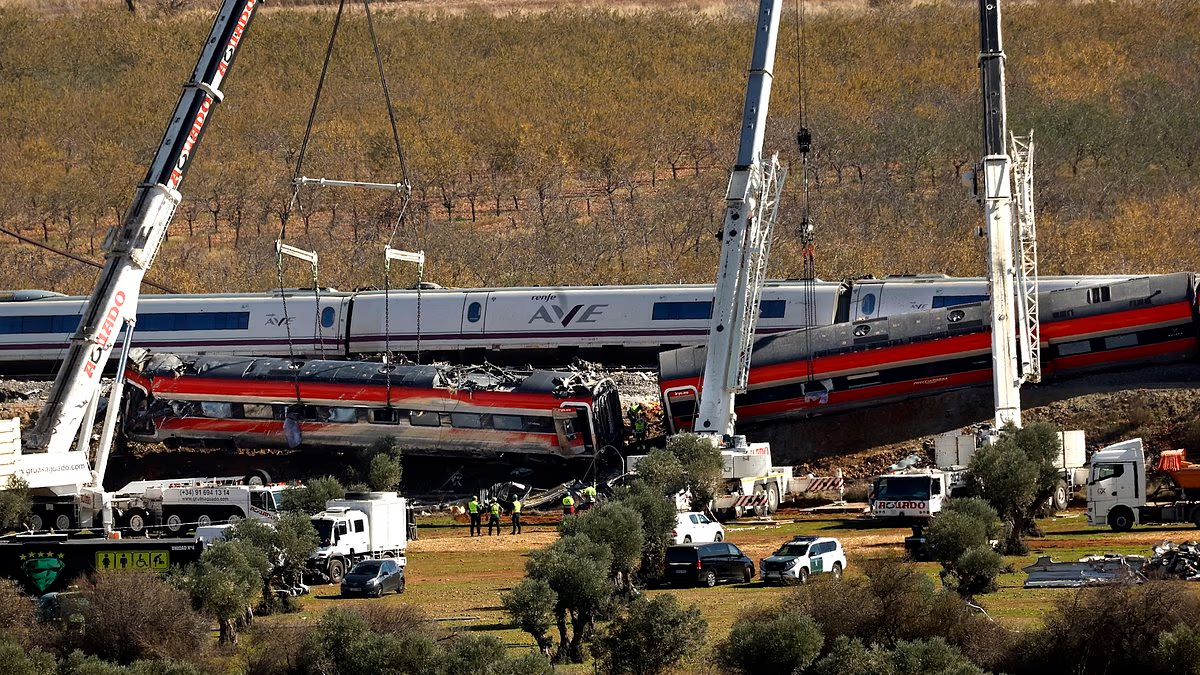
Large cranes lift a wrecked carriage after a Renfe AVE train collided with an Iryo train near Urda in Toledo, days after the deadly crash

The high-speed train crash south of Madrid killed 69 people and injured dozens more in one of Europe’s deadliest rail disasters this century

Spanish Transport Minister Oscar Puente said the collision followed an “inexplicable” order from the central control center overseeing the country’s trains
The impact derailed two carriages at the back of the IRYO train and the front carriage of the RENFE train.
Transport Minister Oscar Puente said the crash followed what he called an “inexplicable” instruction from Spain’s central rail control center after a safety system failed. He emphasized that the train drivers were not responsible.
Puente said the train should never have been cleared to move because a stop signal remained active on the line. At a minimum, he said, it should have been ordered to travel at a reduced speed.
Other foreign nationals identified among the dead include one person each from France, Japan, Argentina, Mexico, Portugal, Tunisia and the Czech Republic.
Three bodies have yet to be identified, while three people remain listed as missing: two Australians and one Japanese national.
Two American college students were also seriously injured in the collision. One needed a ventilator, while the other was left unable to eat or drink without assistance.

Austin Hartman, a Cal Poly business student from Bellingham, Washington, sustained multiple fractures and critical injuries that required him to use a ventilator for 24 hours

Leah Silver-Fajardo, 21, a neuropsychology student from Seattle, suffered a shattered knee, fractured pelvis and ribs, and bruised lungs in the crash
Austin Hartman and Leah Silver-Fajardo, both juniors at California Polytechnic State University in San Luis Obispo, were studying abroad in Europe when the disaster abruptly changed their lives.
Hartman, a business major from Bellingham, Washington, was traveling to Seville on a day trip with another Cal Poly student when the trains collided on October 28.
He sustained fractures to his pelvis, hip, thighbone, upper arm, ribs and lower spine, as well as extensive cuts to his face and body.
His injuries caused serious breathing and circulation complications, forcing doctors to place him on a ventilator for 24 hours.
Hartman is expected to undergo several surgeries and may not be able to return to the United States for at least two months.
“Austin went from enthusiastically and joyfully living a dream abroad to being confined to a hospital bed and facing an extensive recovery,” his GoFundMe page states.
Silver-Fajardo, 21, from Seattle, had been studying neuropsychology in Florence, Italy. She celebrated her birthday with family and friends just three weeks before the crash.
She suffered a fractured knee and pelvis, several broken ribs, bruised lungs, and burns and abrasions across her body.

Hartman was traveling to Seville during his study-abroad program when the crash occurred. He faces multiple surgeries and at least two months in Spain before he can return home

Silver-Fajardo’s family spent agonizing hours searching for her after they initially did not know whether she had survived. She faces months of rehabilitation and cannot eat or drink without assistance
She has undergone knee surgery and was moved out of intensive care, but she will need another operation to repair her pelvis, followed by months of rehabilitation.
In a Monday update on her GoFundMe page, her mother said Leah “is completely immobilized” and needs help eating and drinking.
Her family also recounted the frightening hours after the crash. Leah’s parents, Nicole and Sergio, were contacted by the US Embassy but initially had no idea whether she had survived or which hospital had taken her.
Friends searched hospitals throughout the area before finally finding her.
Her parents and sister, Hannah, have since traveled to Spain to stay by her bedside.
“Now, instead of attending classes, exploring new cities, and enjoying life with her friends, Leah is lying in a hospital bed in Spain, recovering from devastating injuries sustained in a tragic train crash that claimed so many lives,” her aunt Rachel Chernin wrote.

The crash occurred last Wednesday when one high-speed train struck the rear of another train that had stopped on the tracks

The collisions have undermined confidence in Spain’s rail network, long regarded as one of Europe’s fastest and safest

Emergency crews work at the scene of the collision between the Spanish towns of Mora and Orgaz near Toledo last week
The crash in Toledo province came just nine months after another collision farther south on the same Madrid-Seville route killed 46 people.
The two disasters have shaken public confidence in Spain’s rail network, which had long been praised for its speed and safety record.
Prime Minister Pedro Sánchez has promised an investigation and upgrades aimed at restoring trust in a rail system that carried about 45 million passengers last year, including millions of tourists.
The crash occurred one month before a November 29 general election, in which Sánchez is seeking to extend his eight-year tenure as prime minister.
He is now facing scrutiny over railway safety and his governments’ investment in Spanish infrastructure.


