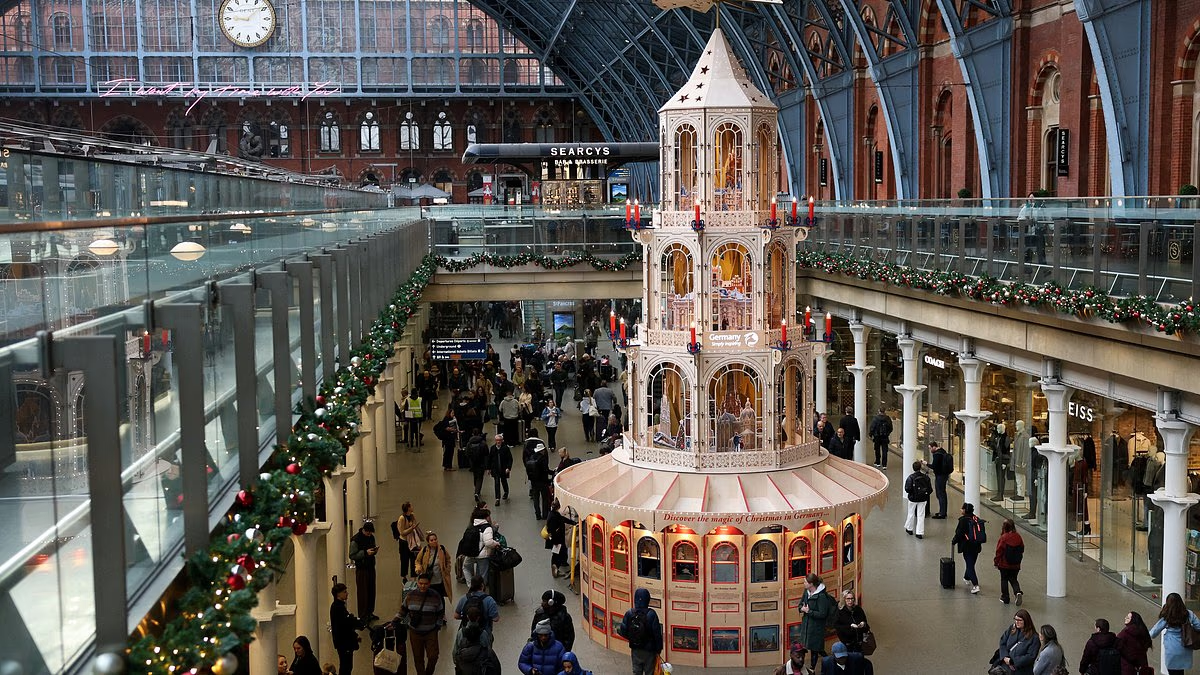

One of London’s best-known railway stations has revealed its Christmas centrepiece: a giant traditional German pyramid created with support from the country’s tourism board.
St Pancras International unveiled the three-tiered display, which features 24 “curiosity windows” showcasing German destinations, customs and festive traditions.
Standing 36ft (11m) beneath the station’s famous roof, the wooden installation is decorated with 1,564 recycled fairy lights. It took 18 workers more than 2,300 hours to build.
The structure was developed in partnership with German tourism officials and consists of 898 individually interlocking components made from biodegradable plywood.
The unveiling follows last year’s collaboration between the station and Great Ormond Street Hospital, which produced a 39ft (12m) Christmas tree featuring a digital donation point for the charity.
The 2025 display celebrated the hopes of seriously ill children and included hand-painted baubles based on 38 artworks inspired by young patients at the hospital.
This year’s pyramid, sponsored by Hilton hotels, will also serve as a giant Advent calendar from December 1, with a different window lighting up each day until Christmas Eve.
Passengers travelling through St Pancras can explore interactive panels and answer questions to reveal facts and stories about Germany.
Prize draws will offer return rail tickets to Germany with Eurostar, along with two-night stays at Hilton hotels in the country. The installation will remain at the station until January 2.
However, St Pancras’s decision to call the installation a “tree” prompted amusement among some social media users. One commented: “I like it, but the word ‘tree’ is doing a lot of work here.”

Passengers pass the 36ft (11m) Christmas “tree” at London St Pancras International station

St Pancras worked with the German tourist board to create the installation inside the station

Television broadcaster Gyles Brandreth, who was born in Germany, attended yesterday’s unveiling

A family views the St Pancras installation, which is lit by 1,564 recycled fairy lights

Passengers take photographs of the installation unveiled at St Pancras yesterday

The St Pancras display has three rotating tiers and 24 “curiosity windows”

Teresa Windschall, ambassador for Nuremberg’s Christmas market, visits the installation
Others agreed that the display was festive, if not technically a tree. Comments included: “It’s not a tree but it still looks Christmassy and festive nonetheless”; “It’s lovely but it’s not a tree”; and “Need to go to Specsavers – that is not a tree.”
Other posts noted that the German Embassy in London had avoided calling it a tree, describing it instead as a “spectacular 11-metre Christmas pyramid”.
READ MORE: 2000s Pop Icon Looks Unrecognizable With Plump New Lips—Who Is She?
St Pancras said the partnership highlights how passengers can already travel to Germany by taking a Eurostar service to Brussels and changing trains there.
A direct London route to Frankfurt and Cologne could follow in the future, after Eurostar and Deutsche Bahn signed an agreement to investigate the possibility.
New research released by St Pancras found that 89 per cent of Britons will observe at least one German-linked Christmas tradition this year. However, only 33 per cent know that those traditions are connected to Germany.
Around 46 per cent said they follow Christmas customs without knowing their origins, while 52 per cent were surprised by how many familiar festive traditions have German roots or links.
Television broadcaster Gyles Brandreth, who was born in Wuppertal, Germany, in 1948, attended yesterday’s unveiling. He said: “This wonderful Christmas pyramid tree gives you both Christmas and Germany in one magical experience.
“As you climb the tree, there are wonderful historic buildings and a lot of traditions that many people will not realise are German.”

2025: St Pancras partnered with Great Ormond Street Hospital on last year’s Christmas tree

2024: A partnership with Universal Pictures UK marked the release of Wicked two years ago

2023: An enormous Christmas tree-shaped bookshelf promoted Hatchard’s bookstore

2022: St Pancras worked with The Prince’s Trust on a tree inspired by London’s skyline
Petra Hedorfer, chief executive of the German National Tourist Board, said: “Christmas traditions are an important part of Germany’s culture, and many have travelled far beyond our borders to become customs enjoyed across Britain today.
“We’re delighted to partner with St Pancras International and Hilton to bring these stories to life in the heart of London, connecting British travellers with the destinations and festive experiences behind them, while inspiring visitors to discover more of Germany this Christmas season.”
Wendy Spinks, chief commercial officer at St Pancras Highspeed, said: “The St Pancras International Christmas Tree has become a much-loved part of London’s festive calendar, and each year we want to give visitors something new and unexpected to discover.
“This year, we’re delighted to be working with the German National Tourist Office and Hilton to celebrate the fascinating stories behind some of the Christmas traditions we all know and love.”
Christmas trees first became widespread in German homes during the 16th century. The tradition later reached Britain after German-born Prince Albert married Queen Victoria.
Their popularity grew quickly in the UK following an 1848 illustration showing Victoria, Albert and their children gathered around a decorated tree at Windsor Castle.
Separately, research by Celebrations chocolates found that up to one in 10 Britons will put up their Christmas tree this week. The trend has been dubbed “Christmas-maxxing”, referring to efforts to extend the festive season beyond December.
READ MORE: One in ten of us is already decking the halls


