
A specialized US Air Force reconnaissance aircraft built to analyze foreign radar systems has crossed the Atlantic on a mission that has not been publicly disclosed.
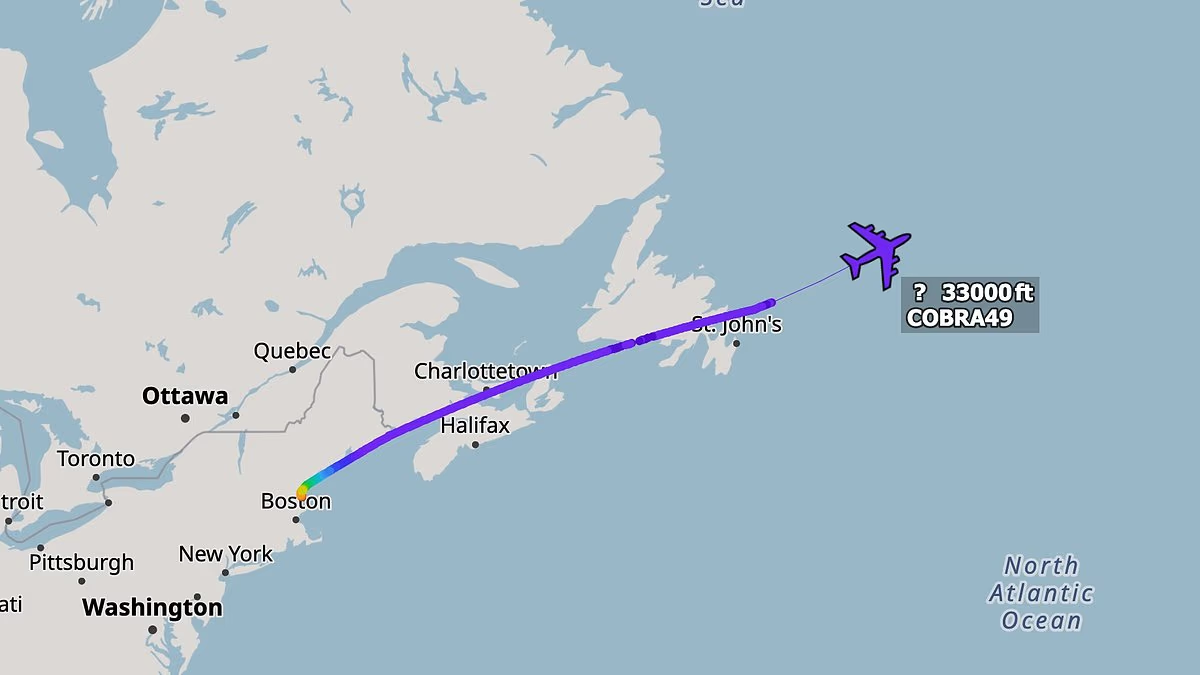
Records from Flightradar24 show that the RC-135U Combat Sent departed Portsmouth International Airport at Pease in New Hampshire at 1:51 a.m. ET on Wednesday.
Operating under the callsign COBRA49, the aircraft reached RAF Mildenhall in Suffolk, England, after a flight lasting six hours and 42 minutes.
The Air Force has only two Combat Sent aircraft. Their central role is to gather highly detailed intelligence about foreign military radar and electronic systems.
That information helps US analysts determine how hostile equipment functions and supports the development of technology designed to identify, avoid or overcome those systems.
The arrival in Britain has prompted speculation among military aviation observers that the aircraft could eventually support operations in the Middle East. However, its flight data does not reveal a next destination or confirm any specific operational assignment.
The deployment comes after President Donald Trump said the United States had no immediate intention of carrying out additional strikes against Iran.
Trump also warned that American forces remained “locked and loaded if we need to go,” while adding that there might be no need to use them.

The RC-135U Combat Sent departed Portsmouth International Airport at Pease in New Hampshire at 1:51 a.m. ET on Wednesday, according to Flightradar24 records
Flightradar24 identified Wednesday’s aircraft as registration number 64-14849. The flight-tracking history also showed that it had traveled from Omaha, Nebraska, to Portsmouth the previous day.
Both Combat Sent aircraft belong to the 55th Wing at Offutt Air Force Base in Nebraska, although their intelligence missions can take them across the globe.
RAF Mildenhall has hosted the aircraft in the past. Air Force images released in 2014 showed a Combat Sent being refueled over Norway by a tanker based at the Suffolk airbase.
The Air Force says the aircraft are used during routine peacetime activities as well as during military contingencies. Their presence in the United Kingdom, by itself, therefore does not prove that a new combat operation is about to begin.
The flight has generated intense discussion on social media. One user on X wrote that the deployment could improve Washington’s ability to monitor regional air-defense networks amid heightened tensions with Iran.
The user added that, while the aircraft’s arrival did not necessarily point to an imminent strike, its capabilities would be especially useful in evaluating advanced radar and missile-defense systems ahead of possible military action.
Another commenter suggested that the flight was more consistent with an annual baseline collection mission along NATO’s eastern flank.
The Combat Sent’s value comes from the electronic intelligence it collects from radar installations on the ground, at sea and in the air.

One of only two Combat Sent aircraft in the Air Force fleet, the jet gathers detailed intelligence on foreign military radar systems
According to the Air Force, the aircraft combines human analysis with an Automatic Electronic Emitter Locating System. This allows mission specialists to locate, identify and assess several electronic signals at the same time.
In effect, the jet serves as a flying laboratory, capturing transmissions that analysts can later examine to determine the capabilities of the systems generating them.
Its reconnaissance role is visible in the antenna arrays positioned beneath the nose, on the wingtips and along the aircraft’s elongated tail.
Systems engineers, electronic warfare officers and other mission specialists operate the collection equipment from inside the aircraft. Air Combat Command says the two jets have slightly different reconnaissance configurations.
The intelligence gathered during these missions is added to national databases and reviewed by specialists who track the development and operation of foreign electronic systems.

Using the callsign COBRA49, the aircraft arrived at RAF Mildenhall in Suffolk after a six-hour-and-42-minute flight
The impact of that work extends far beyond an individual surveillance flight.
An Air Force handbook says intelligence collected by Combat Sent supports the development of advanced weapons and the updating of radar-warning systems.
Those warning systems help aircrews recognize potential threats. Incorporating new information about foreign radar networks can give crews more accurate data during future missions.
The aircraft is also capable of aerial refueling, allowing it to remain airborne longer than its onboard fuel supply would otherwise permit. Air Force specifications list a top speed of more than 500 mph.


