It would be difficult to find a more appealing figure than Charles Leclerc: charming, multilingual, gifted on the piano and the object of teenage admiration wherever Formula One goes.
The Ferrari driver has returned lovingly to Monaco to be with his beautiful wife, Alexandra, who is expecting their first child. The birth comes almost exactly nine months after the couple’s picture-perfect wedding in the principality where Leclerc was born.
They also dote on Leo, an adorable miniature long-haired dachshund whom Alexandra regularly walks through the paddock. The little dog is so popular that he even has his own VIP pass.
Yet beneath Leclerc’s polished exterior lies something rather more calculating.
That, I suspect, was at the centre of Lewis Hamilton’s frustration over the simmering Ferrari dispute he exposed on the opening lap of last Sunday’s Mexico City Grand Prix.
The sequence was straightforward enough. Hamilton started from pole, while Leclerc, third on the grid, made a strong launch in his team-mate’s slipstream. The two Ferraris ran side by side and, at Turn 4, Leclerc left the circuit across the grass before rejoining ahead. He had gained what was judged to be an unfair advantage, yet did not hand the position back.
There was an added complication: the Ferrari drivers’ battle allowed Max Verstappen to move into second place. The Red Bull driver was then wedged between the two red cars.

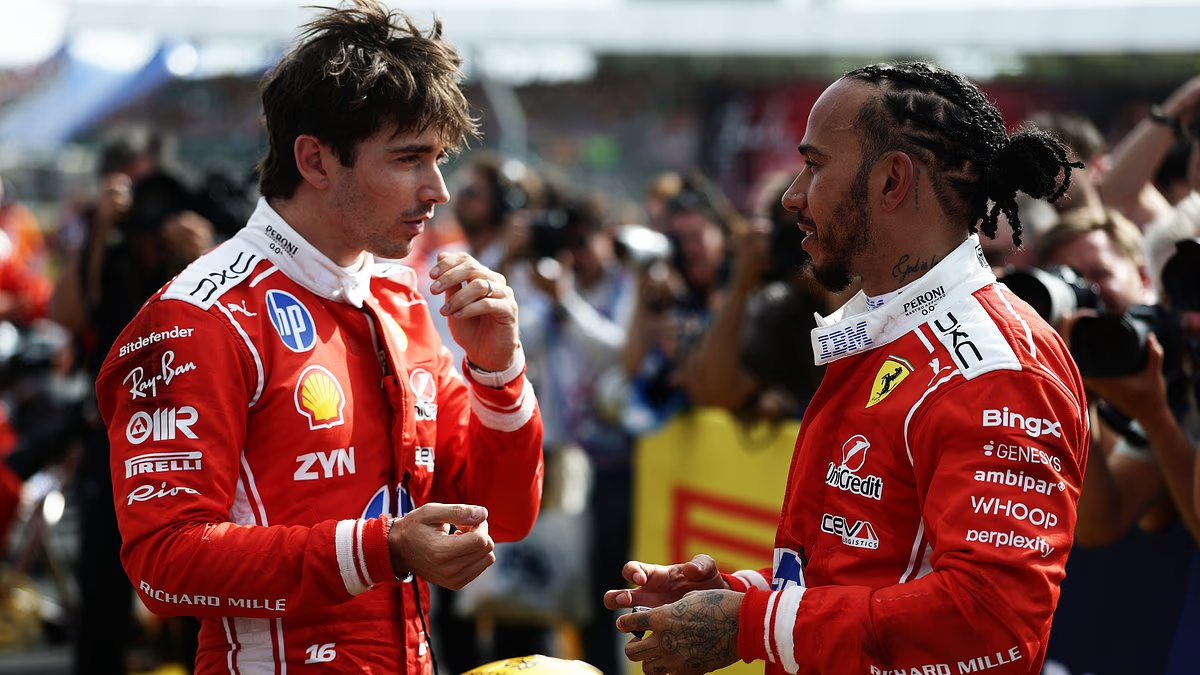
Ferrari are embroiled in an internal dispute after Lewis Hamilton (right) accused team-mate Charles Leclerc of using dirty tactics at the Mexico City Grand Prix

Hamilton (left, 44) believes Leclerc (right, 16) cost him victory after making a daring move on the opening lap
Leclerc recognised the advantage that situation gave him and made the most of it. With Verstappen separating the Ferraris, there was no realistic opportunity for the team to reverse the order. Leclerc surged into the lead and quickly built momentum in clean air.
A five-second penalty eventually followed for the advantage he had gained, but by then Leclerc had created enough distance to limit its effect. Hamilton was livid. He reasonably believed Ferrari might otherwise have finished first and second. Instead, the team came home second and fourth, with Hamilton eventually passing the Monegasque ‘saint’ after a later restart. Verstappen, alert to the opportunity and quick to exploit it, won the race.
Hamilton complained over team radio of “big, big problems” with Leclerc. He called for “talks behind closed doors” and accused his team-mate of breaching the spirit of their pre-race agreement.
Hamilton was not entirely impartial, of course. His primary concern was almost certainly his own chance of winning. But he is also regarded as a fair competitor and, as a seven-time world champion, deserves a significant measure of respect—and at least a genuinely level playing field.
Hamilton has never been known for seeking an advantage through deception or clever manipulation. That is not his way. He believed Leclerc had crossed the line; in my terms, he felt the Ferrari driver had been sneaky. Leclerc, for his part, insisted that he had every right to fight for victory.
Several competing interests are wrapped up in the argument. Formula One’s oldest dilemma is the tension between a driver’s instinct to win and the wider interests of the team. It is a conflict no organisation can ever resolve completely.

Leclerc’s charming image is complemented by his beautiful wife Alexandra and their much-loved dog, Leo, a miniature long-haired dachshund (Source: Instagram/Antoine Truchet)

Ferrari team principal Fred Vasseur (centre) is expected to speak to his drivers after a tense post-race debrief in Mexico
I understand Ferrari’s post-race debrief in Mexico was highly charged. Team principal Fred Vasseur now has to navigate the Hamilton-Leclerc dispute, hold discussions with both drivers and establish rules of engagement that protect the team’s interests.
It is a difficult subject. Leclerc believes he should be free to race as he chooses, backed by elements within Ferrari that have supported him since his days in the team’s young-driver academy. Hamilton, meanwhile, is pushing back against what he sees as an uneven alliance.
Teams develop their own internal loyalties, and Hamilton is attempting to establish his position in an unfamiliar, traditionally anti-English environment. Leclerc, consciously or not, regards it as his territory.
Ferrari should call on Christian
Christian Horner’s book Drive is third on the Sunday Times best-seller list. Whatever one makes of the former Red Bull boss’s partly ghost-written literary achievement, should he not also be Ferrari’s team principal?
Ferrari has ambition. What it appears to lack is imagination. If the team truly possessed both, why would it not bring Horner in immediately?

If Ferrari combined ambition with imagination, it might turn to former Red Bull team principal and successful author Christian Horner
My remedy for the F1 grind
I have picked up more stories for Daily Mail Sport in British Airways lounges than almost anywhere else. People loosen up there, a few drinks may have been consumed and everyone is relaxed on the journey home from a race.
That never happens on the outbound trip. On the way to a race, people tend to keep to themselves.
But the atmosphere leaving Mexico City last weekend was dominated by exhaustion. I have rarely seen such a disorientated group of people. One team principal, whose identity I shall protect, fell asleep in the seat opposite me.
Everyone was drained. This is an increasingly punishing Formula One season, with back-to-back races repeatedly dragging the paddock across different time zones. The hastily arranged ‘Bahrain Grand Prix in Malaysia’ last month added another demanding journey. Over the past six weeks, the schedule has included Azerbaijan, Malaysia, Singapore, Texas and Mexico. That is a brutal run, with Brazil following on Sunday.
On that subject, I advised a colleague preparing for her first race in São Paulo—home to arguably the finest circuit in the world—to ease the pressure of the calendar by sampling Brazil’s national drink: the Caipirinha.
My advice, based on experience, was simple: one Caipirinha is good, two are respectable, and three lead to oblivion.

Did Mercedes’ pursuit of four-time world champion Max Verstappen (left) affect George Russell’s confidence?
Did Mercedes’ pursuit of Max Verstappen hurt Russell?
George Russell was beaten in Mexico by the brilliance of his Mercedes team-mate Kimi Antonelli, who became the youngest world champion at 20 with four races remaining. Russell may insist that team boss Toto Wolff continues to support him, but how much did Mercedes’ pursuit of Max Verstappen over the past two years affect him?
Confidence is crucial in sport. One wonders whether the prolonged and public courting of a rival unsettled Russell, weighed on his mind and ultimately affected his performances.