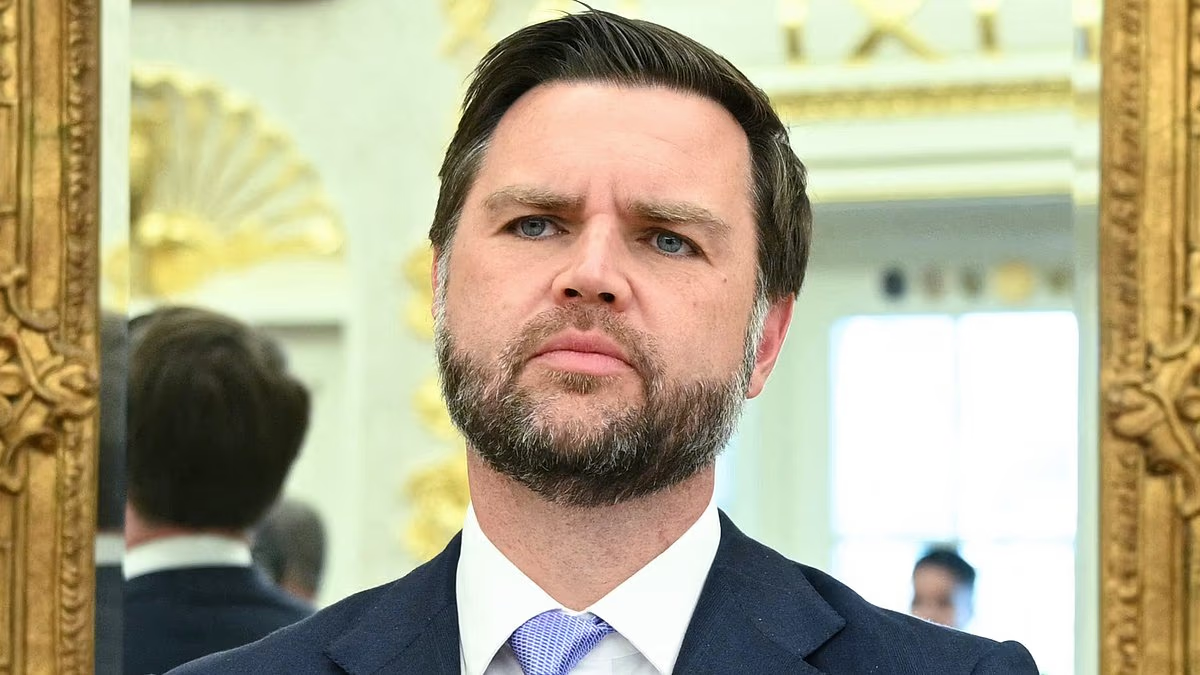

JD Vance is navigating one of the most precarious political balancing acts in recent American history.
The vice president suffered a devastating setback Tuesday night after voters rejected Donald Trump’s version of conservatism and handed Democrats control of both the House and the Senate.
Vance’s prospects of winning the White House in 2028 also collapsed on prediction markets. The longtime frontrunner now trails newly re-elected Georgia Senator Jon Ossoff.
The vice president moved quickly to blame the result on the Iran war in a lengthy statement posted to X early Wednesday. Trump began the conflict in February despite Vance’s private reservations, and the carefully calibrated statement placed much of the responsibility for the midterm defeat at the president’s door.
Donald Trump Jr., who has privately expressed his opposition to the war to his father, endorsed the message less than an hour later, writing: ‘Every word of this is [100 emoji].’
Confronted with the post at the White House several hours later, Trump broadly accepted Vance’s analysis but refused to acknowledge that launching the war had been a mistake.
‘I think it’s largely true because it drove the gasoline up … but at the same time if I had it to do again, I’d have to do it again,’ he said.
A close reading of Vance’s post-election analysis exposes the high-risk strategy he is pursuing as blame spreads through a White House led by an isolated, lame-duck president who is known for abandoning allies at the first hint of disloyalty.
One of the things the data analysts on our side obsessed over was “composition”—whether the electorate looked close enough to 2024 for Republicans to win. And despite polls that showed a Democrat blowout, the data kept on telling us the same story: in some states turnout was…
— JD Vance (@JDVance) November 4, 2026

JD Vance listens to President Trump as he hosts Stephen Hubbard in the Oval Office on October 30

Trump speaks as the final steel beam is placed on the White House ballroom on Wednesday
What JD Vance’s statement means
What Vance says: One issue our data analysts focused on was ‘composition’—whether the electorate looked sufficiently similar to 2024 for Republicans to win. Despite polls predicting a Democratic blowout, the data continued to tell us the same thing: turnout was merely adequate in some states, exceptional in others, and catastrophic nowhere. Our team had a genuine sense of optimism because our voters were turning out.
What he means: Vance begins by conceding that the Republican political operation failed to recognize the depth of public anger, including in deeply conservative states that had supported Trump in all three of his presidential campaigns.
That operation was highly effective in 2024 under Susie Wiles, now the White House chief of staff, and her ally Chris LaCivita.
Wiles repeatedly assured Trump that he was headed for a midterm victory, sources told Our News Outlet, even as his approval rating fell to 32 percent. Vance’s reference to a ‘genuine sense of optimism’ appears directed at her team.
What Vance says: I asked the smartest data expert I know whether we were about to shock the world. ‘No,’ he replied. ‘We may outperform the polls, but the data shows that many Trump/Vance 2024 voters are angry and intend to vote for the other side. Our voters are turning out, but they may not vote for us.’
That assessment now looks prophetic. Our voters did turn out. In Florida, for instance, the electorate was nine points more Republican than Democratic—only a few points worse than in 2024. There were undoubtedly places where turnout could have been stronger, but turnout was not the central problem. The bigger issue was that many people who voted for Trump and Vance in 2024 backed Democrats in 2026.
What he means: Vance repeatedly attaches his own name to the 2024 coalition, referring twice to ‘Trump/Vance’ while avoiding responsibility for his record in government.
At the same time, he concedes that some Republican operatives recognized the danger in advance—and that their warnings were ignored.
Significantly, the voters described as ‘angry’ and defecting in the next section are referred to simply as ‘Trump 2024 voters.’
What Vance says: There will be considerable infighting and debate over what happened and why. A pollster I respect told me that our economic message was not sharp enough in the final stretch. I am sure that is true.
But almost everyone understands the real reason we lost.
What he means: Vance is beginning to protect himself as blame starts circulating. By predicting ‘a lot of infighting and arguing,’ he presents himself as standing above the conflict just as leaks began emerging from the White House.
He does not risk acknowledging that the economy itself is in poor shape, instead attributing the failure to ineffective messaging.
What Vance says: Another pollster—one of the smartest people I know in politics—told me yesterday that we would lose the generic ballot by 13 points. I felt pessimistic going into Tuesday, but even I was stunned. His polling showed that many Trump 2024 voters were angry and planning to support Democrats. He asked those who had left us what might bring them back. Nearly all of the responses fell into four main categories:
1) End the war
2) Address the cost of living and inflation
3) Put America First
4) Rethink our relationship with Israel
What he means: Vance’s list reads like the foundation of a 2028 campaign: a measured shift away from Trump’s definition of MAGA and toward a more explicitly America First agenda.
Each point challenges some aspect of the administration Vance serves, although every recommendation is attributed to an unnamed pollster.
RELATED: DOJ Charges Los Angeles Woman in Alleged $18M COVID Relief Fraud
The list also conspicuously omits concerns about apparent government corruption, which national exit polling indicates may have been the most important issue for voters.
Vance also fails to mention his own role in efforts to end the conflict. He led peace talks with Iran in Islamabad in April.
Trump joked at the time: ‘So, if it doesn’t happen, I’m blaming JD Vance.’
Seven months later, Vance is arguing that the war—not his unsuccessful negotiations—cost Republicans control of Congress.
What Vance says: Our voters turned out, and those four issues explain why many supported Democrats. This comes from a pollster who accurately predicted the results. While many people spent Monday criticizing Rachel Campos Duffy for advocating a diplomatic solution to the conflict, her political judgment proved correct. She is also a great person.
What he means: Vance is making a direct criticism of the administration’s performance. His argument is that Trump voters did not merely stay home; many went to the polls and voted for Democrats.
Early exit polls support that conclusion, although increased Democratic turnout also appears to have played a role.
Vance’s praise for Rachel Campos Duffy, the Fox News host and wife of Transportation Secretary Sean Duffy, is deliberate.
She has faced accusations of antisemitism after objecting to the Iran war and has pushed back against conservatives who accused her of moving to ‘the dark side.’
Vance once again highlights his difference with Trump over Israel, but he also makes the disagreement personal by calling Campos Duffy ‘a great person’ and referencing the accusations he has faced over his own opposition to the war.
What Vance says: In the coming months, expect plenty of gaslighting. We will hear establishment politicians claim that amnesty is the answer to our problems. I am open to changing enforcement—for example, focusing more heavily on businesses that employ illegal labor—but anyone advocating amnesty is misleading you.
What he means: Vance’s warning about ‘gaslighting’ targets the ‘establishment politicians’ he expects to promote amnesty as a solution.
By labeling potential critics as part of the establishment, Vance seeks to shield himself from Republicans who may advocate a more moderate immigration policy.
He nevertheless hints at a less sweeping approach to enforcement. Redirecting attention toward businesses that employ illegal labor could amount to an acknowledgment that ICE raids went too far, while signaling that he remains committed to strict enforcement.
What Vance says: The war is why we lost. The president himself said so last night.
What he means: This is the most pointed section of the statement—and an effective piece of political maneuvering. By claiming that Trump agrees with him, Vance narrows the distance between them while simultaneously drawing attention to their differences.
Trump acknowledged on election night that ‘Iran was a piece of it,’ but he did not say the war was the decisive cause of the Republican defeat.
He told Fox News: ‘I don’t think it’s the war… I think it’s the gasoline price.’ He offered the Wall Street Journal a different explanation: ‘The biggest issue is that I wasn’t on the ballot.’
Vance recasts his considerably stronger conclusion as a position Trump has already accepted, rather than presenting it as a direct break with the president.
What Vance says: If you believe the war was worth losing the Senate for the next six years, say so. Make the case that it was a price worth paying. Whether people agree or disagree, at least that would be honest.
Everyone knows why we lost, and any honest discussion about the party’s future must begin there.
What he means: Vance challenges his critics to defend the war’s cost—and Trump answered that challenge only hours later.
Asked whether the conflict had been worth it, Trump replied: ‘I do, yeah … I would have done nothing differently.’
Trump said he had understood Vance’s position from the beginning. ‘I know how he feels about it,’ he said, while describing the post as ‘good.’
He was less definitive, however, when asked about Vance’s political future. ‘Maybe he won’t run, I don’t know who’s gonna run,’ Trump told reporters.
What Vance says: I remain hopeful about America. To those who are angry and want to say, ‘I told you so’: you were right. You warned us. Put that energy into electing Republicans who share your principles. To those simply angry about the result, you should be. Let us channel that frustration into the work of saving the country.
What he means: This is Vance’s attempt to tell voters that he understands their frustration as he approaches a decision about 2028.
He offers the administration’s critics an unusually direct concession: ‘you’re right, you did tell us so.’
The implied message is that the administration failed to listen—but that the next Republican president would.
Rather than urging angry voters to leave the Republican Party, Vance tells them to direct their frustration toward a debate over its future.
Vance’s ambitions are now closely linked to whether Trump absorbs these lessons during his final two years or dismisses them. Either way, the tension between the president and his likely successor has intensified.


