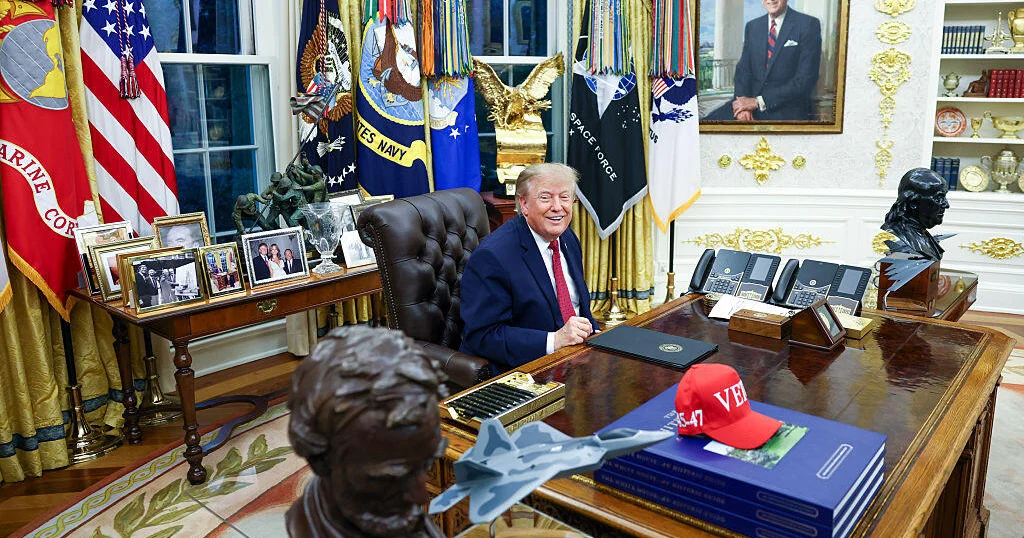

President Trump on Thursday signed a proclamation declaring the Oval Office and Cabinet Room a national monument, making it his first formal move after Republicans suffered sweeping losses in Tuesday’s midterm elections.
However, the proclamation does not stop a future president from redecorating the iconic office, nor does it prevent a successor from rescinding the designation. Mr. Trump has previously rolled back national monument protections established by earlier presidents.
Still, Mr. Trump presented the measure as a broad safeguard for one of the White House’s most recognizable spaces.
“It will not be allowed to be touched by anybody, destroyed, ripped down by stupid people, in order to build something in a slightly different shape,” Mr. Trump said. “We like the Oval Office, and it’s a symbol, like the White House itself.”
Jim Lo Scalzo / EPA / Bloomberg via Getty Images 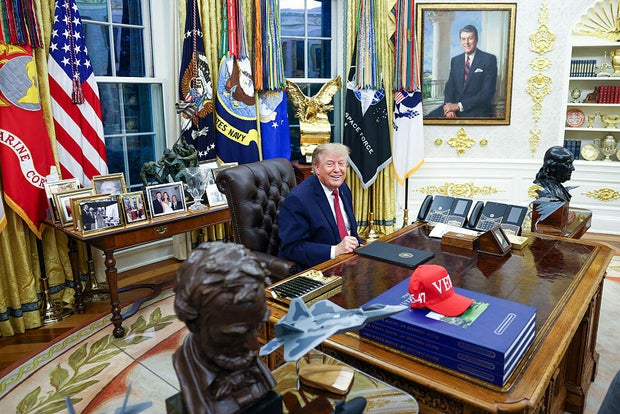
The announcement marked the third consecutive day this week that the real estate developer-turned-president has focused public attention on high-profile projects in Washington. On Wednesday, one day after Republicans lost several closely watched races nationwide, Mr. Trump invited reporters to witness the placement of the final beam on his lavish ballroom. On Monday, he visited the Lincoln Memorial Reflecting Pool to discuss renovations to the landmark.
Issued after Mr. Trump’s comments, the proclamation makes clear that it does not “restrict the President’s authority to redecorate the monument, select furnishings, or make ordinary operational and security modifications that do not substantially impair the monument’s historic structure or architectural character.”
The order directs the Interior secretary to oversee the Oval Office and calls for “documentation, review, and consideration of alternatives before any action that would substantially alter or demolish the monument.” Mr. Trump also said major alterations would require congressional review, although the proclamation itself does not include that requirement.
“If they want to say, ‘Let’s not have oval anymore, let’s make it square,’ what happens is they have to go back to Congress and hopefully the Congress, the people in Congress, will be smart enough not to let that happen,” Mr. Trump said. His comments came despite his decision to demolish the White House’s East Wing to make way for the ballroom.
A red baseball cap bearing the word “VETO” sat on the Resolute Desk as Mr. Trump signed the proclamation, an apparent reference to the changing balance of power in Congress.
MORE STORY: American Convicted of Murdering Girlfriend and Child in Rome
The move to protect the White House’s design comes as Democrats prepare to intensify scrutiny of the president. Connecticut Sen. Richard Blumenthal, the top Democrat on the Homeland Security Committee’s Permanent Subcommittee on Investigations, sent a series of letters Thursday to donors known to have contributed to Mr. Trump’s ballroom, ordering them to provide information or face “alternative measures to obtain compliance.”
Since returning to the White House, Mr. Trump has directed extensive design changes throughout its rooms. In the Oval Office, he has added portraits, a copy of the Declaration of Independence and an array of gold decorative details.
Discussing his interior design choices, Mr. Trump pointed to new chandeliers in the Cabinet Room, saying they were installed to correct “very bad lighting.” The Oval Office has also received gold wall appliqués and portraits in ornate gold frames.
Mr. Trump did not specify what future threat he believed the Oval Office faced, but he suggested that later administrations could seek substantial changes. At the same time, he has been targeted by several lawsuits alleging that his Washington beautification projects proceeded without the required approvals.
“If anybody ever decides to come and start knocking down walls, you call me wherever I may be,” Mr. Trump said, “and I’ll come back here and I’ll make sure it never happens.”
Later Thursday, the National Capital Planning Commission granted final approval to Mr. Trump’s proposed 250-foot triumphal arch, planned for a site between the Lincoln Memorial and Arlington National Cemetery.
The NCPC, the federal agency responsible for planning in the Washington region, is dominated by Trump allies. It voted 8-4 to approve the project after nearly nine hours of public testimony from lawmakers, veterans, architects and residents of Washington, D.C., and Virginia.
A federal judge, however, is still considering whether to temporarily halt construction of the arch.
DON’T MISS: Parents of Baby Allegedly Killed by Nicole Virzi Rebuild Lives


