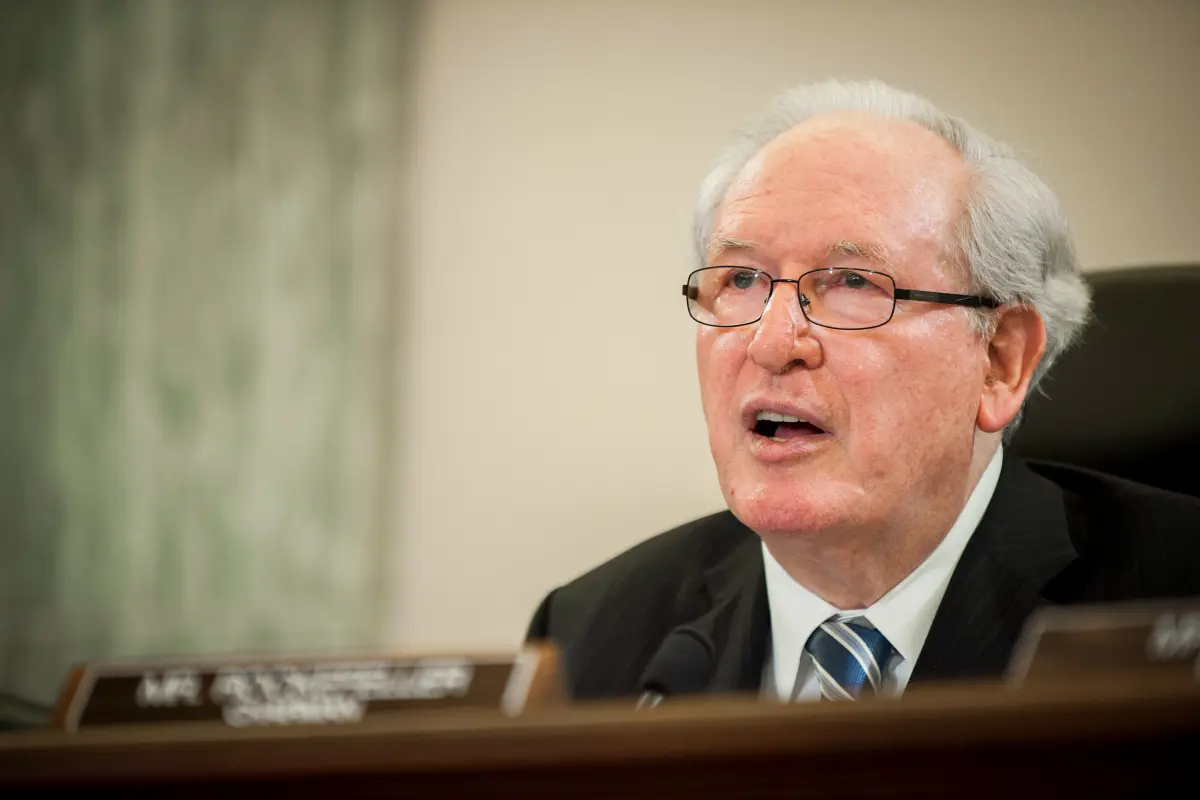

WASHINGTON — John D. “Jay” Rockefeller IV, an heir to one of America’s most prominent and affluent families who spent 30 years in the US Senate advocating for expanded healthcare access and condemning President George W. Bush’s handling of the Iraq War, died Friday at his Washington home, The Washington Post reported. He was 89.
His family did not disclose a cause of death, the newspaper said.
A tall, soft-spoken Democrat known for his liberal views, Rockefeller won election to the Senate in 1984. He went on to serve five six-year terms representing West Virginia, following two terms as governor of the economically struggling coal-mining state.
Rockefeller voted in 2002 to approve Republican President Bush’s resolution authorizing the Iraq War, which began with the US-led invasion in 2003.
He later said he regretted that decision. As chairman of the Senate Intelligence Committee, Rockefeller accused the Bush administration of leading the country into war on “false premises.”
He was the great-grandson of oil magnate John D. Rockefeller and a member of a political dynasty that also included his uncle Nelson Rockefeller, the former governor of New York.
Born in New York, Jay Rockefeller took a different path after graduating from Harvard and joining a national service program in impoverished rural West Virginia, where he worked from 1964 to 1966.
Throughout his public career, he focused on expanding healthcare, combating poverty, improving benefits for coal miners and supporting military veterans. In the Senate, he helped shape the 1997 program through which the federal government assists states in providing health coverage to millions of uninsured children.
Rockefeller supported Democratic President Bill Clinton’s unsuccessful effort to establish near-universal health insurance in the 1990s. He later backed Democratic President Barack Obama’s drive to enact a sweeping healthcare law, which was signed in 2010.
During the debate over Obama’s healthcare plan, Rockefeller unsuccessfully pushed for a government-run insurance option open to the broader public. He argued that it could serve as an alternative to private plans that were often expensive and difficult to access, alongside existing programs for low-income and elderly Americans.
“Championing those most in need has been my life’s calling, and I will never stop fighting to make a difference for the people who mean so much to me,” Rockefeller said in 2013, when he announced at age 75 that he would not pursue a sixth Senate term.
In the lead-up to the Iraq invasion, the Bush administration cited intelligence claiming that Iraq possessed weapons of mass destruction — weapons that were never found — and alleged that Iraqi leaders had ties to al Qaeda, the network responsible for the September 11, 2001, attacks on the United States.
“If I had known then what I know now, I would have voted against it,” Rockefeller told the Charleston Gazette in 2004, referring to the 2002 authorization for military action.
“I think the intelligence was shaped,” he said. “And I think the interpretation of the intelligence was shaped. You had a president who we now know was determined to go to war.”
‘Fundamentally misleading’
A 2008 report issued by the Senate Intelligence Committee, while Rockefeller was chairman, concluded that Bush, Vice President Dick Cheney and other senior officials had overstated intelligence and disregarded disagreements within the US intelligence community over Iraq’s weapons capabilities and alleged links to al Qaeda.
The report also rejected prewar claims by Bush and Cheney that Iraq could provide al Qaeda with weapons of mass destruction.
“Representing to the American people that the two had an operational partnership and posed a single, indistinguishable threat was fundamentally misleading and led the nation to war on false premises,” Rockefeller said when the report was released.
During his Senate career, he also chaired the Commerce, Science, and Transportation Committee and the Veterans Affairs Committee.
Rockefeller was born on June 18, 1937, just weeks after the death of his great-grandfather, who had been the richest man in America.
His family name carried enormous expectations. His father was a renowned philanthropist, while his uncle Nelson Rockefeller served as both New York governor and US vice president. Another uncle, David Rockefeller, led Chase Manhattan Bank, and Winthrop Rockefeller served as governor of Arkansas.
Rockefeller entered West Virginia politics in 1966, winning a seat in the state legislature before turning 30. Two years later, he was elected secretary of state.
After losing the 1972 governor’s race, he became a college president and returned to electoral politics in 1976, when he won the governorship. One of the wealthiest members of Congress, Rockefeller spent millions of dollars of his own fortune on his successful 1984 Senate campaign.
At times, Rockefeller was overshadowed in West Virginia by the state’s other senator, Robert Byrd, who died in 2010 at 92 as the longest-serving member of Congress in US history.
He generally supported West Virginia’s coal and steel sectors but drew the ire of coal executives in 2012 when he opposed Republican efforts to block regulations on emissions from coal-fired power plants.
Rockefeller was married to Sharon Percy Rockefeller, a public television executive. They had four children.