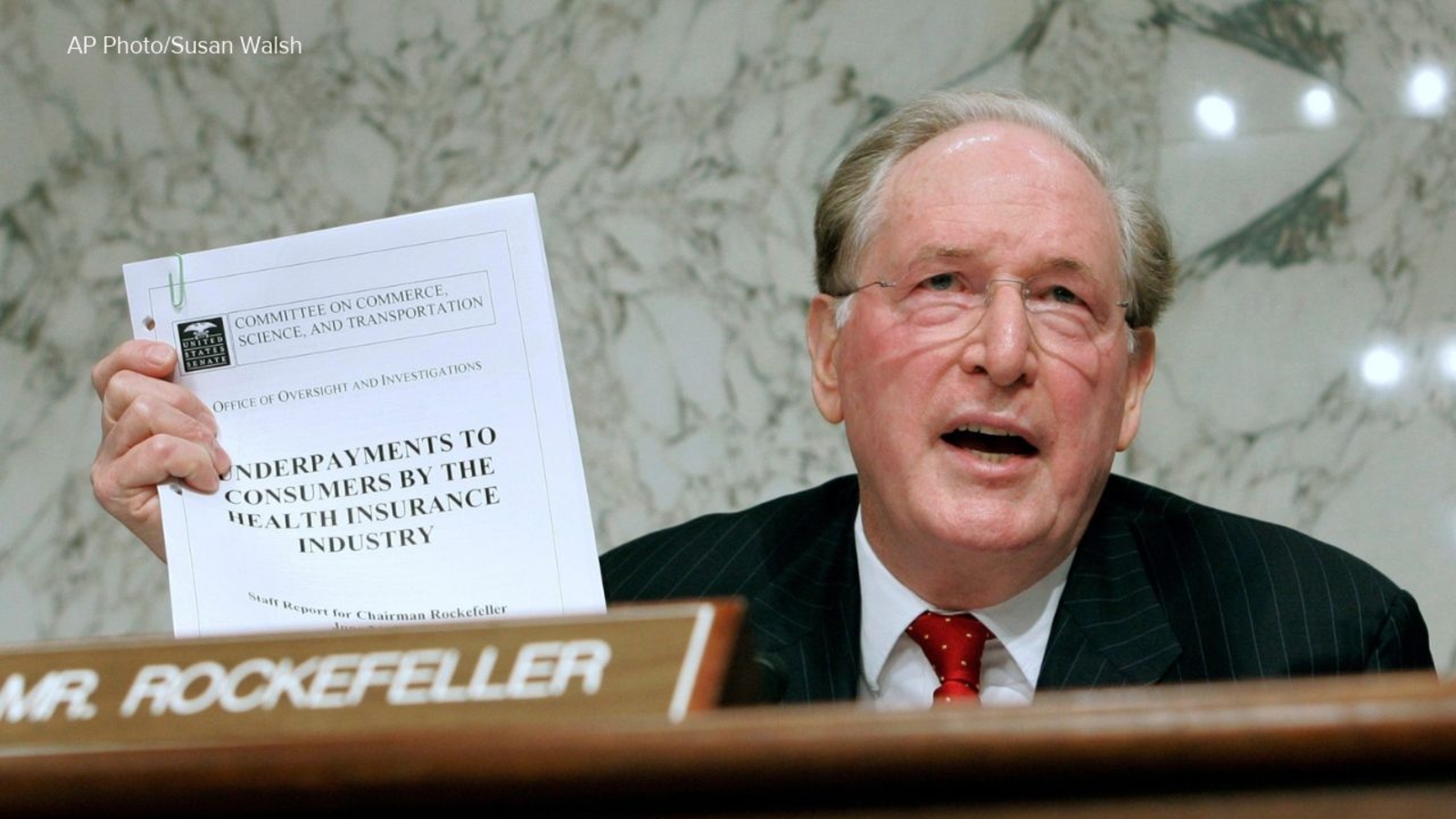

CHARLESTON, W.Va. — Jay Rockefeller, the final political heir to his family’s dynasty and the only Democrat among them to serve as West Virginia governor and a longtime U.S. senator, has died at 89.
Rockefeller died Thursday night at his Washington home, according to Mary Stewart, vice president for external affairs at WETA, the public broadcasting station led by Rockefeller’s wife, Sharon.
Born into one of America’s wealthiest families, Rockefeller devoted five decades to public service in one of the country’s poorest states. He arrived in West Virginia in 1964 as a participant in an anti-poverty program, won election as governor 12 years later and ultimately represented the state in the U.S. Senate for 30 years.
“I could not imagine a more rewarding career,” Rockefeller said when he retired in 2015.
He was born John D. Rockefeller IV in New York City. His great-grandfather, Standard Oil founder John D. Rockefeller, died one month before his birth. His father, John D. Rockefeller III, was a prominent philanthropist. His uncles included Winthrop Rockefeller, the Republican governor of Arkansas, and Nelson Rockefeller, the Republican governor of New York. Another uncle, David Rockefeller, led Chase Manhattan Bank.
A detour from his family’s path
Jay Rockefeller charted a course far removed from his family’s political tradition.
At 27, several years after college, he moved to the mining community of Emmons, West Virginia, to work with Volunteers in Service to America. Rockefeller later described the experience as a defining transformation.
“It explains every policy I pursued and every vote I have cast. It was where my beliefs were bolted down, and where my passions met my principles,” he said during an emotional farewell speech on the Senate floor on Dec. 4, 2014.
Although he initially expected to remain in West Virginia only briefly, Rockefeller broke with his family’s Republican roots and won a seat in the state House of Delegates as a Democrat in 1966. His resources, combined with a relentless work ethic in a traditionally Democratic state, helped him overcome doubts about his motives. He advanced from state legislator to secretary of state and then governor.
A major turning point followed his only electoral defeat, a 1972 governor’s race against Republican Arch A. Moore Jr. Moore’s daughter, Republican Shelley Moore Capito, later won Rockefeller’s Senate seat in 2014. On Friday, Capito remembered Rockefeller as “a true gentleman” who treated her with respect, kindness and encouragement.
“Over the years, we developed a wonderful friendship that transcended politics, and I will always be grateful for that,” she said in a statement.
Rockefeller stayed in West Virginia after the loss, a choice he later called the most important decision of his career. In 1973, he became the first president of West Virginia Wesleyan College without a theological degree. His popularity at the school, along with a shift toward supporting strip mining, helped propel him to a landslide victory over Republican Cecil Underwood in the 1976 governor’s race.
As governor, Rockefeller focused on practical improvements to West Virginia’s roads, sewer systems and bridges. Those projects, he said, were “not very sexy things, I grant you but very, very necessary in West Virginia.”
ALSO READ: Prison Psychologist Jailed for Sex With Life-Sentence Inmate Caught on Camera
Top Stories

Current Gov. Patrick Morrissey said Rockefeller helped define West Virginia and made a lasting difference in the lives of its residents.
“From his early work in some of our state’s most disadvantaged communities to his efforts to strengthen healthcare, protect coal miners and their families, and support our veterans, Senator Rockefeller demonstrated a deep commitment to the people of West Virginia,” Morrissey said in a statement.
Onward to Washington
Rockefeller defeated Arch Moore in a 1980 rematch, then entered the U.S. Senate in 1984 after longtime Democratic Sen. Jennings Randolph retired. His victory came despite Republican President Ronald Reagan’s overwhelming win that year.
Rockefeller and his wife, Sharon, the daughter of former Republican Illinois Sen. Charles Percy, moved comfortably through Washington’s social circles and purchased a multimillion-dollar family estate. He was open about using his inherited $150 million fortune to finance his campaigns, spending millions of dollars of his own money. He won each of his five Senate terms by comfortable margins.
His wealth remained a constant topic in West Virginia politics. Rockefeller spent at least $21 million of his personal fortune on campaigns, including $9 million for his close 1984 Senate victory over Republican newcomer and fellow multimillionaire John Raese. During his 1980 gubernatorial race against Arch Moore Jr., supporters circulated bumper stickers reading: “Make Him Spend It All, Arch.”
For 25 years, Rockefeller served as West Virginia’s junior senator, building influence in the formidable shadow of Sen. Robert C. Byrd. Byrd, who died in 2010 as the longest-serving senator in U.S. history, was celebrated for directing billions of dollars to his economically struggling state.
Rockefeller’s impact was quieter but substantial. As chairman of the Senate Commerce, Science and Transportation Committee, he advocated for consumer protections, expanded broadband access and sponsored legislation aimed at preventing companies from tracking customers’ online activity. In 1997, he wrote the law that created the Children’s Health Insurance Program, which helps low-income families whose earnings exceed Medicaid eligibility limits.
He also chaired the Veterans’ Affairs and Intelligence committees, often clashing with President George W. Bush over foreign policy. Rockefeller later said he regretted voting in 2002 to authorize the Iraq war.
At the same time, he broke with Democratic President Barack Obama over mining regulations. West Virginia was the nation’s second-largest coal producer, and Rockefeller joined other state officials in opposing the Environmental Protection Agency’s oversight of mountaintop-removal mining during the Obama administration.
Rockefeller’s college studies in Tokyo later supported his efforts to attract Japanese investment to West Virginia. He had known Toyota’s founding family since the 1960s and helped persuade the automaker to build an engine-parts plant in a cornfield near Buffalo, West Virginia, in 1996. The $2 billion facility now employs roughly 2,200 people.
Associated Press writer Holly Ramer in Concord, New Hampshire, contributed to this report.
Copyright © 2026 by The Associated Press. All Rights Reserved.


