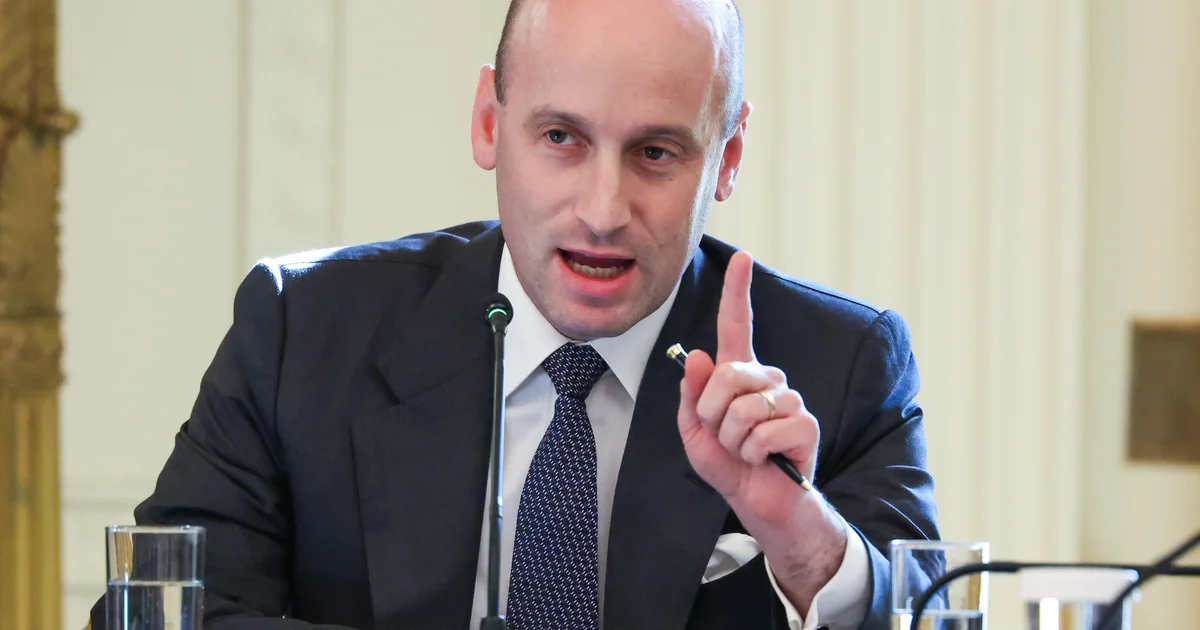

Washington — Stephen Miller, one of President Trump’s top advisers and the incoming White House chief of staff, has played a central role in shaping the administration’s most contentious immigration policies across both of Trump’s terms.
Mr. Trump announced the staffing change Friday, describing Miller as one of his “most trusted” advisers. Miller will succeed Susie Wiles, who has served as chief of staff throughout Trump’s second term.
The transition follows crippling losses in the midterm elections for Republicans and comes as Democrats prepare wide-ranging investigations into the administration, including its immigration enforcement agenda.
Miller helped design many of those policies and promoted the administration’s broader enforcement campaign. The effort has been backed by roughly $170 billion that congressional Republicans approved for immigration enforcement and border security in the One Big Beautiful Bill Act, which became law in July 2025.
During Trump’s first term, Miller helped develop and defend publicly an executive order restricting entry to the United States for nationals of several Muslim-majority countries. The travel ban prompted protests nationwide and faced multiple legal challenges. The Supreme Court upheld a third version of the policy in 2018.
He was also a leading supporter of the administration’s 2018 zero-tolerance policy, which led to the separation of thousands of migrant families. Miller also pushed for steep cuts to refugee admissions. The annual refugee cap was lowered repeatedly, reaching 15,000 for fiscal year 2021 — a record low at the time.
Miller further advocated penalizing legal immigrants who used public benefits and tightening the path to U.S. citizenship.
During Trump’s second term, Miller urged Immigration and Customs Enforcement to carry out at least 3,000 immigration arrests each day. In May 2025, he publicly called for a sharp increase in daily arrests, intensifying pressure on ICE officials and broadening enforcement beyond immigrants convicted of serious crimes.
He also proposed deploying the National Guard to assist with mass deportations.
Miller’s arrest quotas became part of a sweeping enforcement expansion spanning neighborhoods, workplaces and immigration courts. Detentions of immigrants with no criminal record rose sharply, while heightened ICE operations triggered protests around the country.
The longtime Trump adviser also backed the use of the Alien Enemies Act of 1798, a wartime law, to bypass ordinary due process and rapidly deport alleged Venezuelan gang members to El Salvador. The migrants were held at CECOT, a notorious maximum-security prison. The deportations prompted a legal fight, and the Supreme Court blocked the government from immediately removing the Venezuelans without first allowing them to challenge their deportation.
As the administration expanded its deportation campaign, Miller supported a more aggressive use of third-country deportations. Officials sent immigrants to countries where they had neither citizenship nor family connections, including several African nations.
In May 2025, Miller said the administration was considering suspending the constitutional process that permits detainees to challenge their confinement in court.
Speaking at a conference in Miami in March 2026, Miller argued that defeating drug cartels would require military force, rather than relying solely on conventional criminal law enforcement.
Miller joined Mr. Trump in the Oval Office this summer when the president signed executive orders seeking to deny citizenship to some children born in the United States. The action followed the Supreme Court’s decision to strike down Trump’s earlier executive order aimed at ending birthright citizenship.