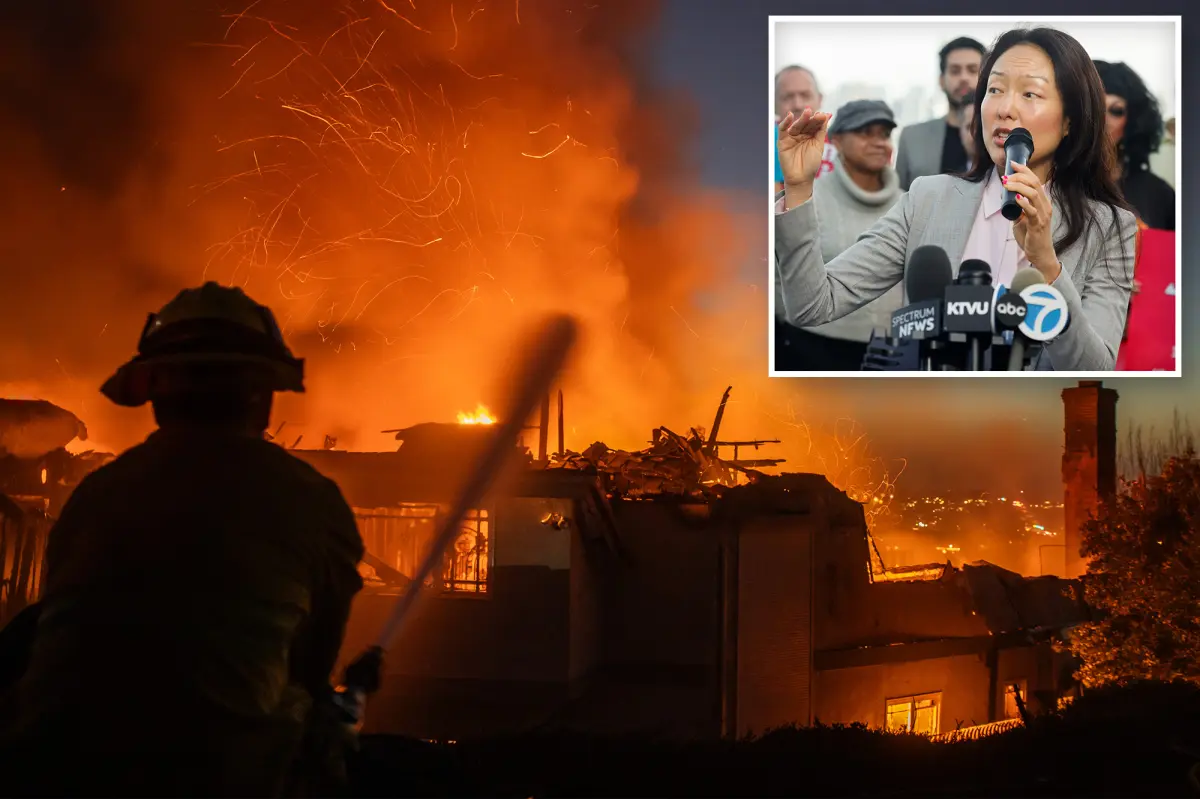

California’s incoming insurance commissioner is vowing to transform the state’s troubled insurance market, including by creating a first-of-its-kind public disaster insurance program designed to guarantee wildfire coverage for homeowners.
Jane Kim, the former San Francisco supervisor who defeated fellow Democrat Ben Allen in the insurance commissioner’s race, claimed victory Friday after running on a plan to reduce private insurers’ control over wildfire coverage and establish a state-operated, nonprofit alternative.
“We are here to say no more. We are going to make insurance work for us again,” Kim told supporters during her victory celebration.
“We are going to take on this $3-trillion industry because they have been profiting for way too long by raising our premiums, canceling our coverage and fighting our claims.”
Kim’s proposal, called “Natural Disaster Insurance for All,” would remove wildfire protection from standard homeowners policies and place it in a publicly managed, nonprofit fund.
Under the plan, every California homeowner with an existing property would be eligible for wildfire insurance. Premium revenue would be used to support coverage instead of paying executive salaries, shareholder returns or corporate marketing costs.
“The idea is that every current homeowner would be covered, and it would be a nonprofit fund where premiums don’t have to go to CEO pay, shareholders and Super Bowl ads,” Kim said.
The proposal arrives as California confronts one of the nation’s most severe homeowners insurance crises. Major carriers are pulling back from the state, leaving residents with higher costs and fewer affordable coverage options.
Seven of California’s largest property insurers have restricted or halted new homeowners policies, further narrowing the private market as intensifying wildfires and rising claims costs put pressure on the industry.
According to Stanford research, homeowners insurance premiums have climbed 84% since 2020. At the same time, enrollment in California’s FAIR Plan—the insurer of last resort for people unable to obtain coverage from traditional carriers—has nearly tripled.
IN CASE YOU MISSED IT: Twist in Case of Ex-NYPD Cop Accused of Killing Jogger Katie Suarez
The FAIR Plan now insures about 5% of California homes, compared with less than 2% previously. The increase suggests the insurance shortage has expanded beyond communities traditionally considered at high risk for wildfires and is now affecting the broader housing market.
Kim’s proposed public fund would create an additional layer of protection for wildfire coverage, reducing homeowners’ dependence on private insurers as the market continues to contract.
However, establishing the program would be a complex undertaking. State lawmakers and local community leaders would need to help create the system, determine its funding structure and decide how it would be managed.
“This office is not a dictatorship. We’re going to have to work with community leaders across the state to make our big ideas possible,” Kim said.
Even with those obstacles, the commissioner-elect said she believes her administration can make meaningful progress on insurance affordability and access during its first year.
“I really believe we’re going to have some wins in our first year because there is a lot of work that can be done to make insurance more affordable, more available and more fair,” she said.
Kim, 49, won roughly 53% of the vote, compared with Allen’s 47%, the Associated Press reported. Her lead has widened to about 400,000 votes as election officials continue counting ballots.
Allen called Kim Friday morning to concede and congratulate her before Kim formally announced the results to supporters at San Francisco’s Dolores Park.
Her victory places Kim in charge of one of California’s most challenged industries at a moment when homeowners are contending with steep premium increases, canceled policies and a shrinking number of companies willing to insure their properties.
The proposed nonprofit wildfire insurance system would mark a dramatic shift from California’s conventional insurance framework—and could become one of the defining tests of Kim’s incoming administration.


