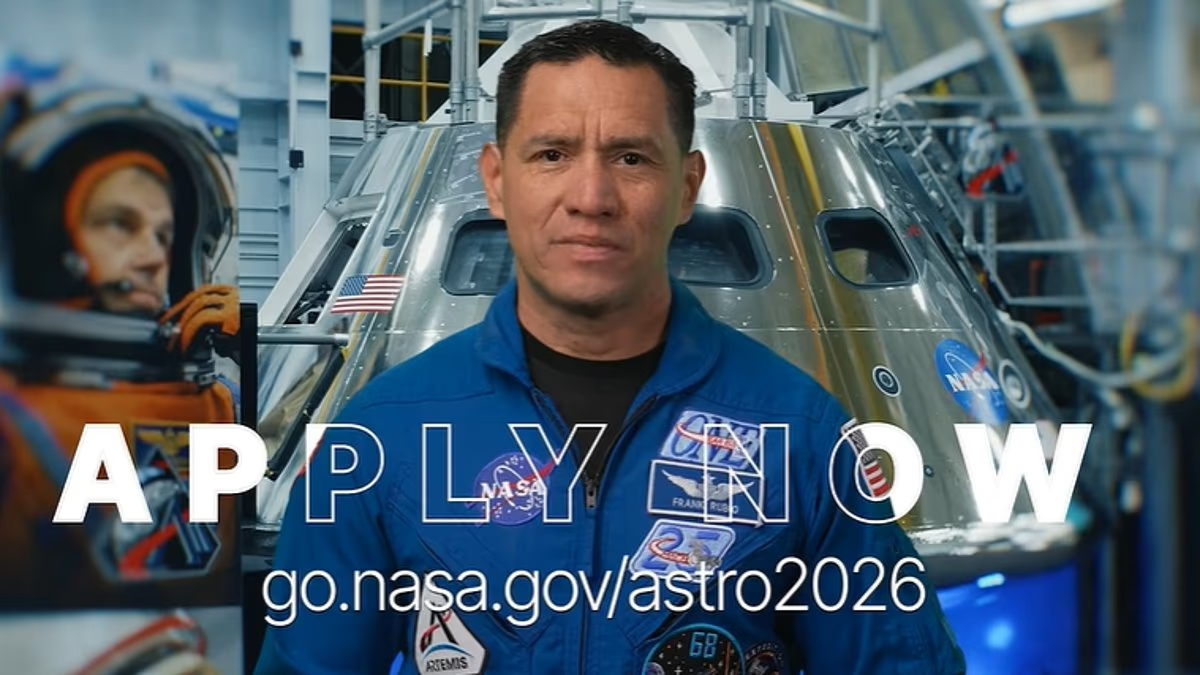

For countless children, becoming an astronaut is the ultimate childhood ambition.
For a select group, that dream could now move closer to reality: NASA is recruiting.
The US space agency is searching for new astronauts to help shape “the next chapter of human spaceflight.”
Those chosen could eventually live and work on the Moon, while earning an annual salary of $164,395 (£122,565).
“This is an extraordinary time to join NASA’s astronaut corps,” NASA Administrator Jared Isaacman said.
“The people we select could walk on the Moon, live and work at the Moon Base, and help pioneer the systems and operations that will ultimately carry crews to Mars.
“Those missions will demand technical excellence, sound judgment, teamwork, and courage.”

For countless children, becoming an astronaut is the ultimate childhood ambition. Now, NASA is recruiting a new class of astronauts who could help shape the future of human spaceflight
Applications are now being accepted through NASA’s website. Prospective candidates have until 23:59 EST on December 3 to apply.
The selection process is highly competitive, and applicants must satisfy NASA’s detailed eligibility requirements.
Applicants must be US citizens and hold a master’s degree in a STEM subject.
That academic requirement may also be fulfilled by completing at least two years of doctoral study; earning a Doctor of Medicine, Doctor of Osteopathic Medicine, Physician Assistant, Doctor of Nursing Practice, Family Nurse Practitioner, or related medical qualification; or completing—or currently attending—a nationally recognized Test Pilot School programme.
NASA said that candidates whose only advanced technical qualification is Test Pilot School must also hold a bachelor’s degree in a STEM discipline, such as engineering, biological science, physical science, or computer science.
Applicants must additionally have at least three years of relevant professional experience after earning their qualifying degree.
For pilots, qualifying experience may include 750 hours as pilot in command of a high-performance jet, 1,500 hours in total—including 750 as pilot—in other fixed-wing aircraft, or 1,000 hours in total—including 300 as pilot—in rotary-wing aircraft.
NASA also requires candidates to pass rigorous medical and security checks and meet demanding physical standards.

Applications are open through NASA’s website until 23:59 EST on December 3. Applicants must meet the agency’s rigorous academic, professional, medical, and physical requirements
Future astronauts must be prepared to work in hazardous, potentially life-threatening environments and spend extended periods living in confined quarters.
The role also involves strenuous physical tasks, including heavy lifting and crawling.
Candidates must consider the personal impact of spending long stretches away from friends and family during missions.
“Must be willing to deploy to space for 12 months or longer, accepting extreme isolation, austere living conditions, and separation from loved ones,” NASA said.
Applicants who meet the requirements and perform well in a face-to-face interview may be offered a place on NASA’s training programme, which lasts about two years.
Only after that process will NASA make its final astronaut selections.
“For those who apply, becoming a NASA astronaut is more than a career opportunity,” said Scott Tingle, NASA’s chief astronaut and chair of the Astronaut Selection Board at the Johnson Space Center in Houston.

Successful candidates could live and work on the Moon while earning $164,395 (£122,565) a year
“It is a chance to join a legacy of explorers who have expanded the boundaries of discovery and to contribute to missions that will help define humanity’s future in space.
“The next generation of astronaut candidates could make history while inspiring future scientists, engineers, and explorers.”
NASA has selected more than 370 people for astronaut-candidate training since the 1960s.
The agency’s most recent recruitment drive took place in 2024, when 10 astronauts were chosen from more than 8,000 applicants.
The latest announcement has already generated widespread excitement among aspiring astronauts on X.
Responding to NASA’s application post, one user wrote: “I have no professional qualifications for this. I just love space and want to go to space.”
Another joked: “Applied in my head at age 9, still waiting to hear back.”
A third user quipped: “I’m a 34-year-old Englishman with absolutely 0 experience needed to be an astronaut apart from I really like space. Have you got room for me?”


