
British forces have been deployed overseas to prevent hackers from carrying out potentially devastating cyber-attacks on the military.
A specialist military “hunt force” is working to identify and disrupt digital threats while they are still being prepared, before they can trigger widespread disruption.
Major General Mike Fayers, commander of the Defence Cyber and Electromagnetic Force, has disclosed the operation for the first time, confirming that British personnel are already deployed abroad.
He said the “highly sensitive” missions require approval from Defence Secretary Wes Streeting.
The disclosure comes after a series of cyber-attacks caused disruption across Europe. Last week, hackers targeted France’s national blood bank and attempted to raise the temperature of storage facilities, potentially putting essential supplies at risk.
Retailers and food businesses have also been targeted, with cybercriminals reportedly accessing freezer systems and pushing temperatures above 55C (131F), leading to the destruction of tons of food.
Several British businesses were among those affected, including a London fruit and vegetable wholesaler. Staff detected the breach and disconnected their refrigeration units from the internet, preventing further interference.
A senior British intelligence official subsequently warned that the recent wave of online attacks could be an early sign of more serious and damaging incidents to come.
“Whereas historically we have defended on our territory, we are now defending ourselves forward of our own networks,” Maj General Fayers said while describing the military’s new “hunt force”.

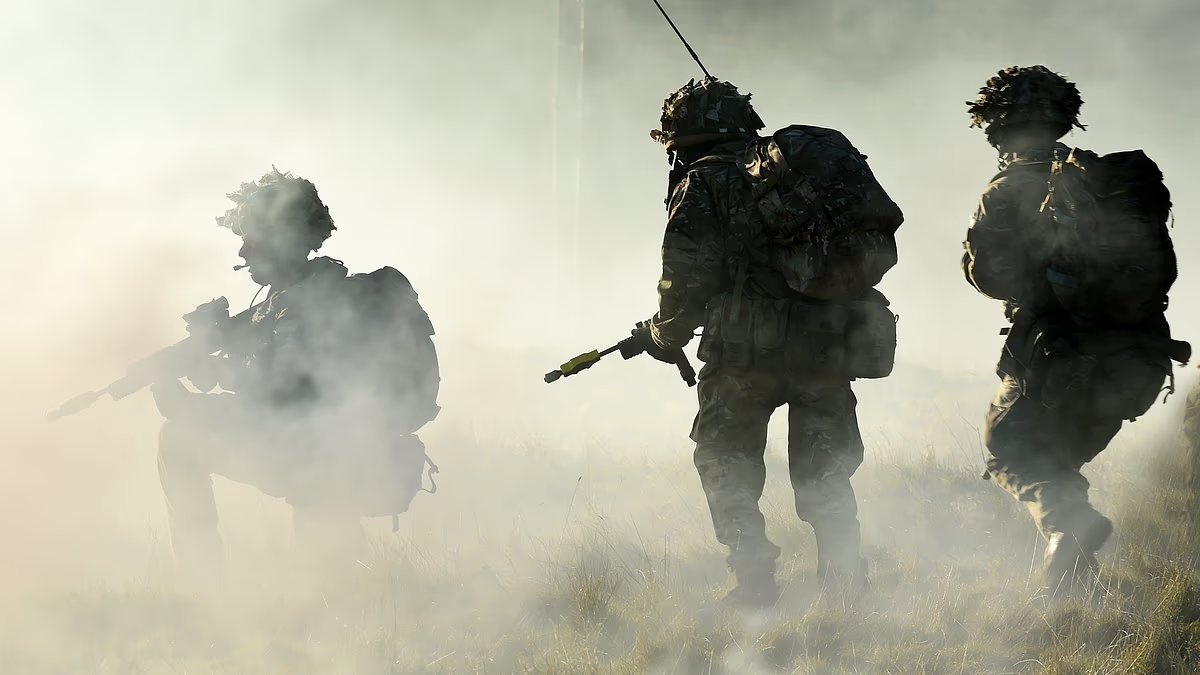
British troops have been deployed overseas to prevent hackers from carrying out potentially crippling cyber-attacks against the military (file image)

Military cyber specialists forming a “hunt force” are operating overseas to track and disrupt hostile hackers (file image)
“We are trying to hunt for our adversaries in places where they prepare before they target UK military systems.”
“I mean sending people physically to places to virtually hunt for the adversary to protect our systems.”
The Army commander told The Times that specialist personnel from the Army, Royal Navy and Royal Air Force were increasingly being sent across Europe to operate on the digital frontline.
KEEP READING: Texas AG Ken Paxton Turns on Trump as Blame Game Erupts
Such deployments are carried out only with the consent of the countries hosting British forces.
The cyber teams can travel by land, sea or air and are assigned to track hacking groups linked to governments or organised criminal networks.
Maj General Fayers did not identify the specific operations undertaken by the force. However, its work could include targeting Russian hackers who have compromised servers in a European country in an effort to create widespread disruption.
“Our adversaries are very cunning. This is not just an (Ministry of Defence) issue, this is a whole-of-UK challenge,” he told The Times.
“We’ve seen AI now exploiting vulnerabilities at a speed we have not seen before. Whereas historically we would have had a few days to fix vulnerabilities, we are now in double-digit minutes to respond to those vulnerabilities.”

Major General Mike Fayers, commander of the Defence Cyber and Electromagnetic Force, said British personnel were already deployed overseas.
The Ministry of Defence said in May last year that it had recorded 90,000 cyber-attacks from “state-linked sources” during the previous two years—twice the number reported in the two years before that.
Last month, Mr Streeting urged millions of people across Britain to keep essential items, including bottled water and canned food, in reserve in case of a major cyber-attack.
Dr Richard Horne, head of Britain’s National Cyber Security Centre, part of the GCHQ intelligence agency, said the attacks on freezer systems represented “just the foothills” of the threats that could face the UK.
“There are so many vulnerabilities out there that in some ways you could say are waiting to be exploited,” he said. “The most serious risk we face in the short term is just a huge rise in the volume of incidents.”
Asked whether the latest attacks supported the Defence Secretary’s advice for households to stockpile supplies, Dr Horne said: “Absolutely. And we saw criminal attacks last year impact retailers in the UK.
“We alert people. We intervene where we can. But, at the end of the day, it’s your business. It’s your charity. It’s your life. You need to make the choice and choose wisely.”
The warnings come as defence officials across Europe grow increasingly concerned that Russia could be running a wider sabotage campaign on the continent.
Mr Streeting said last month that Britain must be prepared for war “in 1,000 days”, as military planners focus on a potential conflict by 2030.


