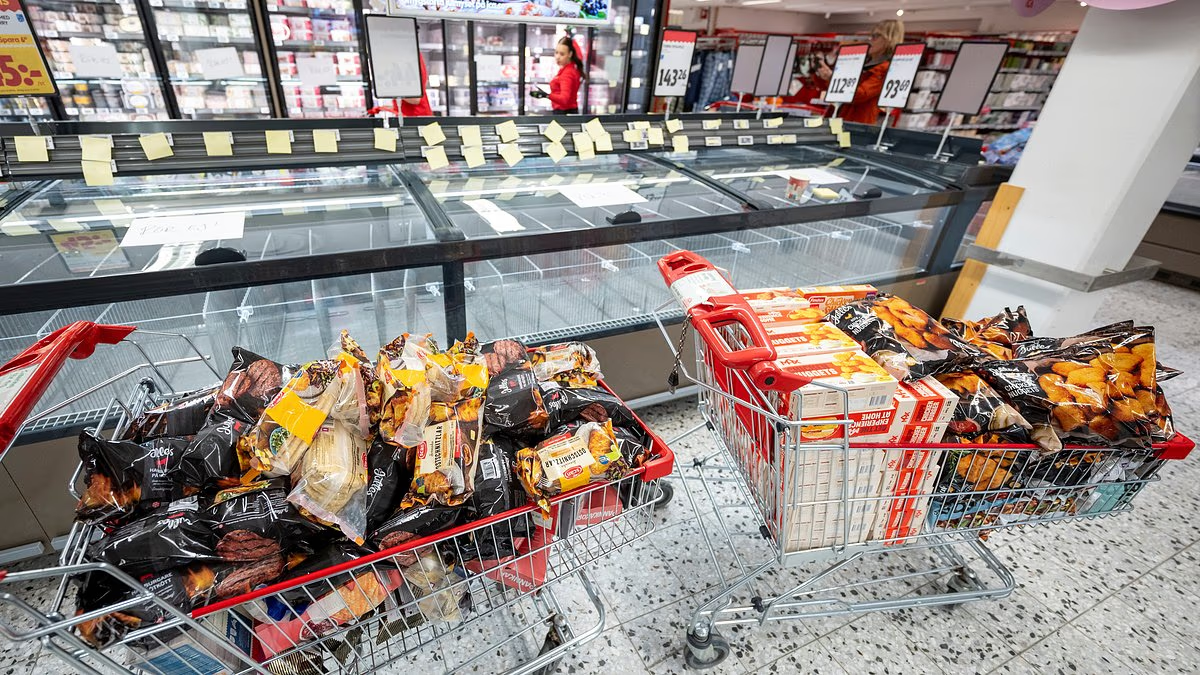

US grocery stores are confronting a serious high-tech threat that could destroy food supplies and drive prices sharply higher for holiday shoppers.
The FBI and other US agencies have issued an urgent warning to American businesses after hackers began targeting freezers, refrigerators and cold-storage systems at supermarkets and other facilities worldwide.
The attacks destroyed millions of dollars’ worth of frozen and refrigerated goods at supermarkets in France, Sweden, Belgium, Luxembourg and Estonia in October.
The cyber intrusions pushed freezer temperatures as high as 122 degrees Fahrenheit, ruining the products inside. US authorities now fear American stores could be targeted next.
The FBI’s Internet Crime Complaint Center (IC3) warned: “The actors may exploit vulnerabilities or weaknesses in unpatched or internet-accessible controllers to remotely alter settings and force units into continuous heating and defrost cycles.”
The Pentagon’s Cyber Command has also been investigating similar acts of sabotage reported in August at US military bases in Arizona, California, Mississippi, Rhode Island and Wyoming.
US stores have been urged to disconnect temperature-control systems from the public internet, update the software running their cooling equipment and restrict access to anyone who can adjust the settings.
On Monday, French officials said Iran was responsible for the cyberattacks, alleging that the country’s Revolutionary Guard had conducted sophisticated hacks for months as the war with the US continued.

Millions of dollars’ worth of food has been discarded after hackers tampered with freezer temperature controls at hundreds of European supermarkets

Stores in France, Sweden, Belgium, Luxembourg and Estonia have been affected, while French officials have accused Iran of carrying out the attacks
The FBI warning was issued in a joint statement on November 5 by the Cybersecurity and Infrastructure Security Agency, the Department of Health and Human Services, the US Department of Agriculture (USDA) and the Department of Transportation.
The agencies believe the suspected Iranian attacks could spread from Europe to the US, creating widespread disruption for businesses and consumers if American supermarkets are forced to close.
They cautioned that a successful nationwide assault on grocery stores could trigger a domino effect. Freezers and refrigerators might be damaged or disabled, leaving businesses facing millions of dollars in repair or replacement costs.
The FBI notice on November 5 also warned that tampering with temperature controls could start fires, destroy additional goods and put lives at risk.
Health officials also warned that customers could become ill after eating food stored at unsafe temperatures, potentially exposing them to bacterial infections or food poisoning.
The vulnerability, already exploited in Europe, stems from the fact that many commercial refrigeration and cold-monitoring systems rely on electronic temperature controllers connected to the internet.
These connections allow technicians to monitor equipment, sign in remotely and adjust settings without traveling to each supermarket in a chain.
But the same technology has left hundreds of stores exposed, as hackers exploit outdated software and weak malware protections to disable cooling systems.
This is a breaking story. More details to follow.

Cyber attackers breached hundreds of supermarkets across France and caused their freezers to defrost last month

Stores have been forced to discard millions of dollars’ worth of food after hackers raised freezer temperatures to 122 degrees Fahrenheit
The IC3 alert advised stores and other facilities that keep goods frozen or refrigerated to ensure their control panels are completely isolated from the public internet.
Facilities that still require remote monitoring were told to place a strong firewall in front of the systems and keep all related software fully updated.


