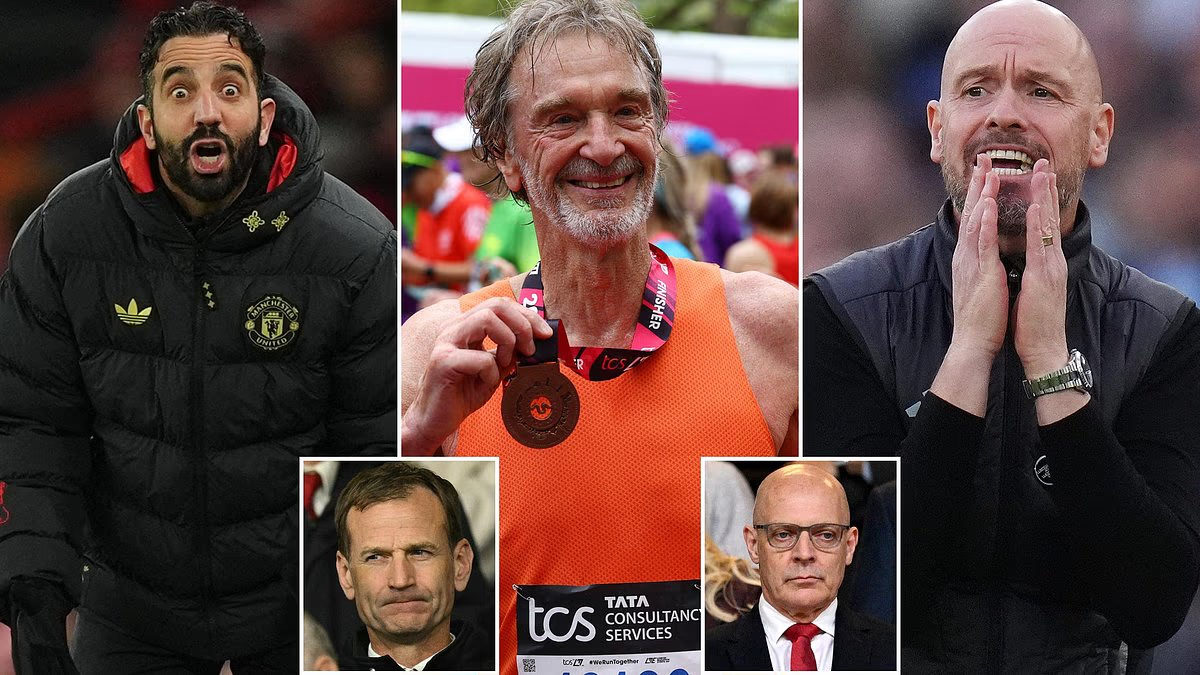

Michael Carrick appears destined to lose his Manchester United job this week after the club’s dismal start to the season. Yet removing the manager would do little to address the problems that have been allowed to take root at Old Trafford.
Carrick collected more Premier League points than any other manager between taking over from Ruben Amorim on an interim basis in January and the end of the previous campaign.
That run earned him the permanent position, but his tenure has rapidly fallen apart. United went into the November international break 18th in the Premier League, were eliminated from the Carabao Cup at the first opportunity and were performing only modestly in the Champions League.
Carrick’s likely dismissal represents the latest damaging chapter for Ineos, which assumed control of Manchester United’s football operations after Sir Jim Ratcliffe became a minority owner in February 2024.
Daily Mail Sport understands that chief executive Omar Berrada and football director Jason Wilcox continue to have Ratcliffe’s support, despite fans recently calling for both men to leave.
Berrada and Wilcox have repeatedly avoided accountability as the club has stumbled from one setback to another. Here are nine Ineos decisions that have helped drag United into an extraordinary relegation fight — and raised serious doubts over whether the leadership team can make the right call on the next manager.

Michael Carrick’s expected dismissal is the latest damaging episode for Ineos, which took charge of Manchester United’s football decisions after Sir Jim Ratcliffe became a minority owner in February 2024

Carrick appears set to pay the price for Manchester United’s miserable start to the season, although his departure would not solve the club’s deeper problems
1. The Ten Hag Debacle
Erik ten Hag appeared to be in danger almost as soon as Ineos arrived at Carrington.
During one of his earliest discussions with the new hierarchy, the Dutchman offered to help create a plan for rebuilding United’s struggling data department. His proposal was rejected.
‘I offered my knowledge and abilities to Ineos to help them to construct, but they were of the opinion that they already knew everything,’ Ten Hag told The Athletic recently. ‘They were convinced of, say, the philosophy, the strategy, the work methods. But they came from petrochemicals, from Formula 1, from cycling. Top football demands something totally different.’
Ineos were then caught off guard by the public support for Ten Hag after United defeated Manchester City in the FA Cup final. The indications had been that they were preparing to dismiss him, yet they continued exploring alternatives just days after the Wembley victory.
Thomas Tuchel, now England manager, met Ratcliffe in Monaco before withdrawing from consideration. Gareth Southgate, Mauricio Pochettino, Thomas Frank and Roberto De Zerbi were also assessed, while Ten Hag remained in limbo and United operated without either a sporting director or a permanent chief executive.
Eventually, an Ineos delegation travelled to Ibiza, interrupting Ten Hag’s holiday to tell him his contract would be extended by a year. Changes to his coaching staff and assurances over the summer transfer window were also promised.

Ineos were caught off guard by the support for Erik ten Hag after United defeated Manchester City in the FA Cup final, despite apparently preparing to sack him
‘They promised me loyalty, they promised me backing, they promised communication, that we get aligned,’ Ten Hag explained. ‘We spoke about the issues. But the promises, they didn’t keep.’
Ten Hag claimed Ineos later broke its word by selling Scott McTominay, who joined Napoli for £27.5million. Just 116 days after his contract was extended — and following another £200m transfer outlay — the manager was dismissed.
By the time Ten Hag and his coaching staff were paid a reported £10.4m compensation package, Ineos had squandered almost a quarter of a billion pounds through uncertainty and delay.
2. Ashworth embarrassment
Ratcliffe made Dan Ashworth a central target as he attempted to assemble an elite football structure. He described the former Newcastle executive as ‘clearly one of the top sporting directors in the world’ and ‘a very capable person’.
United ultimately paid Newcastle almost £3m to release Ashworth from gardening leave. Yet after only five months in the North West, he was gone.
Ratcliffe later blamed Ashworth for the decision to retain Ten Hag, while there was also a belief that Ashworth had reservations about appointing Ruben Amorim. His departure came as a shock after a 3-2 home defeat by Nottingham Forest, when he was escorted through the Old Trafford press area with his head lowered before being dismissed in a meeting.
Ashworth had been presented as proof that Ineos could deliver its promised ‘best in class’ operation. Instead, the club abandoned him within months.

Dan Ashworth (second right) was held up as evidence that Ineos could deliver its ‘best in class’ promise, only to leave the club less than six months later
3. Brailsford’s ‘marginal gains’
Sir Dave Brailsford, one of Ratcliffe’s closest allies, also became a symbol of the upheaval. Initially a major presence behind the scenes, he brought his ‘marginal gains’ philosophy to the club and oversaw work on the Carrington training ground.
Brailsford played a part in appointing Berrada and Ashworth and helped develop ‘Mission 21’, United’s ambition to win a 21st Premier League title, alongside ‘Mission 1’, the aim of securing a first Women’s Super League crown. Both formed part of ‘Project 150’, his plan to deliver trophies during the club’s 150th anniversary year in 2028.
After 16 months, Brailsford was removed from daily football operations. Earlier this year, he cut his final formal connection with United by stepping down from the board.
His period overseeing football coincided with widespread redundancies, growing fan anger towards the ownership, United’s worst Premier League finish of 15th and huge transfer fees spent on players whose market value quickly fell.
4. Ruthless redundancies
Ineos has consistently argued that large-scale redundancies were necessary for United’s long-term health. But the cuts devastated morale and, according to some staff who remain, have fundamentally changed the club for the worse.
In July 2024, employees were told that 250 positions would be removed. Company credit cards were cancelled and staff were asked to cover some expenses themselves. A further 150 to 200 jobs were targeted in February 2025, while austerity measures such as ending free lunches were introduced.
The cost-cutting has taken place while senior executives continue to receive substantial salaries despite what critics regard as unacceptable performance levels.
5. Promoting Wilcox
Jason Wilcox joined United as a technical director under Ashworth, but soon found himself elevated into one of the biggest executive positions in English football.

Omar Berrada (right) is a close ally of Jason Wilcox (left) and trusts him deeply, as does Ratcliffe, who believes Wilcox has the ‘best eyes’ at the club
Before arriving at Old Trafford, Wilcox had spent roughly nine months as sporting director at Championship club Southampton. His earlier experience came in youth development at Manchester City.
Berrada is a close friend and strong supporter of Wilcox, while Ratcliffe also has complete faith in him and considers him to possess the club’s ‘best eyes’. Wilcox helped drive the appointment of Amorim and later became embroiled in the disagreements that contributed to the Portuguese manager’s dismissal.
A highly hands-on figure, Wilcox is regularly seen around training sessions and has accompanied the squad on numerous trips.
‘When I listen to Jason speak, I get what he’s saying,’ Ratcliffe told The Times in March 2025. ‘He’s a warm character, he’s got a sense of humour, he knows what he’s talking about.’
Wilcox has been criticised for becoming too involved in football matters without delivering the coherent playing model Ineos promised would guide the club, regardless of its head coach. Lisandro Martinez publicly challenged him in a post-match interview this season, while Wilcox has largely remained out of sight as Carrick and the players have faced the consequences of United’s decline.
With recruitment proving inconsistent and United preparing to appoint a third permanent manager in under a year, Wilcox has made little visible difference to the first team since taking over Ashworth’s responsibilities.
6. The Amorim affair
Determined not to repeat their mishandling of the Ten Hag situation, Berrada and Wilcox persuaded Amorim to leave Sporting Lisbon in the middle of the season, despite his reluctance to do so, and bring his system to Old Trafford.
United’s decision-makers were warned that adapting a 3-4-2-1 formation to a squad accustomed to 4-2-3-1 would require considerable time. They proceeded regardless, paying £11m for Amorim and his staff.

United chiefs were warned that Ruben Amorim’s 3-4-2-1 system would take time to implement, but still paid £11m to bring him and his staff to Old Trafford

United invested a further £250m in the squad the following summer, but Amorim’s reputation suffered another blow after the League Cup defeat at Grimsby Town
The appointment itself was not necessarily misguided. Amorim was a talented young coach with a clear philosophy — something Ineos has failed to demonstrate in two and a half years — although he had previously been passed over by West Ham and Liverpool.
One well-placed source told Daily Mail Sport that Liverpool had prepared a dossier detailing why Amorim might struggle at Anfield, with the scale of the recruitment required to make his tactical vision work a major concern.
Amorim received only two January 2025 signings, Patrick Dorgu and Ayden Heaven. The following summer brought further disagreement over targets, with Senne Lammens joining even though Amorim wanted an experienced goalkeeper to replace the struggling Andre Onana.
Amorim led United to their lowest Premier League finish and lost the Europa League final in Bilbao to Ange Postecoglou’s Tottenham. Although another £250m was spent on the squad and the attack was rebuilt, his position weakened further after the League Cup shock at Grimsby Town.
The relationship between Amorim and Wilcox deteriorated sharply. They clashed before the trip to Leeds United, which became Amorim’s final match. In an angry outburst, the manager suggested that Wilcox and recruitment director Christopher Vivell were interfering excessively and needed to let him act as the club’s ‘manager’.
Amorim had been pressured to alter his formation and style of play. He was dismissed the morning after United drew at Leeds.
7. Fitness failures
Rather than building a practical plan to support Amorim’s methods, Ineos looked outside football and appointed renowned athletics coach Harry Marra as a consultant.
Marra was asked to examine players’ running mechanics, acceleration and deceleration. Mason Mount was among those assessed, with attempts made to alter the 36-cap England midfielder’s running style.

Ratcliffe even shared stretching advice he had picked up while running the London Marathon with members of the Carrington medical team
Alongside Ratcliffe offering Carrington’s physiotherapy staff stretching tips learned from his London Marathon training, the episode reinforced the impression that United’s owners did not fully appreciate the difference between elite football, athletics and cycling.
United’s performances deteriorated rather than improved.
8. Prioritising new stadium over a new left back
Speaking to reporters in Dublin shortly after receiving the United job on a permanent basis, Carrick used the word ‘push’ almost 12 times while discussing the club’s unfinished transfer business.
Ineos once again ignored those warnings, sticking to a plan of addressing one area of the squad each summer. The attack was the priority in 2025, midfield was scheduled for 2026 and the defence was left for the following year.
That strategy meant United knowingly gambled on Luke Shaw completing another season without serious injury while making no defensive additions. The consequences have arrived almost immediately.
Instead, the club spent £60m acquiring land as it advanced plans for a spectacular 100,000-seat ‘Wembley of the North’ stadium — a project many supporters doubt will ever be completed.

While United’s defence went without reinforcements, club chiefs spent £60m on land for their proposed 100,000-seat ‘Wembley of the North’

Carrick’s treatment throughout the saga has been cruel and demonstrates why prospective managers may think carefully before accepting a job under Ineos
9. Hanging Carrick out to dry
An emergency meeting following a 3-0 defeat by Bournemouth appeared to signal the end for Carrick. Yet Berrada, Wilcox, Ratcliffe and the Glazer family stunned the football world by taking no action, allowing daily business to continue without offering the under-pressure manager meaningful support.
United then lost at Chelsea before producing frantic comebacks from 2-0 down against Roma and Aston Villa. On Monday, it emerged that Berrada and Wilcox had agreed to recommend Carrick’s dismissal to the board. However, no immediate decision was made, and Carrick spent seven hours at Carrington on Tuesday conducting training and watching an Under-17 match.
We are told once again that Carrick’s future will finally be determined at a meeting in Monaco on Wednesday. Until he is officially informed, however, he is expected to continue working while waiting to discover whether he has been dismissed.
The treatment of Carrick throughout this episode has been deeply unfair. It also serves as a warning to any manager considering the Manchester United job: working under Ineos may carry risks few would be willing to accept.


