
A man accused of beating an elderly woman to death before setting fire to her body may have told his brother only that he had “dreamt” about carrying out the crime, a jury has heard.
Brian “Bert” Barnes, 67, is charged with murdering 76-year-old Merril Kelly in the early hours at Quambatook, a small farming town in Victoria.
Ms Kelly’s body was found after emergency services were called to a fire near a cemetery in Quambatook, north-west Victoria, shortly after 6.30am on January 21 last year.
Barnes has pleaded not guilty to murder. On Thursday, he appeared before the Supreme Court of Victoria in Bendigo, where jurors heard the defence case for the first time.
Barnes’s barrister, David Cronin SC, told the jury that his client’s brother, Graeme, may have “misheard” what prosecutors allege was a confession made in the hours after Ms Kelly’s death.
During the trial’s opening on Wednesday, Crown prosecutor Patrick Bourke SC alleged Barnes arrived at his brother’s home at about 4.30am and confessed to the killing in front of Graeme and his wife.
The brother later alleged that Barnes told him: “I have premeditatedly murdered someone.”
“He says to these two witnesses, she deserved it. That he made a foolproof plan, and that she had to go,” Mr Bourke told the jury.

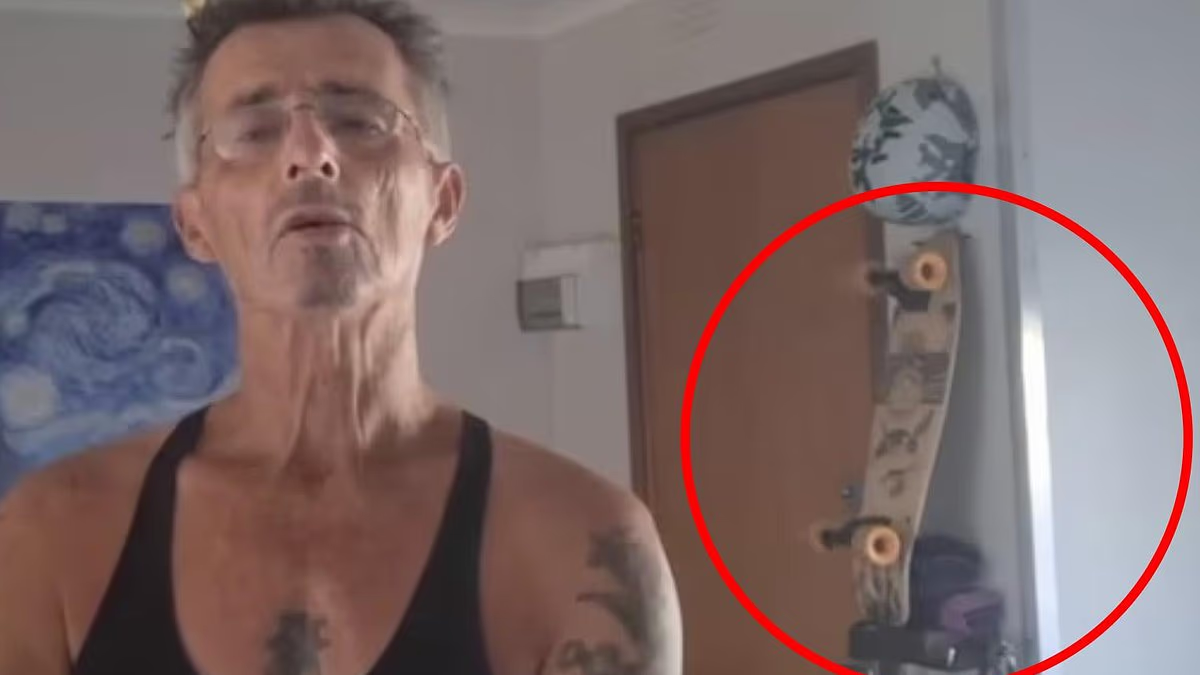
The defence suggested injuries found on Brian Barnes after the alleged murder may have resulted from a skateboard accident
The court heard Barnes allegedly said he had used zip ties to restrain Ms Kelly and later complained that she had “scratched him up” while trying to defend herself.
In a short opening address, Mr Cronin urged jurors not to reach a conclusion prematurely.
“The defence position is that he denies that he said that, denies that he said those words to his brother,” he said.
“So you’ll need to consider whether or not he said those words to his brother … or whether it was something less than that, whether, for example, it was something along the lines of ‘I dreamt that’.
“The two may be similar, but have two very different meanings.”
Mr Cronin suggested Graeme Barnes may have an undisclosed hearing impairment.
“While you’re thinking about those issues that I’ve raised in relation to Mr Barnes, I suppose consider what his hearing is like, what the circumstances are like where he was told these things or allegedly told these things, and could there have been a misunderstanding or could he have misheard what Mr Barnes said in relation to those matters?” he said.
Mr Cronin said prosecutors had to prove beyond reasonable doubt that Barnes was the person who inflicted Ms Kelly’s fatal injuries.
Although there may be evidence that Barnes went to the house, jurors were asked to consider whether “it was reasonably possible that it was someone else”.
MORE ON THIS: Mother and Daughter Killed by Grizzly Bear and Three Cubs

Merril Kelly, centre, was a much-loved member of the Quambatook community
Jurors were told they would hear evidence that Barnes had suffered injuries around the time of the alleged attack.
The Crown alleged on Wednesday that Ms Kelly fought for her life and scratched Barnes as he struck her repeatedly on the head.
Mr Cronin questioned whether the marks had been caused by Ms Kelly or instead resulted from Barnes “falling off his skateboard”.
The defence also argued that prosecutors must establish that Barnes’s actions were conscious, voluntary and deliberate.
Jurors were asked to consider whether Barnes had been in “an altered state” at the time.
“What would be the purpose of bringing and using zip ties to restrain someone after an intentional fatal assault?” Mr Cronin asked.
“If your intention was to go around and fatally assault someone, why would you bring zip ties or methods of restraining them afterwards?
“Why restrain someone that you have just fatally injured?”

Ms Kelly’s body was found after emergency services were called to a fire near the Quambatook cemetery shortly after 6.30am on January 21 last year

Burnt remains believed to be Ms Kelly’s were found near the Quambatook cemetery, pictured
Mr Cronin also questioned why his client would have parked a distinctive ute, fitted with a toolbox and personalised number plates, directly in the victim’s driveway instead of leaving it further down the road.
Mr Bourke told jurors DNA evidence would connect Barnes to a zip tie found on Ms Kelly’s wrist and to a toenail recovered from the driveway. He also alleged that Ms Kelly’s DNA was found in blood inside Barnes’s ute, on his washing machine and on his glasses.
An autopsy determined that Ms Kelly died from head injuries, including extensive trauma to the right side and rear of her head.
The findings indicated that Ms Kelly was not breathing when her body was set alight.
A black cable tie was also found around her neck.
Prosecutors allege Barnes killed Ms Kelly following a minor dispute over repairs to the community swimming pool.
The trial is continuing.


