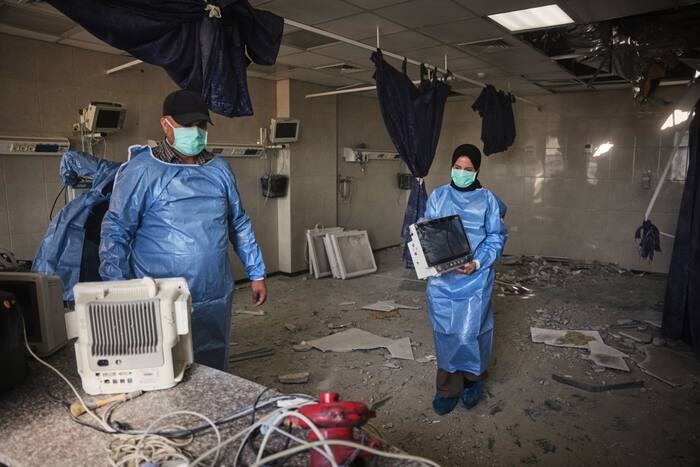


BEIRUT – A deadly Israeli airstrike on Nasser Hospital, the largest medical facility in southern Gaza, has once again exposed the severe damage inflicted on the territory’s healthcare system during three years of war.
The strike hit the hospital’s surgical wing, killing six people, among them a surgeon and a 13-year-old boy. Operating rooms and patient wards were heavily damaged. Israel’s military said it had targeted a Hamas commander who was using the hospital as a base, but offered no evidence to support the allegation.
Israel has continued to carry out near-daily strikes in Gaza despite a ceasefire agreement with Hamas that began in October 2025. Israeli officials say the attacks are directed at militants. The campaign began after Hamas launched its deadly assault on southern Israel in October 2023.
Although direct attacks on hospitals have become less frequent since the truce, Thursday’s strike demonstrated how difficult it remains for Gaza’s medical system to recover.
Here is an overview of Israel’s attacks on Gaza’s hospitals, its allegations against Hamas and the continuing crisis facing the territory’s healthcare system.
Israel has repeatedly targeted Gaza hospitals during the war
Throughout the conflict, Israeli forces have besieged hospitals across Gaza, in some cases surrounding facilities for weeks while shelling and gunfire left patients and medical workers trapped inside and supplies depleted. Some operations ended with troops entering the hospitals, destroying medical equipment or ordering staff and patients to evacuate. Hundreds of healthcare workers were detained.
Two major Israeli raids reduced Gaza City’s Shifa Hospital, the territory’s largest medical facility, to ruins.
Beyond the sieges, hospitals and other healthcare sites have frequently been hit by Israeli fire or airstrikes that the military says were aimed at Hamas fighters. During some of the war’s most intense periods, only 14 of Gaza’s 36 prewar hospitals were operating. Medicine shortages left patients in severe pain without adequate relief, while deadly infections spread through overcrowded facilities.
The World Health Organization says it has recorded more than 1,050 attacks on health facilities in Gaza, resulting in over 1,000 deaths. The United Nations says more than 1,700 medical workers were killed during the war, including personnel who died in attacks away from healthcare facilities. Rights groups documenting alleged abuses in detention say at least six Gaza medical workers, including three prominent doctors, have died in Israeli prisons.
Nasser Hospital has also been struck repeatedly. In 2025, Israeli forces killed 22 people after shelling a rooftop vantage point used by journalists, followed by another strike on rescue workers and reporters who rushed to aid the wounded. Five journalists were among the dead, including Mariam Dagga, who was working with The Associated Press.
Strikes have declined during the ceasefire, but the United Nations says several attacks in recent months have nonetheless damaged medical facilities.
Israel accuses Hamas of using hospitals for military operations
Israel has defended its attacks by alleging that Hamas uses hospitals as command centers and bases. However, the military has released limited evidence, while Palestinian officials and hospital administrators reject the accusations.
Hamas security personnel have at times been seen inside hospitals, where they controlled access to specific areas.
Doctors Without Borders, the international medical aid organization, suspended most of its work at Nasser Hospital in January, citing the presence of masked armed men and incidents in which patients were arrested or intimidated. The group resumed operations several months later after reporting “concrete improvements” following discussions with Gaza authorities, including limits on the entry of armed personnel.
Regarding Thursday’s attack on Nasser Hospital, the Israeli military said its target was Muhammad Abu Ismail, whom it identified as the head of Hamas’ Khan Younis Brigade. Israel said he had been using the hospital as a headquarters to plan attacks.
The military did not explain why the surgical unit was struck. The blast tore through a patient recovery area and destroyed operating rooms as well as a rest space used by doctors.
Israel did not say whether Abu Ismail was killed. His name did not appear on the hospital’s list of fatalities.
International law protects hospitals during war
International humanitarian law protects hospitals, and deliberately attacking them can constitute a war crime.
A medical facility may lose that protection if it is used for military purposes or “to commit acts harmful to the enemy.” Even then, the Geneva Conventions, adopted in 1949, require an effective warning and a reasonable period before an attack. Any strike must also be proportionate to the military threat and planned to minimize civilian casualties.
The Israeli military said it had held “warning conversations” with Gaza health officials before Thursday’s strike, raising concerns about alleged militant activity inside hospitals. It said officials were told that “if the activity was not halted, it would act to remove the threats posed by it.”
Medical organizations and rights groups have separately condemned Israel’s restrictions on medical aid and equipment entering Gaza, saying they violate international law. Israel says it permits humanitarian assistance to enter but blocks certain “dual use” items that it believes could be diverted for military purposes.
Gaza’s healthcare system remains on the brink of collapse
Israeli attacks and restrictions on aid have left Gaza’s healthcare infrastructure devastated. Twenty of the territory’s 36 prewar hospitals are currently functioning, but none is operating at full capacity.
For much of the war, several hospitals provided little more than emergency first aid while treating large numbers of wounded patients. Fuel shortages repeatedly threatened electricity, lighting and essential medical equipment.
The ceasefire has given aid agencies and Gaza’s Health Ministry some room to restore services. Yet the sector continues to face Israeli restrictions and lengthy approval processes for medicines, supplies and equipment. In a Sept. 30 report, the World Health Organization said 47% of essential medicines were unavailable, while shortages of laboratory supplies, medical equipment, spare parts and fuel continued to hinder healthcare operations.
Hospitals and clinics are also serving a population in which nearly everyone has been displaced, with more than 1.6 million people living in tents or other makeshift shelters. Infectious and communicable diseases are widespread, and thousands of people are coping with life-altering injuries sustained during the war.


