
— A senior Emirati official says demonstrations in Europe have moved beyond political expression and become a national security concern, warning that extremism must be addressed before it escalates into violence.
“People can demonstrate, speak and give speeches, but what [we] witnessed in the streets of 11 European cities was not freedom of speech. It was a threat to national security,” Dr. Ali Rashid Al Nuaimi, chairman of the Defense, Interior and Foreign Affairs Committee of the UAE’s Federal National Council, told News Outlet in an exclusive interview.
His comments come as European governments confront renewed concerns over radicalization. On Nov. 3, Europol said authorities in 16 countries had referred more than 9,000 links to extremist and terrorist content found on 47 social media and gaming platforms. The operation focused on online role-playing material that promoted jihadist, far-right, far-left and anarchist violence, including content capable of attracting minors to extremist networks.

A car burns as demonstrators look on during a nationwide day of strikes and protests over wages, the cost of living and public services, called by French labor unions and joined by high school and university students calling for better education conditions, in Lyon, France, on Nov. 5, 2026. (Reuters)
Officials and experts say the UAE’s approach differs because it treats the fight against extremism as something that begins well before a police investigation — in schools, families and the daily interaction of people from different backgrounds.
“The root is extremism, not violent extremism. … In our school system, we promote coexistence. We promote the values that bring us together, regardless of our religion, our nationality, our ethnic [background] or our color. … We have to learn how to live with our differences and accept everyone as they are,” Al Nuaimi said.
Preventing extremism before violence
At Hedayah, the Abu Dhabi-based International Center of Excellence for Countering Extremism and Violent Extremism, News Outlet interviewed Maqsoud Kruse, chairman of the center’s International Steering Board and the UAE foreign minister’s envoy for countering extremism and terrorism.
Kruse, an organizational psychologist who helped create Hedayah in 2012, described radicalization as a progression that may start with ideas, intensify through emotional reactions and, in some cases, end in violent conduct. Recognizing those stages, he said, gives institutions a chance to intervene before violence takes place.
“When we talk about countering extremism and terrorism, we understand and realize that no one country, no one institution and no one individual can deal with this alone,” Kruse told News Outlet. “We need international collaboration, networking and bridge-building, with everyone contributing to the solution.”

Maqsoud Kruse, chairman of Hedayah’s International Steering Board and the UAE foreign minister’s envoy for countering extremism and terrorism, speaks with News Outlet in Abu Dhabi about preventing radicalization through education, psychology and international cooperation. (Efrat Lachter/News Outlet)
Inside the UAE, he said, the strategy combines psychology, sociology, education and economics instead of viewing extremism only through a security lens.
“That integrated approach means we need to shift from focusing on the problem to focusing on solutions, creating patterns of hope,” he said.
That distinction lies at the heart of the UAE’s tolerance strategy. Rather than waiting for extremist beliefs to become violent, Kruse said societies should invest in education, community involvement and other preventive efforts aimed at the conditions that can fuel radicalization.
He also disputed the idea that poverty by itself causes extremism. Wealthy and highly educated people can adopt extremist ideologies, while millions facing economic hardship never do. Kruse cited former extremists who left radical movements, saying their experiences show that rehabilitation and reintegration are possible.
The institution he leads works with governments, researchers and civil society organizations on prevention programs. Kruse does not suggest that education should replace counterterrorism operations; rather, he argues that security measures alone cannot address the ideas and personal vulnerabilities exploited by recruiters. A comprehensive response is necessary.

U.S. President Donald Trump shakes hands with Yousif Al Obaidli, director of Sheikh Zayed Grand Mosque, as he tours the mosque grounds in Abu Dhabi, United Arab Emirates, May 15, 2025. (Brian Snyder/ Reuters)
Messages of coexistence at the Grand Mosque
That philosophy is also reflected at the Sheikh Zayed Grand Mosque in Abu Dhabi.
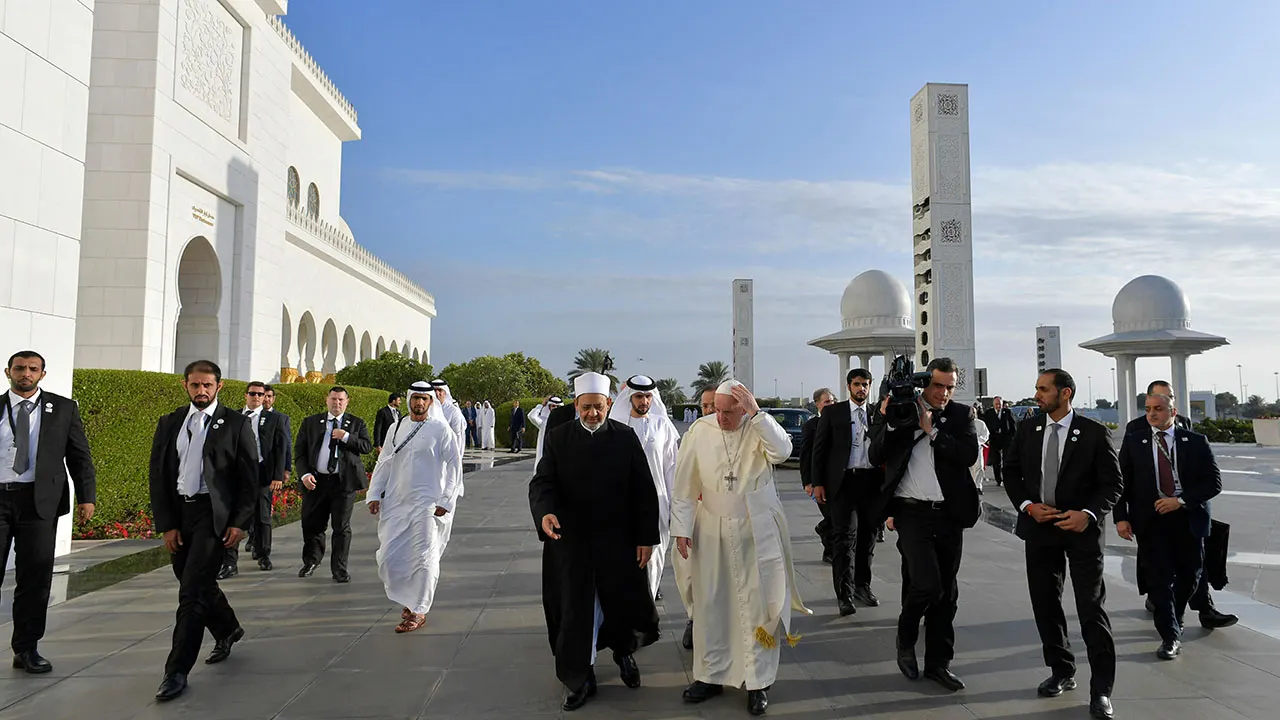
During a visit to the expansive white-marble complex, News Outlet saw displays along the route to the prayer halls highlighting tolerance, mutual respect and the legacy of the UAE’s founding president, Sheikh Zayed bin Sultan Al Nahyan. The message is reinforced by the architecture itself: bright courtyards, floral designs and long colonnades lead visitors toward one of the nation’s most recognizable religious landmarks.
The mosque features 82 domes and architectural influences from across the Islamic world. It serves both as a place of worship and as a destination for visitors seeking to understand the UAE’s religious and cultural traditions.

A sign marking the Multifaith Gallery at the Crossroads of Civilizations Museum in Dubai, United Arab Emirates, where exhibits explore the shared history and heritage of different religious communities. (Efrat Lachter/News Outlet)
The vision represented by those displays predates the UAE’s opening of relations with Israel. Sheikh Zayed helped form the federation in 1971, and the country’s leadership has long described tolerance as a core element of national identity. The Sheikh Zayed Grand Mosque Centre identifies religious accommodation and openness to people from different cultures as part of his legacy.
That policy became more structured over time. The UAE enacted legislation against discrimination and religious hatred in 2015. A year later, it appointed a minister of state for tolerance and introduced a national tolerance program. In 2023, the government updated its legal framework to address discrimination, hatred and extremism.
READ MORE: Chicago Bears Stadium Plan at Former U.S. Steel Site Draws Attention
The UAE government says more than 200 nationalities live in the country, making its diversity an everyday test of how different cultures and faiths share public spaces.
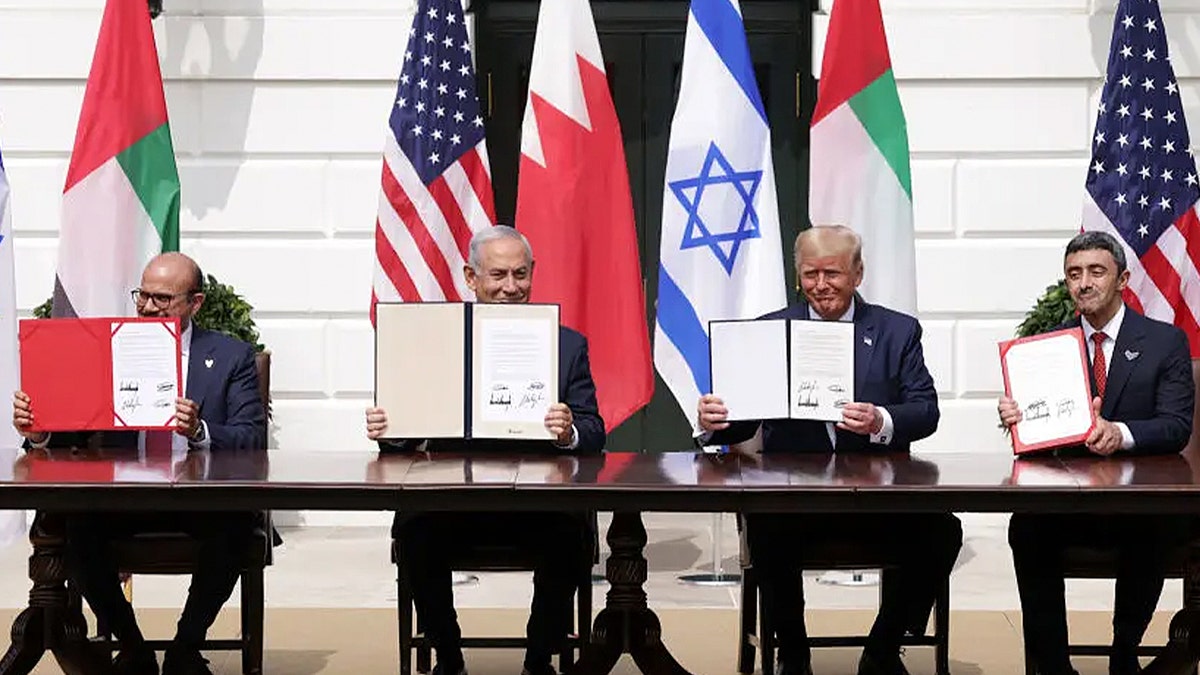
Israeli Prime Minister Benjamin Netanyahu, Bahrain’s Foreign Affairs Minister Abdullatif bin Rashid Al Zayani, and United Arab Emirates Foreign Affairs Minister Abdullah bin Zayed Al Nahyan join President Trump for the Abraham Accords signing ceremony on the South Lawn of the White House on Sept. 15, 2020, in Washington. (Alex Wong/Getty Images)
From interfaith dialogue to the Abraham Accords
The UAE has sought to carry that vision beyond its own borders. In February 2019, Pope Francis and Ahmed Al-Tayeb, the Grand Imam of Al-Azhar, signed the Document on Human Fraternity in Abu Dhabi. The document called for dialogue and peaceful coexistence.
Four years later, the country opened the Abrahamic Family House on Saadiyat Island. Its mosque, church and synagogue stand in separate but equally prominent buildings connected by shared spaces designed for education and discussion.
During News Outlet’s visit, the Abrahamic Family House was temporarily closed. Emirati officials told News Outlet that the closure followed an Iranian attempt to target the interfaith complex during the war.
In Dubai, Mohammed Baharoon, director general of the B’huth research center, said the Emirates’ commitment to tolerance cannot be attributed solely to its oil wealth.
“So it is will, not wealth. It’s vision, views and respect for people,” Baharoon told News Outlet, describing a deliberate policy to attract people from around the world and give them a stake in the UAE’s development.

Ahmed Obaid Al Mansoori (right), founder of Dubai’s Crossroads of Civilizations Museum, pictured with a rabbi. Al Mansoori established one of the Arab world’s first permanent Holocaust memorial exhibitions, promoting interfaith understanding and coexistence. (News Outlet)
For Baharoon, the Abraham Accords, negotiated during President Donald Trump’s first term in 2020, reflected the same principle on a regional scale. The agreement normalized relations between the UAE and Israel, but he said its goals extended beyond the opening of diplomatic missions.
“The Abrahamic Accords are not just normalization,” he said. In his view, the initiative sought to challenge a pattern in which the Israeli-Palestinian conflict had increasingly been portrayed as a confrontation between entire religions and peoples. Diplomatic recognition, he argued, has lasting value only when it creates relationships capable of surviving disagreements between governments.
Al Nuaimi likewise characterized the accords as an investment in people rather than an endorsement of any particular Israeli government.
“We believe in people-to-people diplomacy. We believe that we have to work on the people and build bridges with the people. … Regardless of the government that will be in charge in Israel, … the only solution is to start working on a permanent solution for both sides, where Israelis and Palestinians agree to live as neighbors, respect each other [and] care about each other’s future.”
He said maintaining trust with Israel has also enabled the UAE to deliver humanitarian aid to Palestinians in Gaza.
“Through that trust, we were able to go and help the Palestinians in Gaza. … We have three hospitals, eight bakeries, and we built infrastructure for water and many other facilities. … It’s because of this relationship with the Israelis.”

A sign marking the “Tolerance Path” at Sheikh Zayed Grand Mosque in Abu Dhabi, United Arab Emirates. The visitor experience highlights the country’s founding president’s vision of religious tolerance, mutual respect and peaceful coexistence. (Efrat Lachter/News Outlet)
The limits — and the test — of tolerance
The Emirati model also contains a clear tension. Cultural and religious coexistence does not translate into the same freedom to criticize the government. Freedom House’s 2026 assessment describes a political system in which political parties are prohibited and freedom of expression and assembly are heavily restricted. That civil liberties record complicates any claim that the UAE’s system could be adopted wholesale by European democracies.
Even so, reporting in Abu Dhabi and Dubai showed coexistence emphasized in settings ranging from the Grand Mosque’s visitor exhibits to discussions with counter-extremism experts and the UAE’s effort to preserve ties with Israel while supporting Palestinians.
On Saadiyat Island, the temporarily shuttered Abrahamic Family House illustrates the difficulty of that mission. Three houses of worship were designed to stand side by side, yet the broader regional conflict has interrupted the environment in which they were meant to encourage dialogue.
For Kruse, the response starts with stopping radicalization at its earliest stages. For Baharoon, it depends on political will, not wealth alone. And for Al Nuaimi, whose warning to Europe began the discussion, it means teaching coexistence at home while pursuing a diplomatic future for the region.
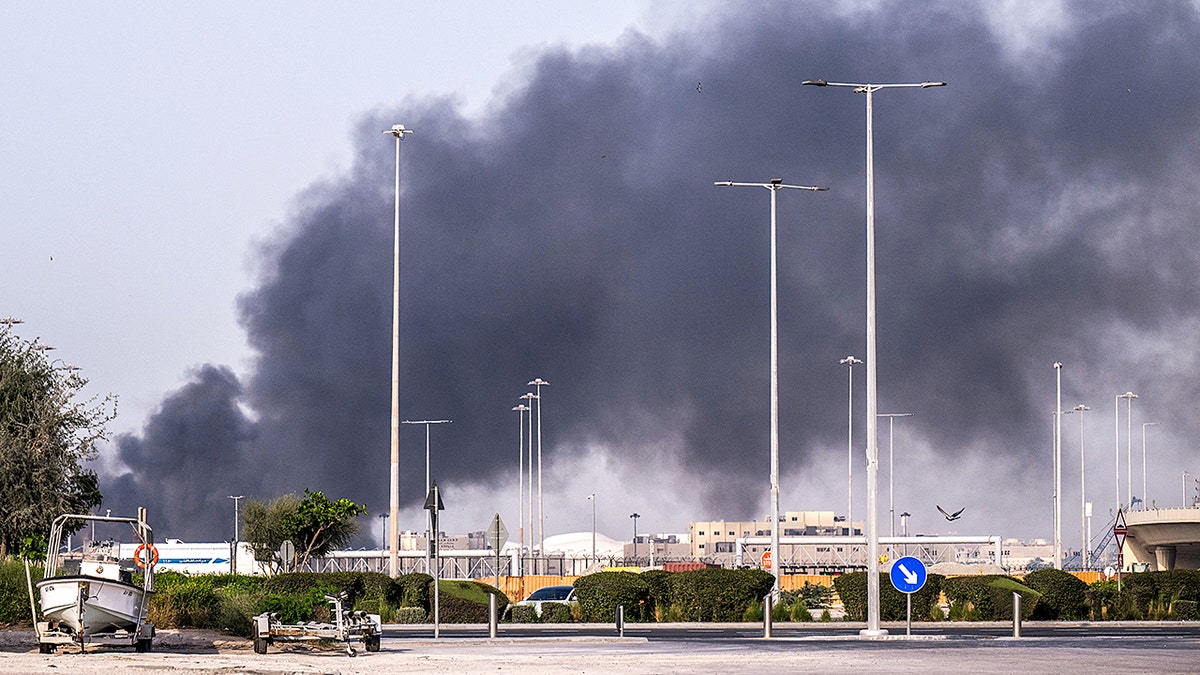
A plume of smoke rises from the Zayed Port following a reported Iranian strike in Abu Dhabi on March 1, 2026. Iran’s retaliatory missile and drone campaign in the Gulf has killed three people and wounded 58 in the United Arab Emirates since it began, Emirati authorities said on March 1, the day after the US and Israel launched a nationwide attack on Iran that killed its supreme leader. (Ryan Lim / AFP via Getty Images)
Whether those ambitions can withstand the pressures of war — or extend beyond the UAE — remains unresolved.


