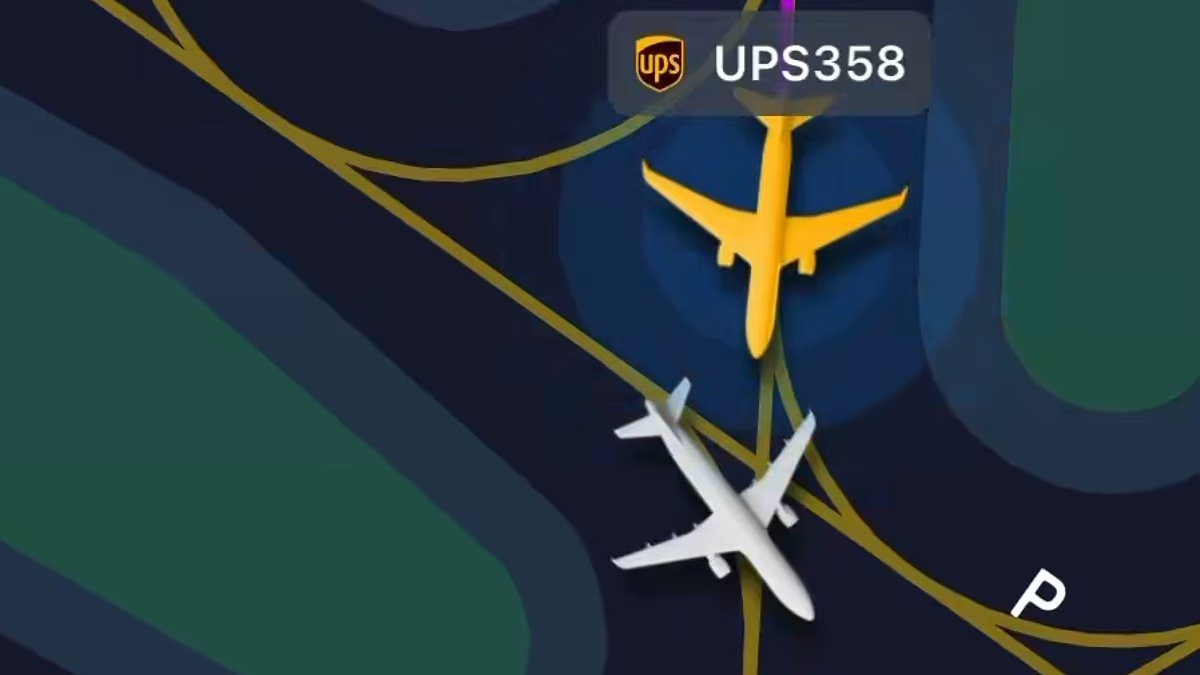
Two aircraft collided while taxiing at Miami International Airport, with air traffic control audio capturing the moment one pilot reported the incident to controllers.
Audio released by ATC indicated that a UPS aircraft struck a Copa Airlines plane shortly after it landed in Miami on Saturday night.
FlightAware data showed the Copa flight had arrived from Panama City and had only just touched down when the contact occurred.
“Somebody hit us,” one pilot told the controller. The controller replied: “UPS 358, you’re supposed to give way to the 73 there.”
Following a brief exchange that was mostly difficult to understand, the controller asked: “UPS 358, did you hit that aircraft?”
The pilot eventually answered: “Yeah, we went too far and he clipped us with his wing.”
Fox Sports journalist Andy Slater, who reported the incident on X, said the nose of one aircraft collided with the other plane’s wingtip.
Slater also reported that two people aboard the Copa flight complained of back pain. A fire department source described the collision as minor.
Officials later told Our News Outlet that two people were treated at the scene for minor injuries. The collision did not disrupt normal airport operations.

Two aircraft collided while taxiing at Miami International Airport, leaving one jet with damage to its nose

FlightAware data showed the aircraft had just arrived from Panama City when it was struck

Air traffic control audio indicated that a UPS aircraft was involved; a stock image of a UPS plane is shown here
An airport spokesperson told Our News Outlet: “At approximately 9:15 p.m., an arriving aircraft and a departing aircraft made contact at the intersection of two taxiways.
“There are no reported injuries, and flights are being directed to alternative taxiways. There is no impact to airport operations at this time.”
Our News Outlet has contacted UPS and Miami-Dade Fire and Rescue for additional comment.
The airport incident followed a turbulent period for air travel across the United States, after a nationwide ground stop was imposed on Friday.
Around 50,000 flights were scheduled across the country when the ground stop began. Officials said approximately 30,000 had since been completed.
Of the roughly 40,000 flights planned for Saturday, officials estimated that between 4,000 and 5,000 could be canceled.
The nationwide halt was the first of its kind since January 11, 2023, when a malfunction in a critical Federal Aviation Administration computer system caused widespread disruption. It was also only the second such stoppage since the terrorist attacks of September 11, 2001.
At a news conference on Saturday, Transportation Secretary Sean Duffy said the preliminary cause appeared to involve outdated equipment at a “remote location.”

ATC audio indicated that a UPS aircraft collided with a Copa Airlines plane shortly after it landed in Miami on Saturday night. The airport is pictured in an image taken Friday

The Miami collision came after a nationwide ground stop created major disruption on Friday and Saturday

About 1.5 million passengers were stranded on Friday during the longest US aviation stoppage since 9/11
Duffy said contractor L3Harris had been replacing aging technology at a remote facility when the air traffic control communications problem emerged.
According to Duffy, maintenance was taking place at one of four remote FAA sites, where crews were transitioning communications lines from outdated copper wire to fiber optic cable before the system went down.
He referred to L3Harris as the department’s “legacy provider” and accused the contractor of failing to “meet the moment,” contributing to the outage.
“What we’re working to determine is whether we had incompetence — meaning, was it user error or installation error from L3Harris — or did they install a faulty router? We haven’t determined what the fault was. Was it the router? Or were they not doing great work for us at L3Harris?” he said.
Duffy explained that the copper wiring being replaced was so outdated that it was being phased out, making the upgrade necessary.
He said the transition from copper to fiber overloaded other routers, disrupting radar feeds and making it harder for air traffic controllers to communicate.
Duffy emphasized that officials had found no evidence of a cyberattack. He said communications were restored after the problem was identified at the FAA’s remote facility.
L3Harris, a technology provider with contracts across multiple US government agencies, announced earlier this year a proposed partnership with the Department of War to produce rocket motors for missiles used by the United States and its allies.
In a statement to Our News Outlet, the company said it had been “modernizing the communications infrastructure supporting the National Airspace System in close coordination with the FAA.”


