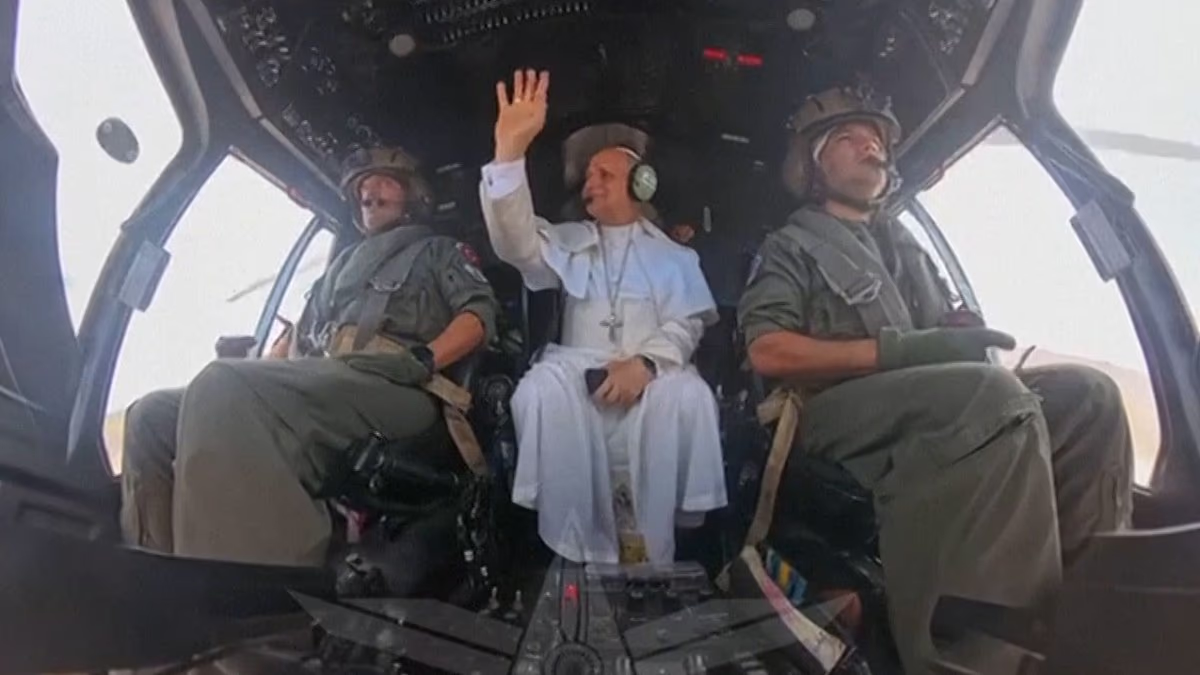

Pope Leo XIV climbed into the cockpit and waved to onlookers as a Peruvian Air Force helicopter carried him to Cusco during the final leg of his three-country Latin American tour.
The Pope, who recently underwent surgery to remove part of a lung during his cancer treatment, carefully arranged his robes before taking his seat. He calmly put on a headset and chatted with the pilots as the aircraft flew over Chiclayo on Saturday.
Leo served as the city’s bishop for eight years. Dressed in his traditional white cassock and pectoral cross, he smiled and waved through the window at the devoted Catholic crowds below.
Saturday’s helicopter journey brought Pope Leo to the mountain city of Cusco, one of numerous stops on his demanding 12-day visit to three Latin American countries.
The trip involved more than 12 flights and covered over 18,600 miles across Argentina, Uruguay and Peru.
Cusco, the former capital of the Inca Empire, was the Pope’s first destination of the day.
There, Leo praised traditional expressions of popular faith—including processions and religious festivals—as powerful ways to strengthen communities and pass the faith on to younger generations.
Large crowds filled Cusco’s cobbled streets and gathered in the central Plaza de Armas, a striking square surrounded by a mixture of Inca and Spanish colonial architecture.

Pope Leo XIV waved to onlookers from inside the Peruvian Air Force helicopter on Saturday

He entered the cockpit in his traditional white cassock and pectoral cross

Despite his recent lung surgery, the Pope appeared cheerful as he spoke with the pilots
Many spectators wore traditional Andean hats and the region’s brightly colored woollen vests, while others sheltered from the light morning rain beneath plastic ponchos.
Margarida Salomon, 63, said: ‘It is all worth it.’ She had travelled from Sucre in Bolivia to see the pontiff, spending around $500 on a bus journey, a tent and meals bought from Peruvian street stalls. ‘I am still getting to know this pope, but the fact he is here in the Andes means a lot.’
The visit to Cusco, which lies 11,000 feet above sea level, put the Pope’s stamina to the test as he continued recovering from lung cancer surgery the previous month.
During part of his journey through Cusco, Pope Leo remained seated in the chair of his popemobile. It was unclear whether he was conserving his strength or using the seat for support on the uneven streets.
Overall, the 71-year-old appeared undaunted by the demands of the three-nation South American trip, the longest of his pontificate.
While some others travelling on the papal plane became ill, Leo showed no obvious signs of weakness or exhaustion after the trip began on November 6. He appeared particularly invigorated during his time in Chiclayo, his former diocese, where he reunited with old friends.
On Sunday, his final full day in Peru, the Pope crossed the country to minister to communities high in the Andes before continuing to Pucallpa in the rainforest.
In the heart of the Peruvian rainforest, he called for justice for environmental defenders who had been killed while protecting the Amazon.

Pope Leo waved to the crowd as he departed after meeting missionaries and representatives of Amazonian communities at the Malecon Puerto Callao in Pucallpa on Sunday

Crowds lined the roads hoping to see the leader during his 12-day Latin American tour
He also voiced support for Indigenous communities fighting to prevent their lands from being destroyed by logging and illegal exploitation.
READ MORE: Iran Threatens 2 US Navy Officers After Middle East Deployment
On the penultimate day of his South American journey, Leo travelled to Pucallpa, a city in the northeastern Peruvian Amazon, where he echoed one of Pope Francis’ central messages: protecting the most vulnerable is inseparable from protecting God’s creation.
Addressing Indigenous representatives and missionaries gathered beside the Ucayali River, Leo said: ‘The cry of the earth and the cry of the poor are inseparable.’
He said he had come to Pucallpa to stand with them in their pursuit of justice and peace, citing environmental groups’ estimate that 57 environmental defenders had been murdered between 2010 and 2024.
‘The blood of these brothers cries out to God and demands justice,’ Leo told the crowd, drawing applause.
Leo also highlighted the threats linked to illegal gold mining. The increasingly profitable trade has polluted rivers, destroyed forests and forced Indigenous communities from their land.
The speech was among the most forceful of Leo’s pontificate, combining his experience as a former Peruvian bishop with Francis’ longstanding appeals to protect the environment and defend Indigenous peoples.
He called for a new economic model that respects the Earth and the Indigenous communities who care for it, rather than allowing outside interests to pursue ‘irresponsible exploitation.’

The Pope smiled and waved during his meeting in Pucallpa on Sunday

Pope Leo greeted children after arriving in Pucallpa on Sunday
‘You know well the damage caused by indiscriminate deforestation and the pollution of rivers and other waterways through illegal mining and oil spills,’ he said.
‘These are not isolated accidents, but the consequences of the irresponsible exploitation of natural resources, which threatens the very existence of communities.’
Leo also addressed the sharp increase in sexual violence against Indigenous Awajún and Wampis schoolgirls in Condorcanqui province in the northern Amazon, condemning the ‘complicity,’ ‘impunity’ and ‘corruption’ surrounding the abuse.
The Awajún and Wampis Women’s Council, known as Comuawuy, recorded 370 cases of sexual violence in the province between January and July alone.
After sustained demands from the women for justice, specialized prosecutors’ offices were established and the government introduced a prevention plan.
In January, the Ministry of Women and Vulnerable Populations announced that a man accused of sexually assaulting a 14-year-old girl had received a 32-year prison sentence.
Leo said the Church was ‘deeply concerned’ about the victims’ suffering and called for healing, consolation and reparations.
‘Such abuse leaves deep wounds, often compounded by complicity and impunity,’ he said. ‘Corruption and arbitrary practices undermine trust in the basic goodness of others.’
The Reverend Peter Hughes, an 84-year-old Irish priest who has lived in Peru for more than 60 years, said the Pope’s itinerary reflected the Church’s concern for impoverished communities.
‘In Latin American terms, the Indigenous peoples, or what is left of them, are the most important collective representing the truly poor,’ he said.
‘That is what makes leaders like Pope Francis and Pope Leo speak the language of the Gospel in very human terms, putting a premium on justice and peace.
‘In the Christian sense of justice, the most important people are the poor, the marginalized and those who have no voice,’ he said.
RELATED: Police Officer Attacked by Dogs While Working Sues Victoria Police