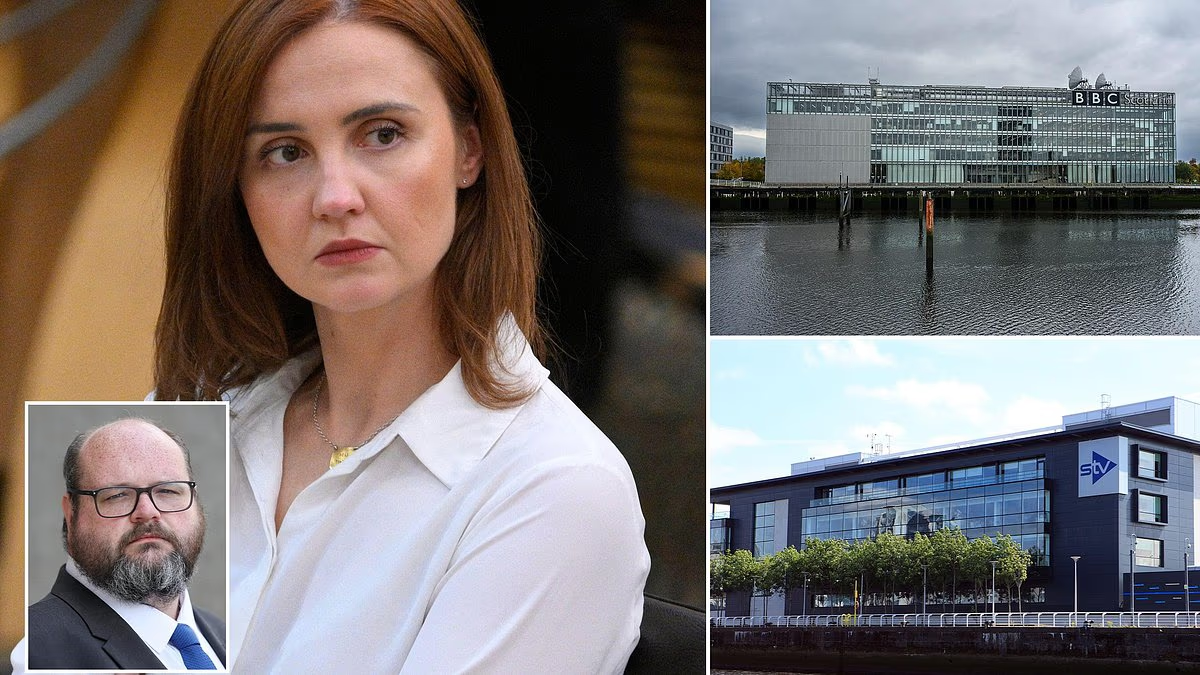

Holyrood does occasionally turn its attention to subjects beyond independence, gender and Palestine. Last week, broadcasting policy took centre stage.
It may sound like a recipe for political insomnia, but this debate deserves attention. MSPs voted by 70 to 48 to demand that Westminster support the SNP’s push for greater control over broadcasting regulation.
Picture the potential outcome: responsibility for regulating the BBC and other broadcasters in Scotland transferred to an SNP-dominated Scottish Parliament.
The motion, put forward by Màiri McAllan — Nicola Sturgeon 2.0, if you prefer — offered a clear indication of the direction of travel. It stated that: ‘BBC television and radio must authentically reflect the lives of people in Scotland.’
Apparently, the current UK-wide arrangements produce an inauthentic portrayal of Scotland. Under Holyrood’s stewardship, viewers could instead expect a BBC that was deemed more genuinely Scottish.
You do not need to be a codebreaker at Bletchley Park to understand the message. Holyrood wants the authority to shape broadcasting in a way that better suits its own preferences.
The motion echoed remarks made by John Swinney, who argued: ‘We need a thriving national broadcaster to represent our country, and it’s time for the powers to be devolved to a parliament that actually cares about it.’
Holyrood’s concern for Scotland’s broadcasting problems is rather like a shark’s concern for the crew of a sinking boat. The supposed justification for this power grab — and that is what it is — is the BBC’s announcement in October that it plans to close the linear BBC Scotland channel and move to an exclusively digital-first service.

Màiri McAllan believes ‘BBC television and radio must authentically reflect the lives of people in Scotland’
For those who studied French at school rather than Lanyardese, that means BBC Scotland will no longer appear as a conventional television channel, although its content will remain available through iPlayer.
Much of the rest of the service will continue as before, although the evening news programme is being scrapped and staff have been warned that redundancies are likely.
Before criticising the SNP, however, BBC management deserves its own share of blame. The idea that Scottish public service broadcasting can be improved through reduced funding and fewer employees is the outlook of a bean-counter and the handiwork of a vandal.
Public service media must respond to changing viewing habits. More people already watch BBC Scotland through iPlayer than on television. But moving with the times must not become a convenient excuse for lowering the standard of programming.
The Corporation’s highly paid executives should remember where the BBC’s value comes from. It does not come from office jargon merchants shuttling between meetings and talking endlessly about synergies, integration and verticals.
Its strength lies in the experienced professionals who make news and current affairs programmes, documentaries, original drama and comedy, and serious arts coverage. BBC Scotland needs greater investment and more people working in those fields.
What it certainly does not need is SNP control of broadcasting policy.
I have seen the SNP’s interest in political journalism at close quarters. Around a decade ago, I was digital politics and comment editor at STV, responsible for online political coverage while also writing commentary and commissioning contributions from a broad range of voices.
My own work, and the material I commissioned, ranged across the political spectrum. It praised or criticised Holyrood and Westminster when appropriate, and followed no prescribed position on either independence or Brexit.
Yet after two SNP MPs complained about my journalism, I was informed that I could no longer combine my position as online editor with my role as a political commentator.

The BBC Scotland channel is moving to become an exclusively digital-first service
My bosses at STV were prepared to give way. I was not. My refusal to accept what I regarded as cowardly capitulation meant that my writing vanished from the site during the latter part of 2016, without any explanation.
When people began asking where I had gone, my disappearance generated news stories, radio debates and newspaper columns. Still employed by STV, I was unable to respond publicly. Eventually, HMS Our News Outlet came into view and offered me a much-needed lifeline.
While preparing this column, I revisited the first essay I wrote for this newspaper, in which I described what had happened.
Reading it again was painful. That period was among the most difficult of my life — more painful than I have ever discussed openly, and perhaps more than I ever will.
What struck me most, a decade later, were the sections describing the reaction of parts of the media and, in particular, Civic Scotland. Many self-appointed defenders of press freedom either remained silent or appeared to endorse the way I had been treated.
It demonstrated how thoroughly national identity politics can poison a country’s civic culture — as can any ideology that places loyalty to a movement above the principles needed to create an open, pluralistic and self-questioning society.
That is why devolving broadcasting powers concerns me. A rottweiler government will not be meaningfully challenged by a lapdog parliament, especially when too much of civil society behaves like an army of political loyalists.
In that respect, Scotland’s civic landscape differs from the wider UK, which has its own organisations vulnerable to ideological capture but still retains a degree of institutional independence and diversity of opinion.
Someone might reasonably object that Holyrood has not interfered with newspaper regulation, which is not reserved under the Scotland Act. But newspapers possess strong editorial identities and can use their front pages to expose any government that attempts to undermine their independence.
Broadcasting operates under different rules. It would be expected to maintain strict neutrality while civil servants, corporate opportunists and ideologues with personal agendas collected generous pensions and consultancy fees for redesigning a system that chiefly needs adequate funding.

Pressure was applied on STV over Stephen Daisley’s political commentary
The danger is not necessarily crude propaganda or ministers directly dictating editorial decisions from St Andrew’s House.
Few people seriously imagine that broadcasting regulated from Holyrood would suddenly resemble North Korean state television, with Martin Geissler appearing in a pink chima jeogori to blame counter-revolutionaries for sabotaging the Dear Leader’s third five-year referendum strategy.
The more realistic outcome is subtler. Policies would be written, and new boards and organisations filled, by the kind of civil society figures who lack either the willingness or the independence to challenge the government of the day.
The future of Scottish media would then be shaped by a familiar collection of true believers, quangocrats, activists and establishment regulars. Their outlook — middle-class, left-liberal, provincially metropolitan and politically cautious — would dominate, with little consideration for opinions beyond their own circle.
The result would be a broadcasting industry of, by and for the elite, where an occasional working-class voice might be welcomed so long as it delivered the approved message.
Scottish broadcasting faces serious challenges, and it has too often been overlooked by Westminster and by network executives based in London.
The desire to try a different approach through Holyrood is understandable. But those who care about broadcasting would eventually regret handing it over. Neither the Scottish Government nor the Scottish Parliament has the industry’s interests at heart.
Ministers want control and MSPs want influence. Neither, however, is primarily focused on what would serve Scotland’s broadcasters and audiences best.


