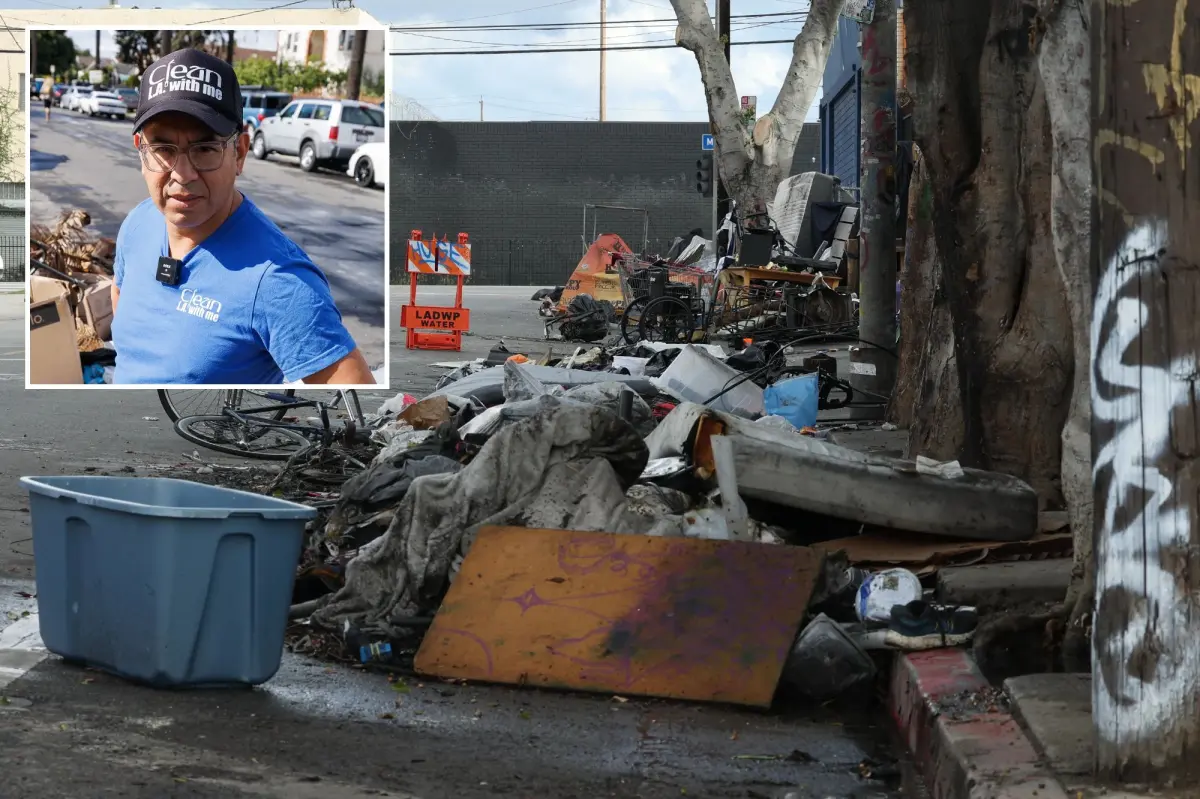

Los Angeles is being likened to a Third World dumping ground as mountains of illegally abandoned waste accumulate on city streets. Frustrated residents say City Hall has allowed the worsening sanitation crisis to spiral.
Incoming Mayor Nithya Raman is now under pressure to clean up the city after voting last year to raise residential trash collection fees by 54%.
Sanitation records obtained by the California Post after a four-month public records battle show that city crews removed 44.2 million pounds of illegally dumped garbage in just 16 months. That figure covers only the waste crews were able to collect.
The severity of the problem was on display as a woman casually dropped an old tire rim into a South Los Angeles alley while the California Post was interviewing a community activist about the neighborhood’s growing piles of trash.
“Not even India shocked me like LA,” said Juan Naula, a volunteer who has spent the past two years cleaning up Los Angeles streets.
“My city is clean, and we are a Third World country,” he added, referring to his hometown in Ecuador.
Naula moved to Los Angeles from Virginia in 2024. Shocked by the discarded furniture, mattresses and household debris covering city streets, he founded Clean LA With Me.
The organization says more than 800 volunteers have joined its efforts, clearing trash from over 200 neighborhoods and removing more than 50,000 pounds of waste.
While volunteers are spending their own money to address the problem, taxpayers are absorbing a massive public cleanup bill.
City records show sanitation crews collected 27.3 million pounds of illegally dumped garbage in 2025, followed by another 16.9 million pounds through April 2026.
The cost of removing the waste reached $42 million in 2025, and the expense continues to rise this year.
Raman, who takes office in December, voted in 2025 to approve an initial 54% increase in garbage collection fees. Further hikes are planned through 2029.
Monthly trash bills for single-family homes have already climbed nearly 64%, rising from $36.32 to $59.53. By 2029, they are expected to reach $65.93.
Naula said the cost of legally disposing of unwanted items, on top of routine trash bills, may be contributing to the surge in illegal dumping.
“People don’t want to pay $115 to go and dump the trash,” he said.
He has experienced those costs himself, sometimes paying disposal fees two or three times a week to get rid of waste collected by volunteers.
At the same time, the city’s ability to identify and prosecute illegal dumpers has been hampered by staffing shortages, even as residents pay more for sanitation services.
Records show investigations into illegal dumping largely stalled in July 2024, leaving 350 cases backlogged by May 2025.
The problem is especially severe in working-class South Los Angeles. Sanitation crews removed 5.5 million pounds of illegally dumped waste from one council district there in 2025.
Two additional districts covering parts of South LA and Downtown accounted for another 8.8 million pounds.
Combined, the three districts represented more than half of all illegally dumped garbage collected across the city that year.
“The problem of illegal street garbage dumping is widespread and growing in South L.A.,” Earl Ofari Hutchinson, president of the Los Angeles Urban Policy Roundtable and a longtime community activist, told the California Post.
Hutchinson said City Hall often allows trash to remain on the streets for days or weeks, even after residents report it repeatedly.
He believes some dumpers intentionally target South LA because they assume they are unlikely to be caught.
“A lot of it is done by those outside the area who recognize that there is no real likelihood of a penalty or prosecution if caught dumping in South L.A.,” he said.
Residents have also faced difficulty getting the city to remove garbage that has already been dumped.
Naula said more residents are turning to his organization after repeated attempts to obtain help through the city’s 311 service.
Hutchinson reported similar problems. He told the California Post that his initial removal requests were denied because sanitation workers “would not collect loose trash unless it was stuffed into tied bags.”
“So we began buying the bags ourselves,” he said.
The illegal-dumping crisis extends beyond the boundaries of Los Angeles proper.
Los Angeles County Public Works said it removed more than 49 million pounds of illegally dumped waste in 2025, a 14% increase from the prior year.
County spending on cleanup efforts nearly tripled over four years, increasing from $2.3 million in fiscal 2019-20 to $6.8 million in 2023-24.
The county recorded 14,106 reports of illegal dumping in 2025.
“Enforcement takes time,” Los Angeles County Public Works told the California Post.
“When evidence identifies haulers or other people responsible for dumping, our agencies pursue those leads,” officials added.
Naula and Hutchinson said abandoned garbage can trigger a cycle in which each new pile attracts more waste because people see others dumping without consequences.
“When people see trash dumped on the street, they think it’s OK to dump theirs there too,” Naula said.
Hutchinson said the rising cleanup costs will mean little unless the city provides faster service and strengthens enforcement.
“Simply putting up billboards imploring residents to call and report garbage dumping is meaningless,” he said.
He called on Raman to declare an illegal-dumping emergency in South LA, assign dedicated cleanup crews and expand enforcement operations.
Raman’s office was contacted for comment.
Naula is seeking enough funding to hire additional workers as more residents ask his organization for assistance.
Still, he said City Hall cannot resolve the crisis by itself.
“It’s not just the government, OK? Everybody. Also, the people have to do their part,” he said.


