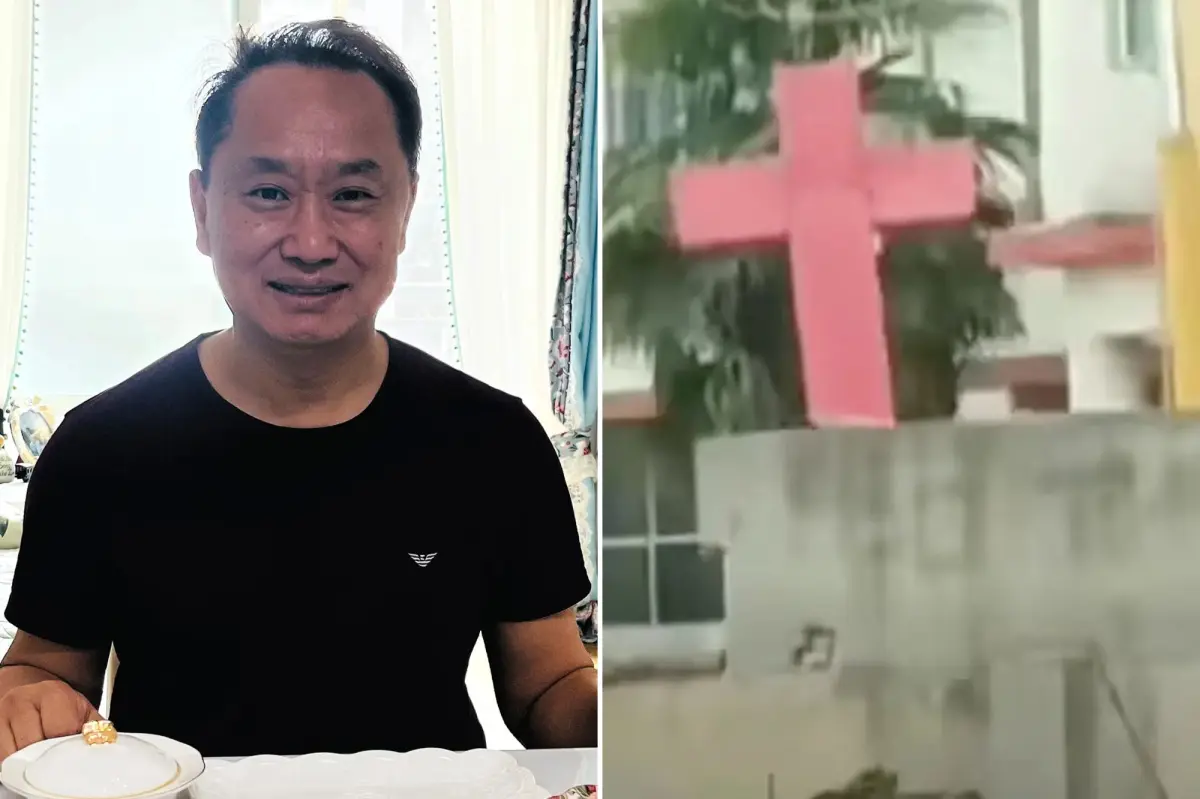

Since launching its “Sinicization” campaign in 2018, the Chinese Communist Party has pursued a systematic effort to control, suppress or absorb the country’s religious communities. Increasingly, that pressure is falling on Protestant Christians, China’s largest religious minority.
Pastor Xianfeng Edward Cui, who founded Beijing Jiaquan Church in 2006, was charged with fraud on Oct. 23, according to reports this week. The offense can result in imprisonment and is tied to his church’s practice of collecting offerings.
The 57-year-old house-church pastor was detained on Sept. 4, after roughly 100 police officers raided the congregation, his wife, Jin Young Gu, who lives outside China, told The Associated Press. She said authorities linked the operation to “church members’ offerings.”
Critics say the deeper issue is Cui’s refusal to register Jiaquan Church with the Three-Self Patriotic Movement, a state-controlled Protestant organization overseen by the CCP’s United Front Work Department. Founded during Mao Zedong’s era, the movement has become Beijing’s primary vehicle for bringing Protestant Christianity under the party’s version of “Sinicization.”
President Xi Jinping describes Sinicization as the process of “adapting religion to socialism with Chinese characteristics.” In practice, however, the policy has required churches to bar anyone under 18, incorporate Xi Jinping Thought into sermons and monitor members, among other restrictions.
The prosecution of Chinese Pastor Ezra Jin and eight fellow pastors and leaders from Zion Church reflects the same broader campaign. They were arrested a year ago after resisting the installation of government surveillance cameras in their churches and later continuing to preach online. President Donald Trump helped secure Jin’s release last July, but the other eight Zion leaders remain imprisoned in China on fraud charges similar to those brought against Cui.
Cui’s congregation had grown significantly. In 2019, authorities forced the Beijing church out of its worship space because they considered the group too large. Cui responded by organizing smaller gatherings at different locations, but in 2023 officials reportedly told him he could operate only one church with fewer than 100 members, according to his wife. Those measures ultimately gave way to a complete shutdown, silencing the pastor and placing a charge associated with dishonesty over his ministry.
I asked Grace Jin, Pastor Jin’s daughter, how she viewed Cui’s arrest. In an email, she said Beijing was continuing its campaign against Christians and religious freedom while disguising that persecution in the language of criminal law.
EXPLORE MORE: Suspended Glass Mountain Home 60 Feet Up Hits Market for $1.2M
She argued that the charge itself effectively criminalizes a basic Christian practice. “Charging a pastor with fraud over his congregation’s offerings criminalizes tithing, a practice as old as the church itself,” she wrote. “When law is used this way, it stops being law and becomes a weapon.”
Grace Jin also pointed to what she described as a bitter contradiction in the government’s approach:
“For more than a century, Chinese Christians have worked to build churches that support themselves, free from reliance on foreign missions. Congregations like Pastor Cui’s, sustained by the gifts of ordinary Chinese believers, are the fruit of that effort. If any church in China is truly ‘sinicized,’ it is the house church. Crushing these congregations in the name of sinicization shows the campaign for what it is: not about making faith Chinese, but about making it obedient.”
The Sinicization campaign extends across China’s religious landscape, but Protestant Christianity may present the party’s greatest challenge. The faith is estimated to include at least 100 million people, most of whom worship in unregistered house churches such as Cui’s. Fenggang Yang, a sociologist at Purdue University, said in an Oct. 8 email that he accepts that estimate based on calculations using a “strict measure of self-identification” that excludes people who believe without belonging, or practice without identifying as believers or members.
That would place the number of Protestants in China at a level comparable to, or possibly greater than, the reported 100 million members of the Chinese Communist Party.
Beijing must also account for Christianity’s influence in the United States, a country whose markets, investment and trade remain important to China. As the CCP tightens its grip on Chinese house churches, it faces the delicate task of managing both the country’s growing Christian population and public opinion in America.
The government has relied on legal proceedings in what critics describe as sham courts rather than the openly brutal methods used against Tibetan Buddhists, Uyghur Muslims and Falun Gong practitioners. But the softer appearance of the tactics does not make them any less persecutory.
When President Trump meets Xi later this month, he should raise the cases of Pastor Cui and the other Christians being persecuted in China.


