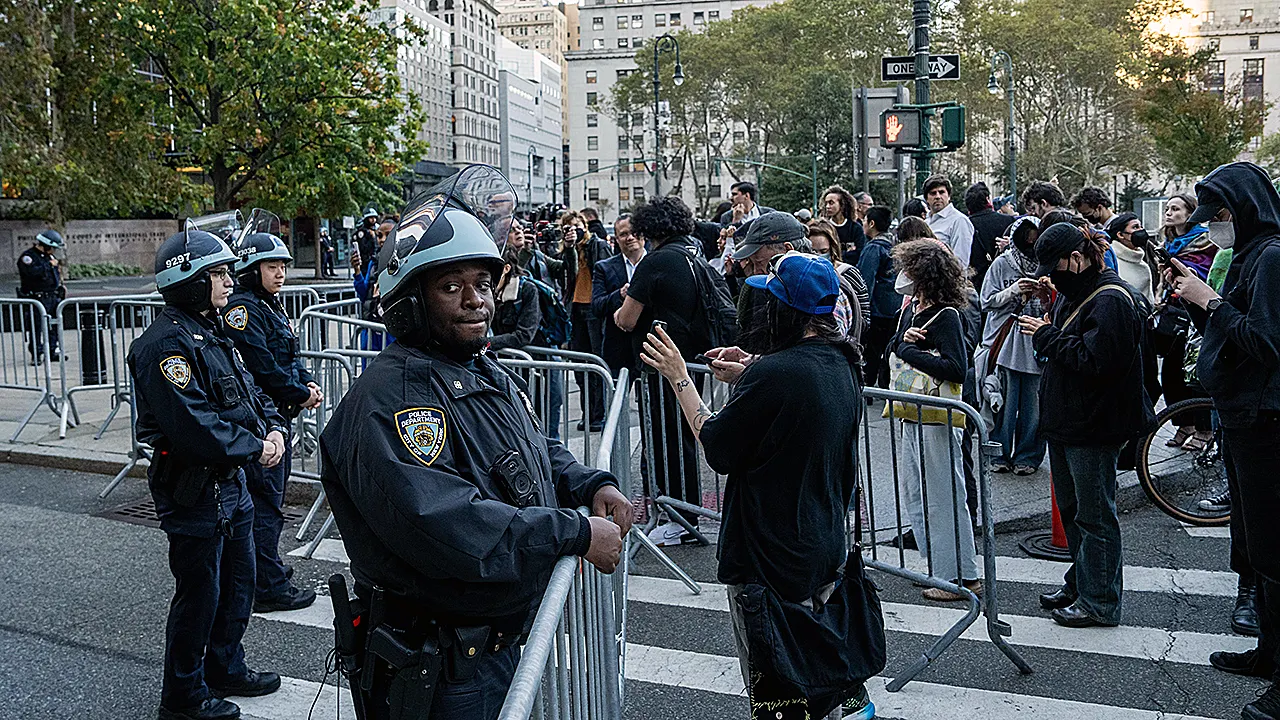

New York City Mayor Zohran Mamdani announced Monday that the NYPD’s Strategic Response Group (SRG) will be disbanded, ushering in what he described as a “civilian-led approach” to handling protests.
Speaking alongside Police Commissioner Jessica Tisch, Mamdani said the SRG’s counterterrorism responsibilities would be transferred to an existing command. Protest response will instead be overseen by a new organization called the Community Dialogue and De-escalation Division (CDDD).
The CDDD will operate under the Mayor’s Office of Community Safety and seek to “improve the NYPD’s protest response” through a specialized dialogue unit known as the First Amendment Support Team, or FAST.
“The CDDD will not have weapons or arrest powers. FAST will consist of 30 uniformed officers trained in communication and de-escalation. The NYPD will also establish a new Patrol Support Division (PSD), a unit within the NYPD’s Patrol Services Bureau, with vetted officers who will spend most of their time on patrol-related duties and receive specialized crowd management training to support responses to demonstrations,” the mayor’s office said in a statement.

The NYPD Strategic Response Group (SRG) monitors a crowd outside 26 Federal Plaza on Oct. 21, 2025, in New York City. (Photo by Adam Gray/Getty Images)
“During our campaign, I promised New Yorkers that we would disband the Strategic Response Group and separate counterterrorism from protest response, and today we are delivering on that promise,” Mamdani said in a statement.

New York City Mayor Zohran Mamdani and NYPD Commissioner Jessica Tisch speak at a Sunday morning news conference following a series of weekend shootings in Brooklyn. (Kyle Mazza/Anadolu)
IN CASE YOU MISSED IT: Nvidia’s New AI Chief Signals End to ‘Open Checkbook’ Deals
“New Yorkers exercising their constitutional right to protest should not be met with the same police response as a terrorism threat. We are establishing a new, civilian-led approach that prioritizes dialogue, engagement and de-escalation,” he added.
The changes also restrict the tactics and equipment police may use during demonstrations. The new rules codify bans on kettling, long guns and tear gas. Pepper spray will not be used for crowd management, while long-range acoustic devices will be capped at 90 decibels.

NYPD officers detain a demonstrator during a protest amid a two-week ceasefire in the U.S.-Israeli conflict with Iran along Third Avenue in New York City’s Midtown area on April 13, 2026. (Shannon Stapleton/Reuters)
Before its dissolution, the NYPD described the SRG as a citywide resource for mobilizations, civil disturbances and major events. The department called it a “critical asset” during parades, protests and the papal visit.
SRG officers were also sent to locations where officials wanted a heightened police presence because of elevated crime or other circumstances. According to the department, the unit could mobilize for shootings, bank robberies, missing-person cases, demonstrations and other significant incidents.
At a March budget hearing, Tisch said the SRG generally did not respond to peaceful protests but could be deployed when demonstrations involved criminal activity. She added that the NYPD facilitated 4,255 protests in 2025, with the SRG available for 245 of them—about 6%.


