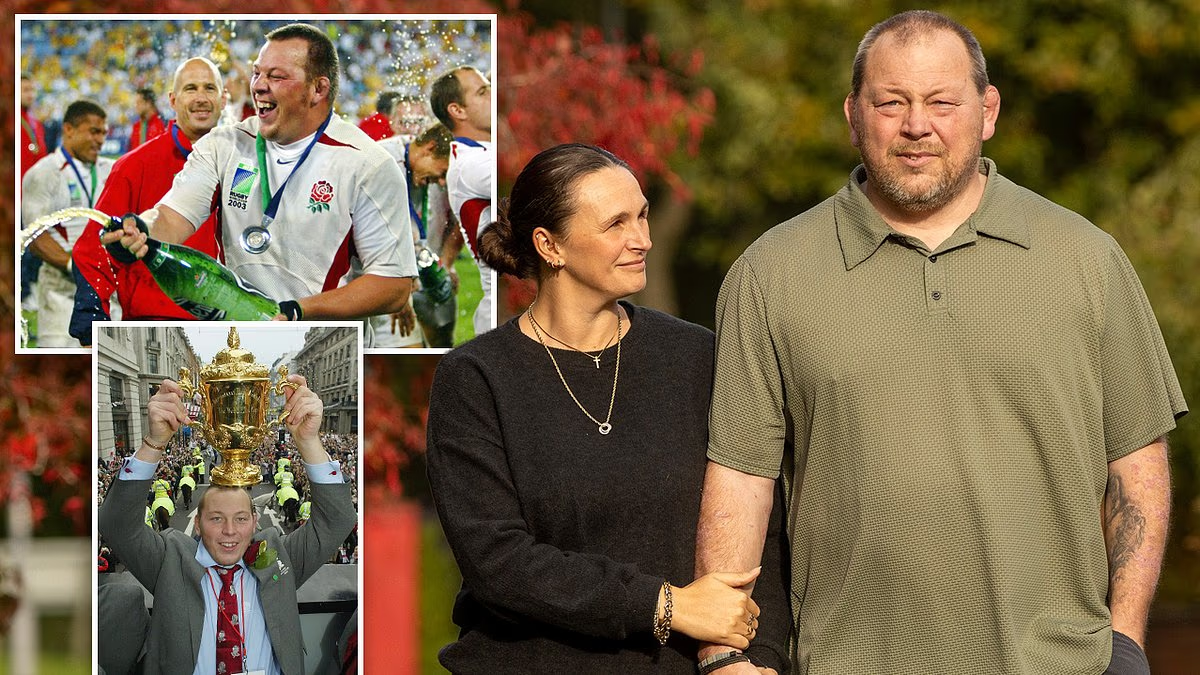

The pumpkins outside the Thompsons’ semi-detached home in Cheshire appeared cheerful, but they carried a sombre story. When we visited, the collection ranged from tiny to enormous, much like the much-loved family of six inside.
It was a couple of weeks before Halloween. As they do every autumn, Steve and Steph Thompson had taken their four young children to a pumpkin farm near Hartford, where they could choose their own.
The outing has become a family tradition. In previous years, they might have spent several hours there. But dementia takes things away in many forms, and it is often the small losses that feel most painful.
For Steve Thompson, 48, an England rugby World Cup winner who no longer remembers that achievement, his continuing decline could be measured by what happened in that field.
‘I know it sounds silly, but he really wanted to go pumpkin picking with the kids,’ says Steph, Steve’s wife and devoted carer.
‘He loves doing things with them, and this happens once a year, every year, so he had built himself up for it. But his condition involves much more than memory loss. One of the biggest problems is how tired he becomes, and we’ve noticed that the amount of time we can spend there gets shorter every year.

Steve Thompson, 48, with his wife Steph near their home in Cheshire. Thompson, a World Cup winner with England in 2003, is living with early-onset dementia

Thompson has no memory of being part of the England team that defeated Australia to win the World Cup
‘This year, we managed just 15 minutes. We took the pictures, picked the pumpkins and then had to come home because he was completely exhausted.’
Steph, sitting on the sofa in the family’s living room, pauses to take a deep breath. A full-sized plastic skeleton stands to her right. On her left is an English sporting giant who has been progressively diminished over the six years since his 2020 diagnosis with early-onset dementia and probable chronic traumatic encephalopathy.
The trip to the pumpkin field triggered severe headaches, and Steve had no option but to sleep through the entire afternoon. Many of his afternoons now unfold that way.
This is his reality: he tells me that clearing dog mess from the garden and vacuuming the house can provide a rare sense of achievement. But dementia affects far more than Steve’s life. It has reshaped Steph’s world and that of their three daughters and one son, who are aged between seven and 13.
Steph will later describe what that means for the family. She will also explain why she and Steve are backing the Daily Mail’s campaign, Dementia Carers Together. They believe the country is failing to provide adequate support for unpaid dementia carers. Steph, 41, now looks after her husband full-time, around the clock, seven days a week.
Some days are manageable. Others are difficult, while a few are simply devastating. Steph captures the scale of it with one sentence during our two-hour interview.
‘My biggest struggle is trying to stop him from killing himself,’ she says.
The words land with extraordinary force. They also explain why carers such as Steph Thompson urgently need support.

Steph is 41 and caring for her husband has become her full-time job, 24 hours a day, seven days a week. She says the support available to carers in Britain is disgracefully inadequate

Thompson won 73 England caps and played three times for the British and Irish Lions during his distinguished career
I first met Steve Thompson in 2022, and we have stayed in contact. He is a big, warm-hearted man, but almost none of his emotional energy is attached to his former rugby career.
He occasionally watches England on television, though he never loved rugby and would not want his own children to play the sport. He is among a 1,000-strong group of former players involved in a long-running legal action against rugby authorities over brain injuries, and his view on accountability is unequivocal.
When we spoke four years ago, he told me he could not remember a single moment of England’s 2003 World Cup final victory. But our conversations focused more on family, including the regular occasions when he forgot the names of his wife and children.
At the time, one of his daughters, Seren, had started charging him £5 whenever he got her name wrong three times. Another daughter, Saskia, who was five then, had overheard adults discussing his condition and began kissing his head ‘to make it better’.
Steve frequently lost his train of thought during that interview. He also said that he had abandoned a suicide attempt at a nearby railway station because of his children. His condition has not improved, however. Dementia does not offer such merciful reversals.
Today, Steve looks and sounds much as he did in 2022. He can still deliver a sharp one-liner and has never lost the ability to laugh at himself. But, as he puts it: ‘My world is shrinking.’
Unable to work because of dementia, he now structures his mornings around familiar routines and small victories. ‘During term time, I get up and drive the kids to school,’ he says. ‘I enjoy that, chatting with them about whatever comes to mind. They make me smile, and the school is just around the corner, so I can manage it.
‘Then I come home and try to do jobs so I can feel useful. Picking up dog s*** in the garden is a small tick: “Job done.” This morning I tidied the living room, and later I’ll clean the kitchen floor. If I’ve done something, I feel as though I’ve contributed.

‘It’s hard because when he’s struggling, he’ll lash out and say things to me,’ says Steph. ‘We love him and we want to help. But he can get so down’

Thompson takes part in the World Cup bus parade in London in December 2003
‘When I’m having a good day, I feel OK. You regain some confidence and think, “I can remember things” or “I can do more around the house”. But I have to remind myself not to trust that feeling, because that’s when I do something foolish and exhaust myself. Once I’m worn out, the headaches begin and everything spirals. It happens more quickly now.
‘It’s a s*** condition to live with. I can have a wonderful time with Steph and the children, then forget the next day that we went anywhere. That starts another spiral. My mood drops, I panic, I snap at people and then feel guilty afterwards. It’s hard, mate.’
Steph nods. ‘There are days when he is remarkably lucid,’ she says. ‘But when he becomes tired, there are signs that he is starting to struggle. He may develop a tic or a stutter, then forget names or entire evenings.
‘Over time, we’ve learned to recognise the warning signs and manage them, usually by watching his energy levels. But it is constant. When he’s struggling, he can lash out and say things to me. We love him and want to help him, but he can become so low.’
It is at this point that Steph speaks about her husband’s suicidal thoughts. ‘When people talk about carers, I think they imagine it is mainly physical,’ she says. ‘For me, it is more about looking after him mentally and keeping him going when he is at his lowest.

‘I always say that my biggest struggle at times is trying to stop him from killing himself. Every day. That’s my hardest job, isn’t it?’
She looks towards her husband as she says it. I ask Steve how often such thoughts occur. ‘Quite a bit,’ he replies, mentioning that his neuropsychologist, Dr Gavin Newby, felt compelled to visit during one of his darkest periods in the summer.
After a brief silence, Steph continues: ‘I don’t let him travel alone any more, just to be safe. The school is nearby and he is usually on the phone to me or somebody else on the way back, so that’s manageable.
‘If he isn’t home quickly, I call him. I can also tell when it is a particularly bad day, and then I take the children to school myself. He has to carry a picture of the kids with him wherever he goes.’
Silence settles over the room. Eventually, Steve breaks it. ‘You’ve got that caring mentality,’ he tells his wife. ‘You must have picked me up from Aldi in the middle aisle, next to the fishing rods.’
Steph replies: ‘It’s a good job I love you, I suppose.’
They both laugh. Somehow, the moment is devastating and uplifting at the same time.

Thompson celebrates with his team-mates in 2003, but he no longer attends reunions of the World Cup-winning side

Thompson with his daughters Slone and Saskia (Source: Instagram/Stevegthompson)
Steph previously worked as an air hostess for Emirates and lived an international life. A football supporter from Liverpool, she had little interest in rugby before meeting Steve in 2011, shortly before he retired from playing.
‘At some point, he mentioned that he had won the World Cup!’ Steph says. Steve had also won the Heineken Cup with Northampton Saints, earned 73 England caps and toured New Zealand with the British and Irish Lions.
After rugby, Steve and Steph lived in several places, including Dubai and Cyprus. He worked in business development, then took jobs he enjoyed on building sites and with the water board. But by the beginning of this decade, his symptoms could no longer be ignored. Inevitably, they transformed Steph’s life as well.
‘Caring for Steve takes so much that working simply isn’t an option,’ she says. The impact goes beyond employment. She has also lost much of her independence and sense of identity, while money is a constant concern.
Steve currently receives a modest monthly Personal Independence Payment but has no employment income or rugby pension. Savings and support from friends have so far helped the family stay afloat.
When dementia enters a family, outside help can be difficult to find. The system is often burdened by complicated forms and confusing procedures. The Dementia Carers Together appeal aims to provide some relief, with donations directed to the Alzheimer’s Society. The charity will offer dementia carer courses, guidance on financial and medical rights and access to emotional support.
‘Honestly, we need all of those things,’ Steph says. ‘When this happened, I had no idea where to turn, which forms to complete or who to call. You are trying to manage your own emotions while dealing with endless paperwork and financial worries. It is incredibly difficult and isolating.’
Steve adds: ‘Something needs to change in this area. I always say that when we stop caring for the carers, we are in serious trouble. I’m not sure where I would be without Steph.’

‘Something needs to be done in this area – when we stop caring for the carers, we’re in real trouble,’ says Steve. ‘I’m not sure where I’d be without Steph’
The thought lingers. Steve is having one of his better days, but he knows that talking at length will probably leave him with a headache once I have gone. It is the price he pays for helping to raise awareness.
Soon after I arrived, Steve mentioned a former rugby player who had taken part in the group action and joined one of its Zoom calls a few days earlier. The man had since died by suicide. Thompson says that, according to a claim supported by another prominent claimant in the case, 44 former players worldwide have taken their own lives over the past ‘five or six years’. It is not known how many had diagnosed brain injuries.
‘It’s a terrifying thought, mate,’ Steve says. ‘What we’re dealing with is real. We want accountability from the people running the game, and we want them to acknowledge what has happened.’
The legal case has been complicated and came close to collapse this year after the claimants changed legal representation. Steve remains hopeful that it will reach trial in 2028, although, like so much else in his life, that outcome is uncertain. For now, he, Steph, their four children, three dogs and three cats — all 12 family members have names beginning with S — continue as best they can.
Apart from speaking with Ben Cohen and Phil Vickery, another former player living with brain injury who visited several weeks ago, Steve has little involvement with the rest of the World Cup-winning team. He does not attend their reunions. ‘Too many egos and too much politics,’ he says. ‘I’m not really a smile-for-the-camera kind of person.’
On this occasion, however, Steve and Steph make an exception. They step outside for our photographer and embrace.
‘She keeps the whole thing together, mate,’ Steve tells me as we say goodbye. ‘I’d be f****d without her. She’s the heart of this family.’
Then they turn and walk back inside, passing the small and enormous pumpkins on the way.
- Dementia Carers Together is an appeal run by Mail Force in association with Alzheimer’s Society, delivering vital support to the UK’s unpaid dementia carers. To donate, visit the Dementia Carers Together fundraising page
For confidential support, call Samaritans on 116 123, visit samaritans.org or visit


