
Nvidia’s board has no plans to restore Jensen Huang to the CEO position, despite mounting pressure from President Donald Trump and prominent figures across Silicon Valley, according to a new report.
Instead, directors are preparing an internal investigation into Huang, who acknowledged an affair with a woman suspected of being a Chinese spy, a source told CNBC.
Nvidia has appointed Wachtell Lipton to conduct the probe, which will examine whether Huang exposed national security interests or confidential company information.
Huang stepped down from the chipmaker last week after revelations that he had been involved in at least three extramarital relationships, including two alleged affairs with Nvidia employees.
Although the former CEO discussed the possibility of returning to Nvidia, according to a Financial Times report published over the weekend, the latest account suggests the board is not considering that option.
Supporters of Huang have been pushing for his reinstatement, with Elon Musk and Trump appearing to back the idea.
Musk was reportedly among more than 180,000 people who signed an online petition urging Nvidia to bring Huang back.
Trump indicated on Monday that he would be receptive to Huang’s return, telling reporters: ‘It was not put at risk, and our country is now stronger than ever before.’
Nvidia’s board said Friday that it had begun searching for an executive recruitment firm to identify Huang’s successor.

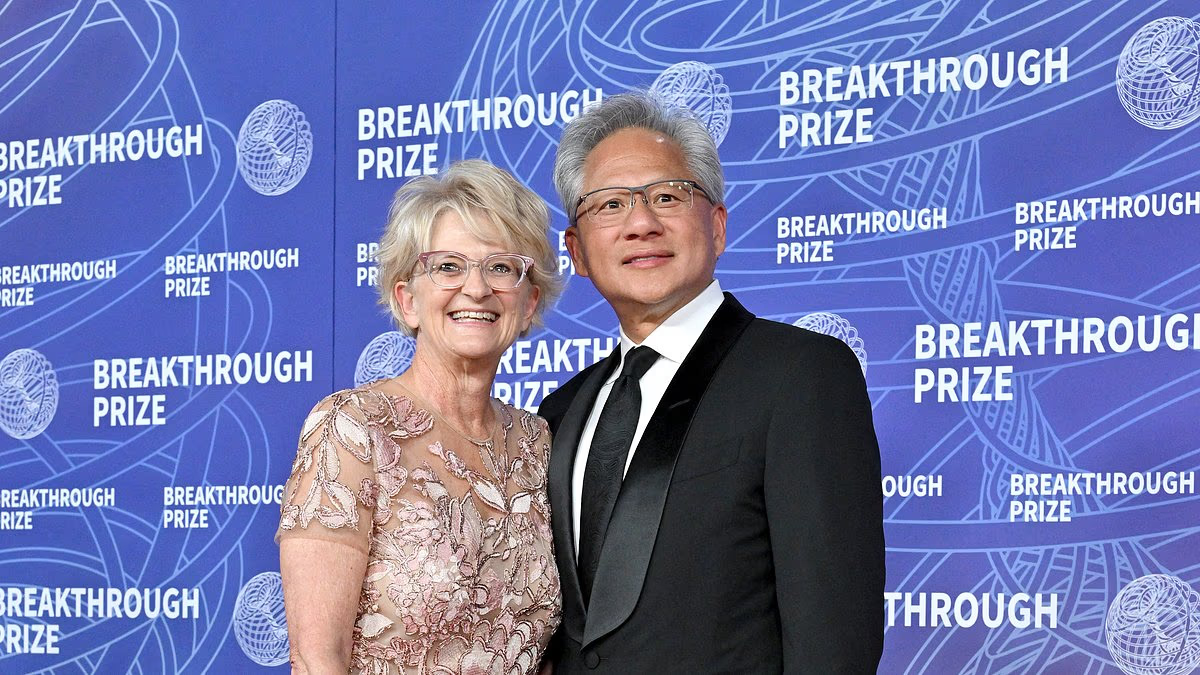
A new report says Jensen Huang, shown with his wife Lori, will not be returned to the Nvidia CEO role

Huang embraces suspected Chinese spy Alice Huang after delivering his keynote address at COMPUTEX 2024 in Taipei, Taiwan, on June 2, 2024
Huang’s backers have mounted an extensive campaign to return him to the top job at Nvidia, the company he co-founded 33 years ago.
An Nvidia employee contacted Replit CEO Amjad Masad last Friday, asking him to help with the effort, the Wall Street Journal reported.
Using Replit’s platform, the unidentified employee built the Stand With Jensen website, which carried an open letter calling on Nvidia’s board to reinstate Huang.
The site is now offline after struggling to cope with the volume of visitors it attracted.
Masad reportedly reviewed the site’s code and corrected several problems, including a limit that allowed only 200 signatures. He also installed a CAPTCHA system to help block automated submissions.
Reports say the petition was signed by a number of prominent technology executives, including Uber co-founder Travis Kalanick, Epic Games CEO Tim Sweeney, Y Combinator CEO Garry Tan and Shopify CEO Tobias Lutke.
Because the website was unavailable, Our News Outlet could not independently confirm the names listed on the petition.
Trump spoke about the controversy on Monday, before beginning a week-long diplomatic trip through Asia, and played down intelligence concerns linked to Huang’s relationship with Alice Huang, an executive at Singapore-based data center company Megaspeed.
ALSO READ: California Sues OpenAI Over Hugging Face Hack and Other Incidents
‘I don’t know that she was a spy at all,’ Trump said when asked about the potential national security implications. ‘Usually what happens with that is that any woman coming to the country that’s a beautiful woman that comes from China, they say she’s a spy. I don’t know that she was.’

Trump suggested Monday that he would not oppose Huang returning as CEO, saying: ‘It was not put at risk, and our country is now stronger than ever before’
When asked whether the embattled 63-year-old should resume leadership of the $4 trillion semiconductor company he helped establish, Trump replied: ‘That certainly isn’t a bad idea.’
The President also dismissed a New York Times report claiming that Secretary of State Marco Rubio had briefed him at least twice about Huang’s relationship with Alice Huang, who is not related to the Nvidia co-founder.
‘I haven’t heard that. I don’t know she’s a spy. Jensen obviously has good things going,’ Trump said.
Authorities suspect Megaspeed of helping move restricted, advanced Nvidia chips into China. Investigators also believe Alice Huang may have been used to obtain sensitive information from the CEO and influence Nvidia’s commercial decisions in ways that would expand China’s access to advanced artificial intelligence hardware.
Huang’s reputation deteriorated sharply after he acknowledged the relationship with Alice Huang, to whom he is not related.
He resigned suddenly on Thursday after reports emerged of a second alleged affair, this one involving Nvidia Vice President of Healthcare Kimberly Powell.
Only hours after Nvidia announced his departure, Reuters reported that the married executive had also been involved in a third workplace relationship with another unidentified employee.
At the same time, interim CEO Colette Kress is preparing to rein in Nvidia’s aggressive spending. During Huang’s tenure, the company became a major financial backer of hundreds of artificial intelligence startups.

Interim Nvidia CEO Colette Kress is expected to scale back the company’s aggressive spending program associated with Huang’s leadership

Huang has also faced allegations of affairs with Nvidia Vice President of Healthcare Kimberly Powell (right) and another unidentified Nvidia employee
Kress, Nvidia’s finance chief and interim successor, is expected to reduce the company’s startup financing activity, the Wall Street Journal reported.
Sources described Huang as treating Nvidia like an ‘open checkbook,’ while Kress frequently questioned some of the company’s largest investments.
Nvidia took part in 129 venture capital deals over the past year, a record number compared with 49 in 2023. Those investments represented 27 percent of the total value of global venture capital deals, according to the Journal.
Huang accelerated the strategy earlier this year as Alphabet’s Google and Advanced Micro Devices began offering comparable incentives. He reportedly wanted to ensure Nvidia did not surrender market share to its rivals.
The company’s latest quarterly filing shows that it has $36 billion in off-balance-sheet agreements, or backstops, tied to AI cloud computing.
The future of those commitments is uncertain under Kress. Founders and venture capital investors at AI startups with little or no revenue have warned that a retreat by Nvidia from future equity investments could leave some companies without the funding needed to survive.
UBS analyst Tim Arcuri estimated that a pullback by Nvidia could remove at least $50 billion from the market, potentially starving emerging AI companies of capital as interest rates climb.


