Critics have lavished extraordinary praise on the film, calling it “ingenious”, “stupefying”, “gloriously destabilising”, “more than fascinating” and an “unalloyed masterpiece”. Even five stars seem inadequate.
Some are already predicting a Best Picture Oscar nomination, while reports from the US suggest audiences have been so transfixed that they remain in their seats for all 174 minutes, resisting even the most basic urge to leave.
The film attracting such feverish attention? You Can See Everything, a documentary about convicted Silicon Valley fraudster Elizabeth Holmes.
Now the excitement has crossed the Atlantic ahead of its UK release on Friday. Picturehouse Cinemas says demand for tickets has been “bonkers”.
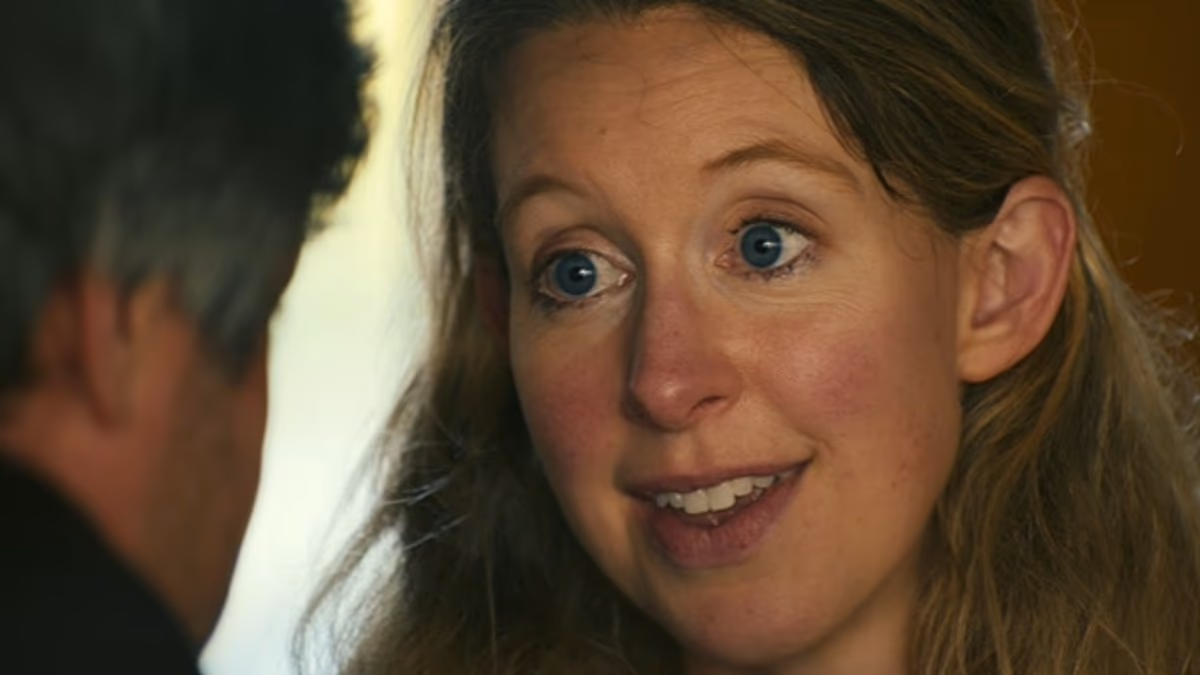
Above London’s Piccadilly Circus, a huge billboard displays an extreme close-up of Holmes’s wide eyes. The 20ft-high image watches eerily over the shoppers below.
If the eyes are the windows to the soul, what exactly lies behind Holmes’s unsettling stare? That is the question at the heart of the documentary.
Is she a sociopathic narcissist, an idealistic genius who overreached or simply a misunderstood eccentric? As one of the filmmakers observes, she is either “fully sincere” or “the most manipulative person who ever lived”. The uncertainty is precisely what makes her so compelling.
Holmes is a spectacularly fascinating figure, someone who appears to have emerged from the womb with a business plan and a Rolodex full of people to approach for money.

If the eyes are the window of the soul, what lies behind Holmes’s unsettling stare? This is the question that drives the film

Nathan Fielder, left, and Elizabeth Holmes are pictured in a scene from ‘You Can See Everything’
Her grand vision was a machine capable of analysing hundreds of health markers from a single drop of blood, including vitamin levels and thyroid function. Holmes described it modestly as “the most important thing humanity has ever built”, claiming it would transform healthcare and save millions of lives.
Once Holmes fixed her sights on global dominance, little seemed capable of stopping her. She abandoned a chemical engineering degree at Stanford University to launch Theranos. In the company’s early days, she reportedly slept for just four hours a night and relied on chocolate-covered coffee beans to sustain her through the remaining 20 hours.
There was one glaring problem: the machine did not work. During demonstrations, it clanked, malfunctioned and failed to deliver the promised results. Components fell away. It resembled someone presenting a GCSE science project as a time machine.
Holmes nevertheless behaved as if she had created the greatest invention since the wheel. How could she maintain that conviction? Some have linked it to the Dunning-Kruger effect, a form of cognitive bias in which people dramatically overestimate their own abilities. Lacking the skills to achieve greatness? Never mind. Fake it until you make it.
That was precisely Holmes’s approach. Fake Pfizer logos appeared on laboratory reports to make them seem more credible. Fake blood-test results were submitted to regulators. False projections claimed the start-up would generate $100 million (£76 million) in a year, when the true figure was closer to $100,000 (£76,000). Holmes even claimed the machine was being used in combat zones in the Middle East. The deception kept multiplying.
Perhaps her outsized ambition was part of the family inheritance. Her great-great-great-grandfather built Fleischmann’s Yeast, helping make the family one of the wealthiest in America at the turn of the century. Her great-great-grandfather founded Cincinnati General Hospital.
“I grew up with these stories about greatness,” Holmes has said. Her parents encouraged her to think on a grand scale. At one family dinner, her father reportedly sent a paper aeroplane across the table with “PhD” written on it.

Here lies an intriguing theme in the tale of Elizabeth Holmes: her power to beguile and bewitch the men around her
“No, Dad,” Elizabeth replied. “I want to make money.”
Employees at Theranos who questioned the failing technology were dismissed with ruthless efficiency. “What matters is the company,” Holmes told staff, sounding almost like a cult leader. An investment fortune of $1.6 billion (£1.2 billion) was assembled on a foundation of deceit – one of the boldest frauds since the Eiffel Tower was supposedly “sold” to a gullible scrap-metal dealer. At Theranos, many of those who were deceived were older, male investors.
And this reveals one of the most intriguing elements of the Elizabeth Holmes story: her ability to charm and captivate powerful men.
Former US Secretary of State George Shultz was among them. He joined the Theranos board, became deeply attached to its founder and called her every day, praising her as “brilliant”.
When Shultz’s grandson, who worked at Theranos, tried to expose the fraud, Shultz attempted to silence him and defended Holmes fiercely.
Shultz’s biographer went so far as to suggest that “he fell in love with Elizabeth Holmes… he was infatuated with her and she understood that and played on it in a calculating way”.
Other influential men were similarly taken with her, and spoke about her in glowing terms. Another former US Secretary of State, Henry Kissinger, admired her “ethereal quality”.

Though Holmes is pretty enough, she is not a bombshell. In homage to her idol Steve Jobs, she dressed every day in black polo–neck and trousers, blonde hair swept back
Stanford professor Channing Robertson said she was unlike any other student he had taught.
James Mattis, the retired four-star Marine general, considered her a “revolutionary”. Media tycoon Rupert Murdoch invested $125 million (£94.5 million) in Theranos and, after meeting Holmes for the first time, emailed to say he had “enjoyed every minute” of it.
In Bad Blood, the definitive account of the Theranos fraud, author John Carreyrou writes that Holmes “wrapped people around her finger and persuaded them to do her bidding”. One after another, they “fell under her spell”.
How did she do it? Holmes is attractive, but she is not a conventional bombshell. Like her idol Steve Jobs, she wore black polo-necks and trousers almost every day, with her blonde hair swept back. Occasionally she added a slick of red lipstick, but her appeal had little to do with the traditional image of a sex symbol.
MORE ON THIS: Fire Outside MetLife Stadium Sends Smoke Over Field After Jets’ Fifth Straight Loss
Holmes’s appeal came from somewhere less obvious. She combined two qualities that proved especially intoxicating to the men around her: confidence and vulnerability.
On one side, she was an intensely self-assured, black-clad force who could overwhelm seasoned investors with her certainty. On the other, she knew how to awaken their protective instincts. They were not merely investing in Holmes as a business proposition; they embraced her, invited her to family brunches, worried about her safety and fretted over her working in a dangerous neighbourhood.
She understood the role of the protégée, winning over powerful men by deferring to them and giving them her complete attention.

You Can See Everything, directed by Nathan Fielder and Lance Oppenheim, was unveiled at the Telluride Film Festival’s Sunday TBA
Above all, Holmes could bewitch people through what might be described as charismatic intensity, expressed most vividly through her wide, unblinking eyes.
In Bad Blood, it is remarkable how frequently people describe the force of Holmes’s gaze. One journalist who met her “felt himself drawn in by the young woman sitting across from him who was staring at him intently without blinking”.
A former school friend recalled that Holmes had “this intense way of looking at you while she spoke that made you believe in her and want to follow her”.
When Theranos’s chief financial officer entered her office, he was “immediately reminded of her charisma… the way she trained her big blue eyes on you without blinking made you feel like the centre of the world. It was almost hypnotic.”
That same hypnotic stare is repeatedly captured in You Can See Everything.
After being convicted on four counts of fraud in 2022, Holmes was sentenced to 11 years in prison. Aware of how badly her reputation had suffered, the disgraced entrepreneur made an astonishing decision: she invited two filmmakers to live with her family for more than a month between her conviction and the start of her sentence. Her lawyers had lodged an ultimately unsuccessful appeal, and she remained at home on bail while it was considered.
The filmmakers would be able to “see everything” and perhaps help reshape public perceptions of Holmes. One of them, Nathan Fielder, is an American comedian whose approach recalls Louis Theroux: dry, awkward and disarming, with a talent for encouraging subjects to lower their guard.
But as Fielder spends time with Holmes, it is he, rather than she, who appears to let his guard fall.

One minute she is showing flashes of the bleach–blonde tyrant of Theranos; the next she’s crying or cuddling her three–month–old baby daughter or son
Their prolonged looks and palpable chemistry are impossible to ignore. In one breathless exchange, Holmes stares silently at him with a faint smile, an unreadable expression flickering in her eyes.
We watch Fielder being drawn in, seemingly hypnotised by her intensity. It is all the more striking because, unlike the investors she persuaded, he already knows the darker story: the bullying, the sackings and the repeated lies.
He knows those lies could have cost people their lives, since sick patients were effectively used as guinea pigs for Theranos’s unreliable blood-testing machines.
Yet as the documentary unfolds, it strongly hints that Fielder, too, has been affected by Elizabeth’s charm.
“She was so different than I thought she would be,” he admitted recently. “She was disarming in real life.”
Like the investors she captivated, Fielder appears susceptible to Holmes’s potent combination of certainty and fragility.
One moment she resembles the bleach-blonde Theranos tyrant; the next she is crying, cuddling her three-month-old baby daughter or son, then nearly two, and looking like any other frizzy-haired mother you might pass in Walmart.
“In my life, I’ve never been so confused by a person,” Fielder reflects.
The story becomes even more complicated when toxic relationships enter the picture. In You Can See Everything, viewers expect Holmes to occupy the role of villain, yet another possible antagonist emerges in the shape of her own partner.
Billy Evans, heir to an extremely wealthy family, comes across as shifty and manipulative – and seemingly oblivious to how badly he presents himself.
He exerts control over Holmes in numerous ways, from criticising the way she scrambles eggs to taking charge of her social-media account, becoming her power of attorney and boasting that he can “literally do anything”.
Nor was Evans the first controlling man in Holmes’s life. During the rise of Theranos, she had a long relationship with Sunny Balwani, a technology executive 20 years her senior.
At her trial, Holmes alleged that Balwani repeatedly belittled her, telling her she “came across as a little girl”. Testifying tearfully, she described a pattern of physical and psychological abuse.
Now she appears to be caught up with another controlling partner. Even after her imprisonment, Evans has tried to profit from his connection to Holmes in ways the film reveals without spoiling its surprises. Suffice to say, he is not a good man.
This creates another mystery at the centre of You Can See Everything. Is Holmes so skilled at manipulating the filmmakers and the audience that she has cast her husband as the true villain, encouraging sympathy for herself? Or is she another woman trapped by an unpleasant, controlling man? Is she a victim or a manipulator, vulnerable or calculating?
Fielder rejects the notion that Holmes must fit neatly into one category. “Different things can be true about Elizabeth Holmes at the same time,” he says.
She remains an enigma, a shape-shifter and an unresolved riddle. Whether you loathe her or feel sympathy for her, she is mesmerising to watch – even if, in the end, you cannot truly see everything.


