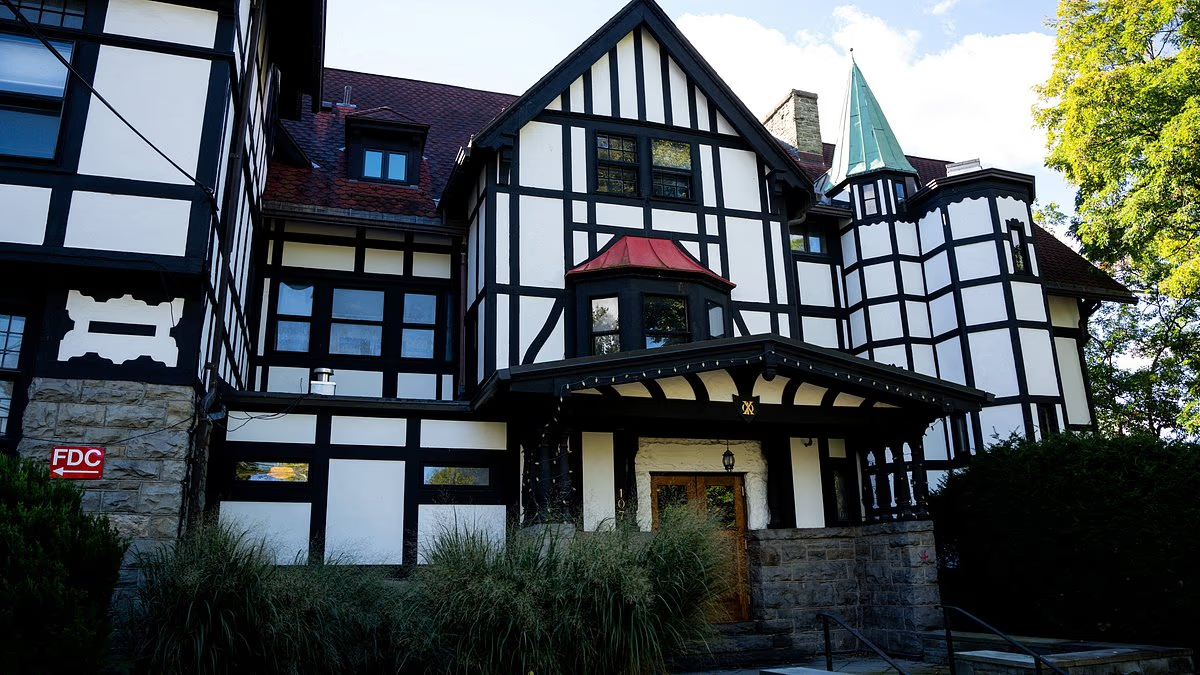

Cornell University is launching a sweeping examination of Greek life after public anger over a former student’s allegation that she was gang raped at a fraternity house in 2024.
University President Michael Kotlikoff announced the review on Monday, saying the university will examine the Greek system and its links to housing and residential life.
“This review will consider the future of fraternities and sororities at Cornell,” he said.
Cornell has already prohibited parties at fraternity houses for the rest of the year.
The decision comes only weeks after the university’s faculty senate approved a largely symbolic resolution declaring that it had “no confidence” in Kotlikoff’s ability to “effectively address the ongoing crisis of sexual assault at Cornell University.”
Meanwhile, an alumni petition demanding greater accountability from Cornell’s leadership has attracted tens of thousands of signatures.
In Monday’s statement, Kotlikoff conceded that members of the Cornell community had raised “necessary questions” about student safety and the university’s handling of a former student’s allegation that she was sexually assaulted at the off-campus Chi Phi house in October 2024.
“You have called for greater transparency and better communication about what we are doing so that nothing like this can ever happen at Cornell again,” he said.

Cornell President Michael Kotlikoff said the university would undertake a comprehensive review of campus Greek life

The move follows a civil lawsuit filed by a former student who says she was gang raped at the off-campus Chi Phi house in October 2024

Kotlikoff said Cornell had increased the number of campus activities “not centered around alcohol.” Students are shown walking across campus
“I am committed to doing the necessary work to rebuild that confidence: regularly communicating and engaging about the work we have been doing and will do to build a culture of care and responsibility.
“That commitment will be backed by regular reporting on our progress, through community messages and a new accountability dashboard on the Addressing Sexual Violence website,” Kotlikoff added.
The university also outlined several initiatives that have been introduced in recent weeks. One is a pilot late-night transportation service designed to help students get home safely on weekends, a program Kotlikoff said will be expanded next semester.
As part of its efforts to reduce the risk of sexual violence, Cornell has also broadened its selection of social events that are “not centered around alcohol.”
The university plans to reassess its drug and alcohol rules while exploring ways to provide more public gathering areas outside student residences.
Cornell has hired a new victim advocate in its sexual harassment and assault prevention office and added a case manager to its civil rights office, responding to criticism that survivors do not receive enough support after reporting abuse.
The university is also recruiting another case manager and two specialists focused on prevention.
Under updated procedures, survivors who want a criminal investigation may ask New York State Police to handle their cases instead of campus police. They may also request an investigation by the Ithaca Police Department or the Tompkins County Sheriff’s Office, Cornell said.

The new procedures allow sexual assault survivors seeking criminal charges to work with New York State Police instead of campus law enforcement
The university will require additional instruction on healthy relationships and sexual violence. An orientation session on those subjects, already offered to incoming students, will be extended to all undergraduates next semester.
Cornell also plans to create an academic center dedicated to research and education focused on preventing sexual assault on college campuses.
“All these efforts are in service of our goal to cultivate a culture of care and shared responsibility to keep each other safe,” Kotlikoff said.
“It is a culture that encourages speaking up, stepping forward and taking responsibility to care for and support each other, because how Cornell shows up for you and how you show up for each other truly matters.”

Students and faculty demonstrated against university administrators last month over their handling of the Jane Doe case

Cornell’s new scorecard tracking 25 initiatives shows that just one has been completed: the agreement with state police
To monitor its progress, Cornell has introduced a new scorecard covering the university’s planned reforms.
The tracker lists only one of the 25 initiatives as completed: the agreement with state police.
Of 16 recommendations issued by a sexual assault task force in March, none has been completed. Thirteen are listed as “in progress,” while three remain “planned.”
Even so, Iris Packman, a faculty sponsor of the no-confidence resolution, said the announcement showed that pressure from across the Cornell community was beginning to produce results.
“The president’s message and stated commitment to change would not have come about without the tireless advocacy from undergraduate students, graduate workers, faculty and staff who are working to hold this administration accountable for the unconscionably high rates of sexual violence at Cornell,” she told The New York Times.
MORE ON THIS: Sen. Markwayne Mullin Shares Theory Behind Recent Airport Chaos
The lawyer for the woman who says she was drugged and sexually assaulted by seven Chi Phi members at an off-campus house on October 19, 2024, said Cornell’s latest steps fall short.

Thomas Giuffra, who represents Jane Doe in the lawsuit, said Cornell’s response does not yet amount to sufficient accountability
“The university’s decision to review its Greek system, partner with external law enforcement and expand survivor advocacy comes only after Jane Doe filed a civil lawsuit, endured relentless public scrutiny and helped catalyze a global movement of survivors,” he said.
“True accountability is not achieved through reactive public relations milestones; it is measured by how an institution treats survivors before the public is watching,” the attorney said.
Giuffra said his client, identified as Jane Doe in court filings, “welcomes any genuine effort that prevents another student from enduring what she suffered.”
“However, meaningful reform requires full transparency into how past reports of sexual violence were mishandled, real consequences for those people and a permanent end to a culture that prioritizes institutional reputation over student safety.”
He added that Jane Doe “stands in solidarity with every survivor at Cornell and around the world who demands to be heard, believed and protected.”
Every man accused by Jane Doe has denied wrongdoing. Prosecutors previously declined to file criminal charges, saying there was insufficient evidence.
The Tompkins County District Attorney’s Office has since reopened the investigation. Cornell officials have also hired Sally Yates, a former Obama-appointed Justice Department official who was later dismissed by President Donald Trump, to examine the university’s response to the allegations.

New York Governor Kathy Hochul selected Attorney General Letitia James as special prosecutor in the alleged gang rape case

Separately, New York Attorney General Letitia James’ investigation encountered resistance after two Chi Phi members accused her of bias last month.
New York Governor Kathy Hochul had appointed James as special prosecutor in the Cornell sexual assault investigation.
But in September, James wrote on X: “What this young woman has been forced to endure is horrific and unacceptable. I’m holding her in my heart and in my prayers. To her, and to all survivors: you’re not alone. We stand with you.”
Gillio Lopes, one of the accused Chi Phi members, argued last month that the message showed James “is not objective.”
In a petition filed October 7 in Albany County Supreme Court and reviewed by Our News Outlet, Lopes claimed James’ statement demonstrated that she had already formed an opinion about Jane Doe’s allegations.
Winston Lee, another man named by Jane Doe, has likewise accused James of being biased.
A motion filed in Tompkins County Court by Lee’s attorneys, Teny Geragos, Marc Agnifilo and Jacob Kaplan, alleged that James’ comments had “prejudiced grand jurors” against Lee, according to an affidavit obtained by LAmag.
Four additional men named in the lawsuit have since said they will join the effort seeking James’ removal.
James and Hochul opposed the attempt to add those four men in a legal memorandum filed Monday.


Jane Doe accused Matthew Ingalls, left, and Jonathan Newell, right, among others, of rape. James argues the two cannot join the petition seeking her removal because they do not live in New York
The filing said two of the men seeking to join the Article 78 proceeding—Matthew Ingalls and Jonathan Newell, whom Jane Doe says she initially had intercourse with—live outside New York and are “not subject to the jurisdiction of this Court.”
James argued that they therefore cannot become parties to the proceeding unless they consent or appear before the court.
She further maintained that adding the men would prolong the case.
“Although [a] delay of a few weeks, like the delay already incurred here, is normally not unduly prejudicial, there is a substantial risk that this delay will be interminably prolonged by the proposed amendment because it contemplates adding new parties to this proceeding who apparently cannot be located,” the memorandum states.
“As a practical matter, adding new respondents whose whereabouts are unknown would result in protracted delay while Petitioner continues his effort to first locate and then serve these new respondents.”
James also said Lopes’ challenge to the appointment of Jacqueline Kelly to oversee the investigation “reflects a fundamental misunderstanding of the constitutional predicate for criminal investigations and prosecutions.”

James appointed Jacqueline Kelly to oversee the investigation
“Contrary to Petitioner’s contentions that the investigation must proceed without the AG’s involvement, in fact, it cannot,” James wrote, citing a ruling that it is unconstitutional to establish a special prosecutor other than an attorney general or district attorney because doing so would “take an essential function from a constitutional officer and give it to a different officer chosen in a different manner.”
She also pointed to New York executive law authorizing the attorney general to exercise prosecutorial powers when directed by the governor. In that situation, “the district attorney is divested of any prosecutorial authority.”
“That ultimate prosecutorial authority cannot be further divested from the Attorney General and installed in an unelected person,” James argued. “Rather, the AG as the sole constitutional officer currently vested with the constitutional and statutory prosecutorial powers and responsibilities must retain ultimate authority and control.
“Though the AG may be assisted by an unelected person, as she will here by the outside counsel, ultimate responsibility and accountability for the prosecution must remain with the AG, and her complete exclusion from the investigation is constitutionally impermissible.”


