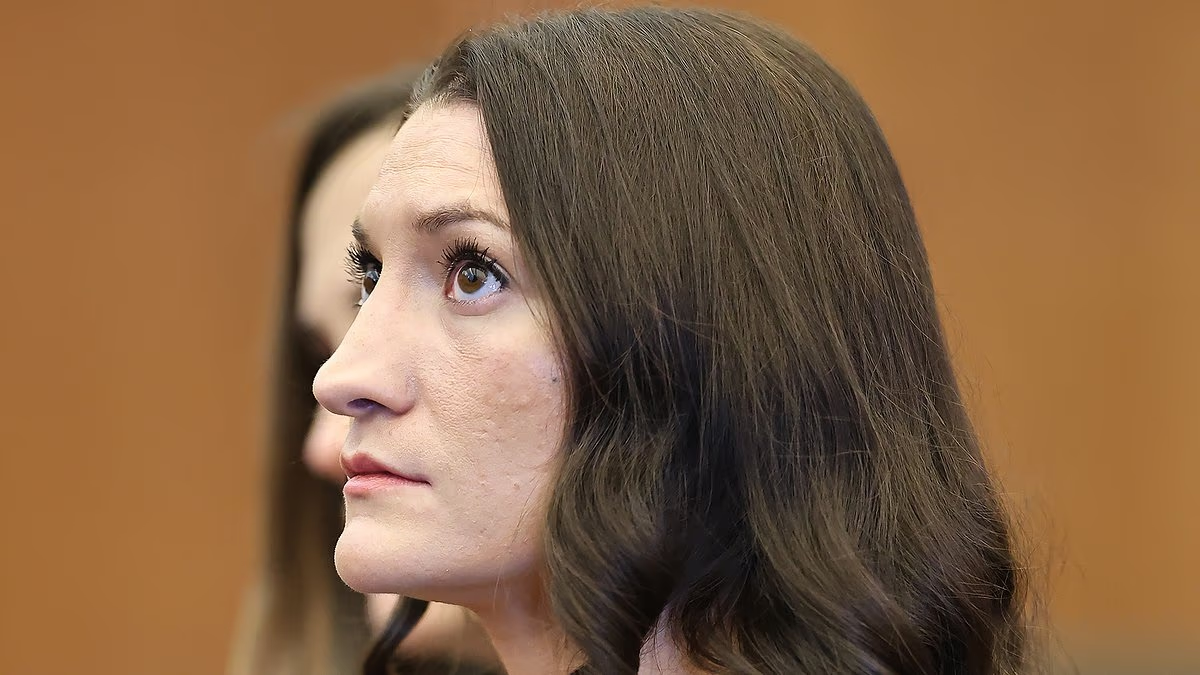
Lindsay Clancy has been given a new trial date after prosecutors indicated they intend to pursue first-degree murder charges following the collapse of her first trial in a deadlocked jury.
The mother of three appeared Monday morning in Plymouth County Superior Court in Massachusetts for a pivotal hearing, only days after a judge rejected her last effort to prevent a retrial.
The Plymouth County District Attorney’s Office has not formally confirmed the charges, but prosecutor Jennifer Sprague strongly suggested the state will again seek first-degree murder convictions.
“Given what the charges are, it requires a jury trial,” Sprague told the court.
Massachusetts defendants facing second-degree murder or lesser charges may choose a bench trial. The state’s insistence on a jury therefore indicates it is continuing to pursue first-degree murder charges.
After a tense exchange with prosecutors, Judge William Sullivan scheduled Clancy’s retrial for March 29, 2027.
Sprague said other murder cases that are older than Clancy’s have not yet reached trial and noted that she is scheduled to handle a 2014 homicide case in April.
Judge Sullivan pressed the attorneys to select a date in either March or April, ultimately settling on the March 29 trial date.

Lindsay Clancy is scheduled to face a retrial over the deaths of her three children on March 29, 2027

Clancy’s first trial involved three first-degree murder charges stemming from the January 2023 deaths of five-year-old Cora, three-year-old Dawson and eight-month-old Callan
The timing is important because Sullivan is required to retire in June 2027.
A later trial could therefore have forced another judge to assume responsibility for the case.
The hearing came two months after Clancy’s first trial ended in a highly publicized mistrial. It was expected to clarify whether prosecutors would try her again, which charges they would pursue and when proceedings would resume.
Until now, Plymouth County District Attorney Tim Cruz’s office had remained publicly cautious about its plans.
The uncertainty followed a jury’s failure to reach a unanimous verdict, with most jurors concluding that the prosecution had not proved its case beyond a reasonable doubt.
Clancy, 36, had faced three counts of first-degree murder in connection with the January 24, 2023 deaths of Cora, Dawson and Callan.
Prosecutors said the labor and delivery nurse strangled the children in the basement of the family’s Duxbury home before attempting suicide by cutting her wrists and neck and jumping from a second-floor window.
She survived the fall but was left paralyzed from the waist down.

Judge William Sullivan chose the retrial date after a tense exchange with prosecutors

Residents expressed anger and disbelief that Lindsay Clancy was prosecuted as jurors considered her fate

Patrick publicly supported Lindsay while privately selling the family home and relocating to New York City
Clancy has never disputed that she killed her children. However, she pleaded not guilty by reason of insanity, maintaining that postpartum psychosis and depression left her not criminally responsible for the deaths.
Jurors deliberated for 38 hours across seven days but could not agree on a verdict.
Eleven jurors favored finding Clancy not guilty because of a lack of criminal responsibility, while one juror believed she should be convicted of murder.
With the jury deadlocked, Sullivan declared a mistrial on September 4.
Near the end of deliberations, the jury foreperson sent the judge an extraordinary series of notes accusing the lone holdout, Michael Desronvil, of refusing to apply the legal standard of reasonable doubt.
Several jurors later repeated those accusations in media interviews. Desronvil has rejected the claims, saying he followed the law and had no doubt that Clancy was guilty.
For a second prosecution, the state could seek the same first-degree murder charges or pursue lesser counts, including second-degree murder or manslaughter.
The charging decision could significantly affect how the next trial proceeds.

Hours before the killings, three-year-old Dawson and five-year-old Cora built a snowman in the family’s yard with their mother

Neighbors told Our News Outlet they believed Clancy was suffering from severe mental illness when she killed her three children, Cora, Dawson and Callan
Under Massachusetts law, first-degree murder must be decided by a jury. Defendants facing lesser charges, however, may choose to have a judge determine the outcome in a bench trial.
At a hearing earlier this month, Sprague declined to disclose the prosecution’s strategy, saying prosecutors would wait for the court to rule on several motions before deciding whether to retry Clancy and what charges to bring.
Sullivan issued those rulings last week, rejecting defense requests to dismiss the case and to investigate Desronvil. The decisions cleared the way for a second trial.
Defense lawyer Kevin Reddington argued that the case should be dismissed on double-jeopardy grounds, claiming the mistrial might have been avoided had the judge questioned the holdout juror more extensively.
Reddington also requested an investigation into Desronvil, seeking access to his juror questionnaire, phone records and information about a 2021 arrest. The defense wanted to determine whether he had been truthful during jury selection and whether he used his phone while jurors were deliberating.
Sullivan, who is scheduled for mandatory retirement in June 2027, denied both motions on November 9.
Desronvil welcomed the decisions. His attorney, Heather O’Connor, said he wants to put the ordeal behind him and resume his ordinary life.
“Does this mean it’s over? Can I go back to living my life?” was his reaction to the news, she told Our News Outlet.
The judge also rejected a prosecution motion seeking a gag order in the case.
Although a retrial is now scheduled, the case could still end in a plea agreement.
Reddington has previously indicated that he would consider a deal, but only if Clancy does not have to serve time in prison.