
In a south London pub, Blackpool supporters are preparing for their team’s League One meeting with AFC Wimbledon when a message arrives: half the squad have been struck down by a sickness bug so severe that the starting XI will look unlike any they have seen before.
Three players are too ill to leave the team hotel, while the goalkeeper named in the line-up has not made a league appearance this season. The EFL does not consider the circumstances serious enough to postpone the fixture. Blackpool are already enduring a difficult run, with five defeats in their previous seven matches.
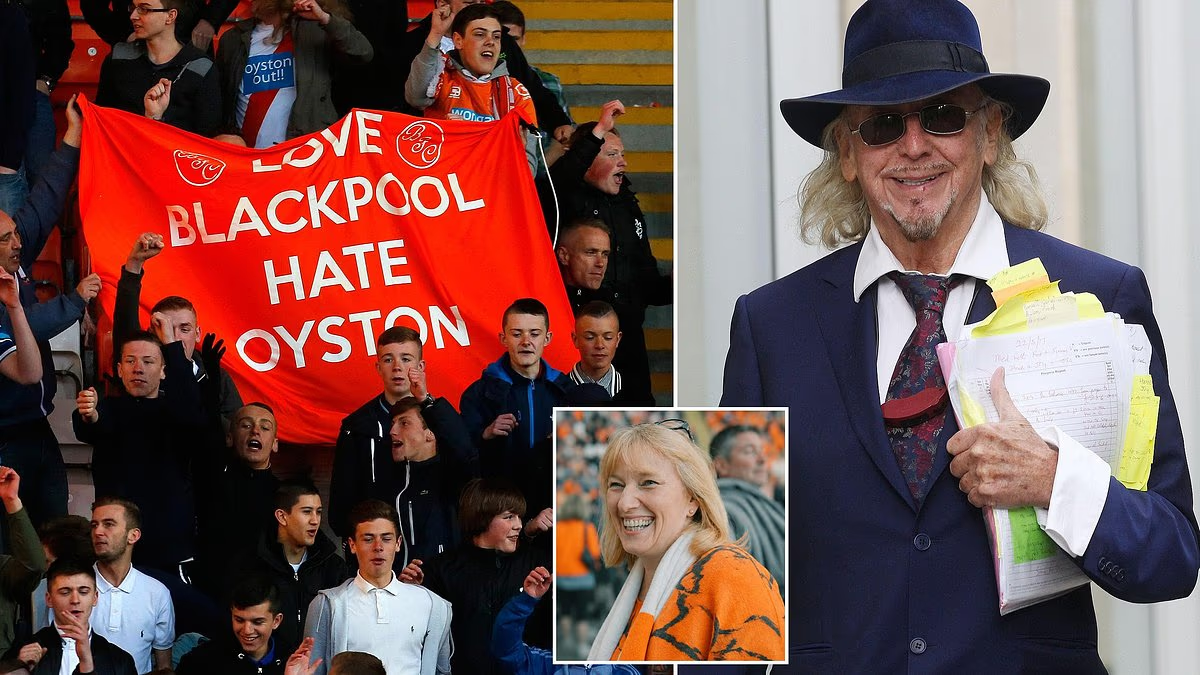
Episodes such as this underline the Blackpool fanbase’s remarkable sense of perspective, shaped by a long and often bitter campaign to remove one of British football’s most reviled owners, Owen Oyston.
‘We’re still here and we’re following our club home and away,’ says Andy Higgins, chair of the Blackpool Supporters Trust. Sitting with Higgins in the Earlsfield pub, his friend Dave Ragozzino adds: ‘We have a good relationship with the club. They ask us to explain to supporters what is happening, and they know we will help. Ten years ago, our club’s owners were suing us.’
The campaign that united these supporters and many others is chronicled in a superb new documentary, The Battle for Blackpool. Screening this week, it captures the imagination, determination and intelligence that fuelled their fight.
Oyston and his son Karl both agreed to take part. Oyston senior, wearing dark glasses and his familiar fedora, is interviewed at his stately home in the Forest of Bowland. His son Karl, who still appears consumed by anger and contempt for the supporters, is filmed clay pigeon shooting across the family estate.

Blackpool supporters watch their side suffer another League One defeat at AFC Wimbledon on Saturday

The Tangerines sit only two points above the relegation zone after losing five of their last seven league matches

Blackpool supporters waged a long and bitter campaign against former owner Owen Oyston, pictured in 2017
The documentary’s central figures are the supporters who organised the resistance: Christine Seddon, Tim Fielding and Ragozzino, alongside two fans who travelled in a Mk1 tangerine Golf GTI and twin sisters of advancing years who embraced the campaign’s guerrilla-style tactics.
Karl Oyston, who became chairman at his mother’s request after his father was jailed for rape in 1996, tells the filmmakers: ‘My father likes football. I didn’t.’
The family’s greed and sense of entitlement came into sharper focus after Oyston stumbled upon a managerial genius in Ian Holloway, who guided Blackpool into the Premier League for the 2010-11 season.
The Mail on Sunday’s Nick Harris revealed that Oyston senior had paid himself £11million from the Premier League windfall. Critics argued that the club appeared to receive little in return for promotion beyond a new sprinkler system. The battle against the Oystons gathered momentum. The Blackpool Supporters Trust, chaired at the time by Fielding, became its strategic and political force, supported by the inventive acts of disruption carried out by the Tangerine Knights.
One of the documentary’s most memorable sequences recalls a plan to smuggle tennis balls into Bloomfield Road for a home game against Burnley in April 2014, then throw them on to the pitch en masse. Supporters hid the “missiles” in their trousers, socks and bras.
‘I had them in my knickers,’ says Christine Atkinson, who appears alongside her twin sister, Pauline O’Rourke. ‘I didn’t have tennis balls. I had tangerines. They were softer and less uncomfortable!’
Karl Oyston’s family ridiculed the tennis-ball protest on social media. But tensions escalated when his father began suing ordinary supporters, including pensioners, over criticism directed at him.
‘My father created an entire department that searched message boards full-time so he could sue people,’ Karl Oyston tells the filmmakers.

‘I had tangerines in my knickers,’ says Pauline O’Rourke, right, who appears with her twin sister Christine Atkinson in the documentary about Blackpool’s battle with its owners

‘My father created an entire department that searched message boards full-time so he could sue people,’ Karl Oyston, pictured in 2010, tells the filmmakers
‘We felt like medieval peasants facing a king,’ says Tangerine Knight Kevin Quirke, who is interviewed with fellow campaigner Scott Koudellas inside the tangerine GTI, parked at Blackpool’s South Shore — one of the film’s many carefully observed touches.
Ragozzino lost his job and faced a £150,000 legal claim. Fielding, a solicitor, was warned that defending himself against Oyston’s action could cost more than £250,000. The Oystons ultimately forced him to pay £10,000 in cash and issue a public apology.
Karl Oyston admits how much he enjoyed the conflict with the supporters, recalling the ‘Oyston Out’ personalised number plate his wife gave him for Christmas as a way of keeping the joke alive. ‘She thought it was highly amusing. Which it was,’ he says.
He says suing elderly Blackpool supporters was his father’s idea. ‘But once the board makes a decision, you fight to the death to support it.’
Oyston senior insists he was entirely justified in taking £11million from the Premier League money. ‘Why wouldn’t we? Why shouldn’t we?’ he asks. ‘We owned the company. We had spent 25 years pouring money down the drain, with no realistic prospect of ever seeing any of it again.’
Fielding devised the strategy that changed the course of the dispute: persuading minority shareholder Valeri Belokon to launch a successful legal challenge against the Oystons. That eventually cleared the way for Simon Sadler, a Hong Kong-based financier and Blackpool native, to purchase the club.
The years since have not been entirely smooth. An interim board installed after Oyston’s removal included Ben Hatton, later Aston Villa’s chief operating officer, former Inter Milan chief executive Mike Bolingbroke and Fielding. However, a succession of respected figures have since departed.
Brett Gerrity, once a close friend of Sadler who helped persuade him to buy the club, resigned in 2023; the pair are no longer on good terms. Ben Mansford, the well-regarded former chief executive of Leeds and Barnsley, also left unexpectedly. Former sporting director David Downes was recently appointed CEO. During the upheaval, Sadler has not found a successful manager since Neil Critchley left in 2022 to join Steven Gerrard’s staff at Aston Villa.

‘We felt like medieval peasants facing a king,’ says Tangerine Knight Kevin Quirke, right, pictured with fellow campaigner Scott Koudellas inside the tangerine GTI

Christine Seddon was one of the leading figures in the campaign to remove the Oystons from Blackpool
None of that has changed the supporters’ view of Sadler, a lifelong Blackpool fan whose investment continues to provide the club with a top-eight budget in League One. He has funded improvements to the stadium and training ground, while the team’s playing surface is in excellent condition.
Yet Sadler’s own future at Bloomfield Road remains uncertain. He is on trial in Hong Kong over allegations of insider dealing connected to his former hedge fund and could receive a prison sentence if convicted.
A conviction would mean failing the EFL Owners’ and Directors’ Test, apparently forcing him to sell the club. A verdict is expected next February. Sadler, who has pleaded not guilty, has disclosed little about any contingency plans. He is believed to be willing to sell, but only to a buyer committed to acting as a genuine custodian of Blackpool.
‘He is acutely conscious of not putting Blackpool back in the position it occupied under Oyston,’ says one source.
‘The club is far better and more professional than it was,’ Seddon tells us. ‘But we lack experience in the football business. We do not currently have a proper board.
‘Managing a hedge fund — our owner’s professional world — does not always translate easily to football. It is a steep learning curve.’
In a recent interview, Oyston senior said he wanted to buy Blackpool back and give supporters a majority stake. ‘In 2015, we suggested that he walk away and leave the club’s assets to the fans,’ says Seddon.
‘He ignored us, yet now he is proposing this. These are deluded ramblings. Simon Sadler would not give Oyston the time of day.’

‘When I hear some supporters complaining about the club, I think: “Have you forgotten? Are your memories really that short?”’
Karl Oyston tells the documentary-makers that he has not spoken to his 92-year-old father since the family’s 32-year ownership of Blackpool ended in 2019. Asked whether he will ever see him again, he replies: ‘No. That ship has sailed.’
Blackpool, backed by a loud and loyal away following, lost 1-0 at Wimbledon. Manager Ian Evatt’s position will be under scrutiny when they meet fellow strugglers Wigan on Saturday, making the documentary a timely reminder of how far the club’s supporters have travelled.
‘Of course we want better results,’ Seddon says. ‘But when I hear some people complaining about the club, I think: “Have you forgotten? Are your memories really that short?” Our club became an opportunity for people who were dismantling it for their own benefit. There were moments when we thought we might lose it altogether.
‘But we are now in a place we had begun to believe we would never reach. We are grateful for that.’
The Battle for Blackpool will premiere in the UK on November 21 on Sky Documentaries and the streaming service NOW


