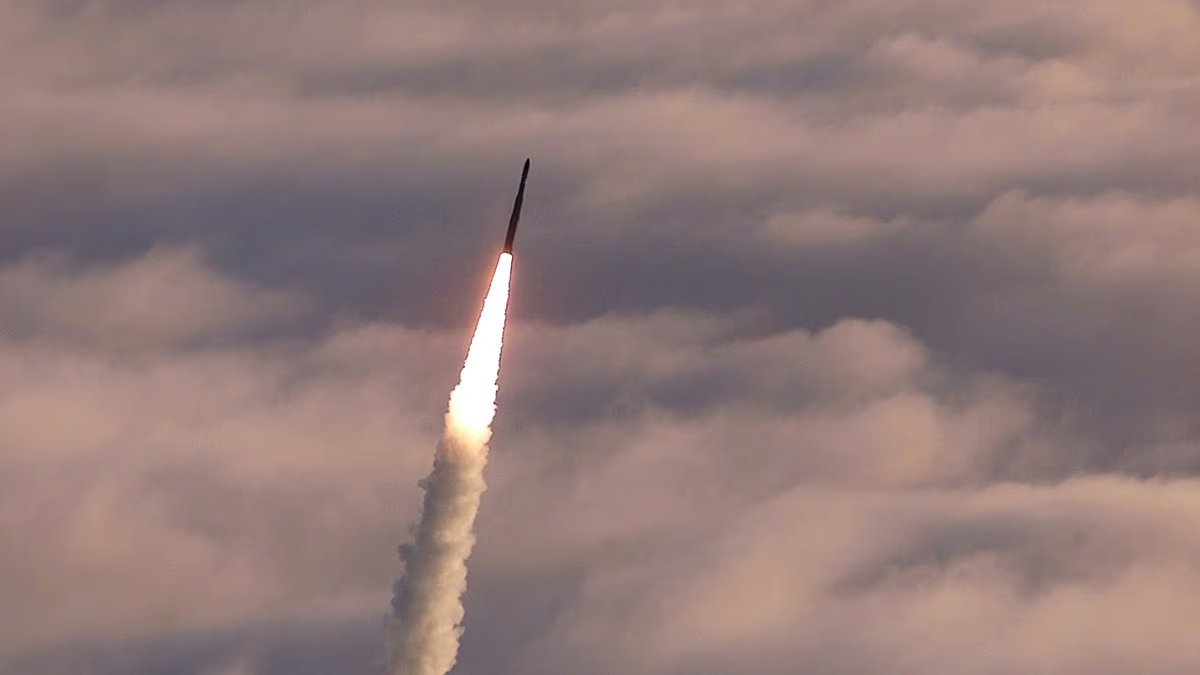

The US Air Force is set to fire an unarmed nuclear-capable missile from American territory in a scheduled test designed to measure the reliability and precision of one of the nation’s most powerful weapons.
A Minuteman III intercontinental ballistic missile is expected to launch from Vandenberg Space Force Base in California sometime between 11:01 p.m. PT on Tuesday and 5:01 a.m. PT on Wednesday.
After liftoff, the missile will travel about 4,200 miles over the Pacific before its unarmed reentry vehicle lands in a designated target zone near Kwajalein Atoll in the Marshall Islands.
The land-based Minuteman III is a central element of the US nuclear arsenal. It can reach speeds of roughly 15,000 mph and has a range of more than 6,000 miles. Military officials emphasized that the launch was planned years ago as a routine readiness exercise and was not prompted by current international tensions.
The test is nevertheless taking place amid a period of heightened concern. CNN reported Monday that US intelligence suggested Iran was exploring plans for a potential dirty bomb or chemical weapons attack in Washington, DC, possibly aimed at senior officials in the Trump administration.
Officials characterized the reported activity as contingency planning rather than proof that an attack was imminent. The White House said it had not identified any credible threat to the US homeland, KRDO reported.
The missile launch also follows a series of recent disruptions, including Thursday’s worldwide Microsoft outage, a nationwide flight grounding on Friday and reports of problems affecting banking services on Monday.
Separately, researchers said Monday that a cyberattack had injected malicious code into websites operated by 178 organizations through the Optimizely platform. The code was designed to steal payment information and cryptocurrency from website visitors.


Air Force explains the purpose of the Minuteman III launch
During the exercise, military teams will monitor the missile throughout its flight, gathering performance data to evaluate its accuracy, dependability and readiness for operational service.
Air Force Global Strike Command said: ‘This routine test, designated Glory Trip 257, was scheduled years ago and is not in response to world events.
‘The purpose of the ICBM test launch program is to validate and verify the effectiveness, readiness and accuracy of the weapon system.’
The Minuteman III is one of two ballistic missile systems currently operated by the United States. The other is the submarine-launched ballistic missile, or SLBM, carried aboard nuclear-powered submarines.
Together, these systems form a critical part of America’s nuclear deterrent, with the Minuteman III capable of delivering a nuclear warhead to targets around the globe.
The decades-old Minuteman III is expected to be replaced by the LGM-35A Sentinel. The Air Force anticipates that the new missile will begin entering service during the early 2030s.
The service has called Sentinel ‘the most cost-effective option for maintaining a safe, secure, and effective land-based leg of the nuclear triad.’ The system is intended to remain in service through 2075.

Trump responds to Iran reports while downplaying outage concerns
President Donald Trump said Tuesday that the US was treating the reported Iranian planning ‘very seriously’ and warned Tehran that it would face severe consequences if an attack took place.
Speaking to reporters after arriving in the Philippines, where he was attending the Association of Southeast Asian Nations summit, Trump also played down concerns surrounding the recent technology, aviation and banking disruptions in the United States.
‘It’s life. When you’re big and powerful and have all the money, things like that happen,’ the president said. ‘It’s fine.’
Authorities have said there is no evidence linking the earlier outages to cyberattacks. However, Monday’s discovery of malicious code on websites operated by 178 organizations highlighted a separate danger facing the online services used by millions of Americans.
Researchers found the code in digital tools used by organizations including Zoom, CNN, the BBC, HSBC, Equifax, Salesforce, Peacock, IKEA, Fox News, NPR, the ASPCA and Invisalign.
The campaign focused on Optimizely, a platform that businesses use to experiment with website designs, layouts and features.
Attackers exploited the platform’s customization functions to place harmful code on webpages. Because the code was delivered alongside legitimate software through Optimizely’s trusted infrastructure, it was more difficult for security teams to spot.
The malware was built to divert cryptocurrency payments, collect credit card information submitted through some online forms and compromise iPhones and iPads affected by security vulnerabilities.
Researchers said they had traced cryptocurrency payments worth more than $7,000 to wallets controlled by the attackers. The total number of people whose card data may have been taken, along with the number of devices successfully compromised, remains unclear.


