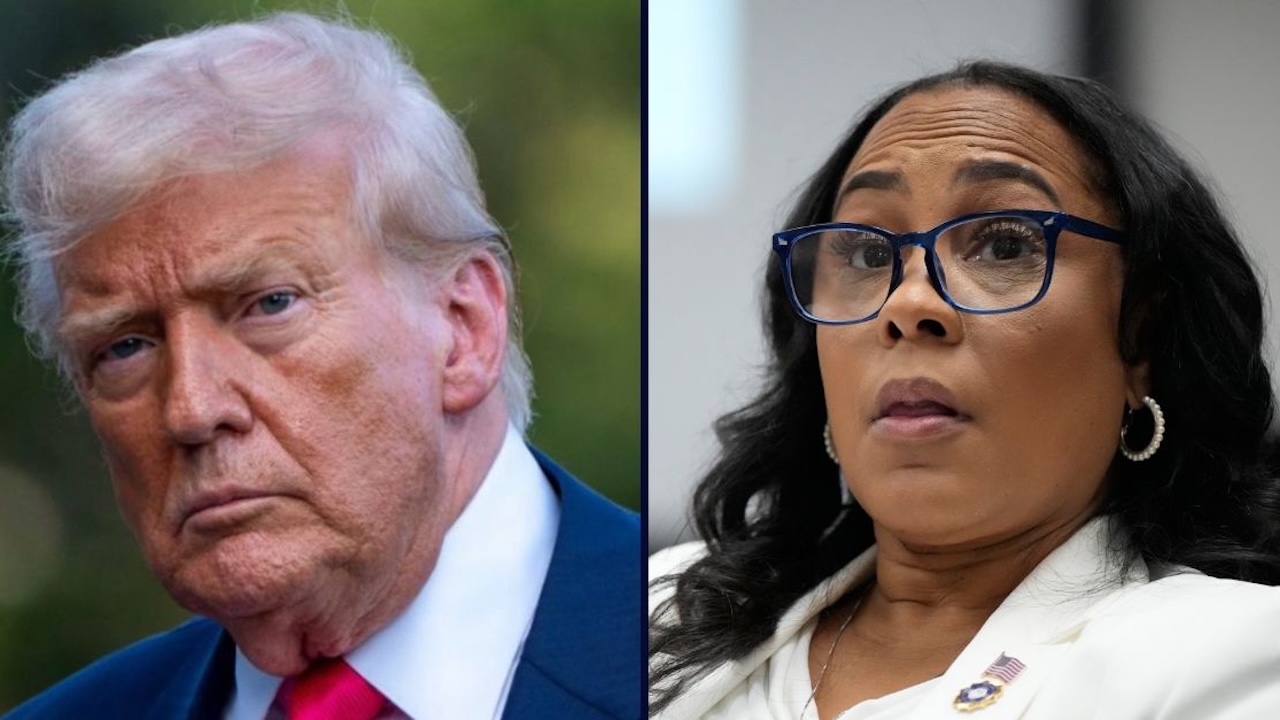

Left: President Donald Trump walks away from Marine One after landing on the White House South Lawn on Tuesday, July 15, 2025, in Washington (AP Photo/Alex Brandon, File). Right: Fulton County District Attorney Fani Willis appears at the Georgia State Capitol while answering questions from a Georgia Senate panel about her prosecution of President Donald Trump on Wednesday, Dec. 17, 2025, in Atlanta (AP Photo/Brynn Anderson).
Fulton County District Attorney Fani Willis’ office told a three-judge panel of the Georgia Court of Appeals on Tuesday that Willis, whom the court deemed “wholly disqualified,” was improperly denied the opportunity to intervene as President Donald Trump and other former RICO defendants pursue millions of dollars in legal fees.
Judges Elizabeth Gobeil, J. Wade Padgett and Ken Hodges III immediately questioned Chief Senior Assistant District Attorney Donald Wakeford after he described the dispute as “quite literally” unprecedented under Georgia law.
Wakeford argued that Fulton County Superior Court Judge Scott McAfee made “clear errors” by refusing to let Willis’ office participate in the legal-fee proceedings.
Wakeford maintained that the fee dispute is “wholly distinct” from the RICO prosecution itself because it arose from an earlier criminal case but is not a criminal proceeding. The RICO case, he said, “has ended,” making the fee issue more comparable to a contempt proceeding.
“If you were to look at an appeal from a contempt matter and you looked at the underlying case number, it would be a criminal case number. That doesn’t mean what you’re seeing is a criminal proceeding,” Wakeford said. “It doesn’t mean the state of Georgia’s interests are implicated in that proceeding, and it doesn’t mean that a prosecutor, a DA, could stand in the stead of the person whose rights are at risk in that appeal.”
Wakeford was referring to Peter Skandalakis, executive director of the Prosecuting Attorneys’ Council of Georgia. Skandalakis appointed himself “District Attorney Pro Tempore” after the Georgia Supreme Court declined to review or overturn Willis’ disqualification from the case.
The Georgia Court of Appeals previously ruled 2-1 that McAfee “erred by failing to disqualify DA Willis and her office.” The majority said this was a “rare case” in which the “significant appearance of impropriety” alone required Willis and her office to be “wholly disqualified.”
McAfee had ruled that either Willis or Nathan Wade, the special prosecutor she selected and with whom she had a romantic relationship, would have to leave the case.
After the disqualification dispute was resolved, Skandalakis formally entered a nolle prosequi, abandoning the prosecution in order to “serve the interests of justice.” The former RICO defendants then pointed to a newly enacted Georgia law that “shall” entitle them to an award after “improper conduct” by Willis.
Wakeford argued that Skandalakis did not adequately represent Willis’ office and emphasized that “we haven’t been disqualified from this matter.”
“The interest of the taxpayers in seeing that these funds, which are otherwise supposed to be allocated to the prosecution of crimes in the Atlanta Judicial Circuit by the DA’s office, are imperiled by these claims,” Wakeford said. “If they are not rigorously evaluated and contested, and the reasonableness of them assessed by some adversarial party, then otherwise the interests of the taxpayers are completely disregarded.”
Padgett then interrupted.
“Just because we haven’t seen it, do you contend the legislature does not have the authority to do it?” the judge asked, referring to Georgia Code 17-11-6.
After pausing, Wakeford replied, “I would say that, yes, the legislature does not have the authority to do it.”
“I would say this is an unconstitutional statute,” he added.
READ MORE: Mom Seeks Answers After Son Leaves ‘Horrible Note’ and Vanishes
“That’s something for another court in another day,” Hodges said. Wakeford did not dispute that characterization.
The district attorney’s office responded that the unresolved questions were “part of the problem.”
“We’re here answering a very specific question, talking about adequate representation, but there are all these other issues that are created by this statute, by its novelty, by its confusion, that need to be fully addressed, and that we did not have the opportunity to participate in because of how this order was handed down,” Wakeford said.
Chris Anulewicz, representing the former RICO defendants, pushed back, saying the matter was neither unprecedented nor confusing.
“This is an easy case,” Anulewicz said, defending the Georgia General Assembly’s authority to enact the law. “Just because the case is over doesn’t mean that this statutory right for fees isn’t in the [criminal] case. The General Assembly knows what it’s doing.”
Padgett asked whether there was “any question” that Section 17-11-6 applied, noting that the law is based on a finding of improper conduct.
“The trial judge found an appearance of impropriety and found that actual misconduct had not been established,” Padgett said. “Is that problematic?”
Anulewicz said he did not believe it was, because Willis’ conduct created an “appearance of impropriety.”
“Did that conduct cause the disqualification?” Gobeil asked.
“Absolutely,” Anulewicz replied.
“And did it cause the dismissal, or what’s your perspective?” Gobeil followed up.
Hodges also asked, “Does it matter at all whether or not the conduct was the reason for the dismissal?”
Anulewicz said it did matter “for the purposes of” Section 17-11-6.
“There is an improper conduct element to the award of attorney’s fees, just like there is if you are acting in bad faith or all these other things that you put into attorney’s fees-type provisions,” Anulewicz said. “Here, yeah, it becomes a question. The trial judge is going to have to find that there was improper conduct. I think the record supports that.”
Wakeford argued that the “unique circumstances and facts of this case required” McAfee to “understand and to consider how strange this was” when he placed “the very party whose decision initiated these proceedings” — Skandalakis — “in charge of representing the interests of the DA’s office, whose interests are imperiled by these proceedings.”
The post ‘We haven’t been disqualified from this’: Fani Willis calls the fee law ‘unconstitutional’ and says it created a ‘strange’ situation after Trump’s RICO case first appeared on Law & Crime.


