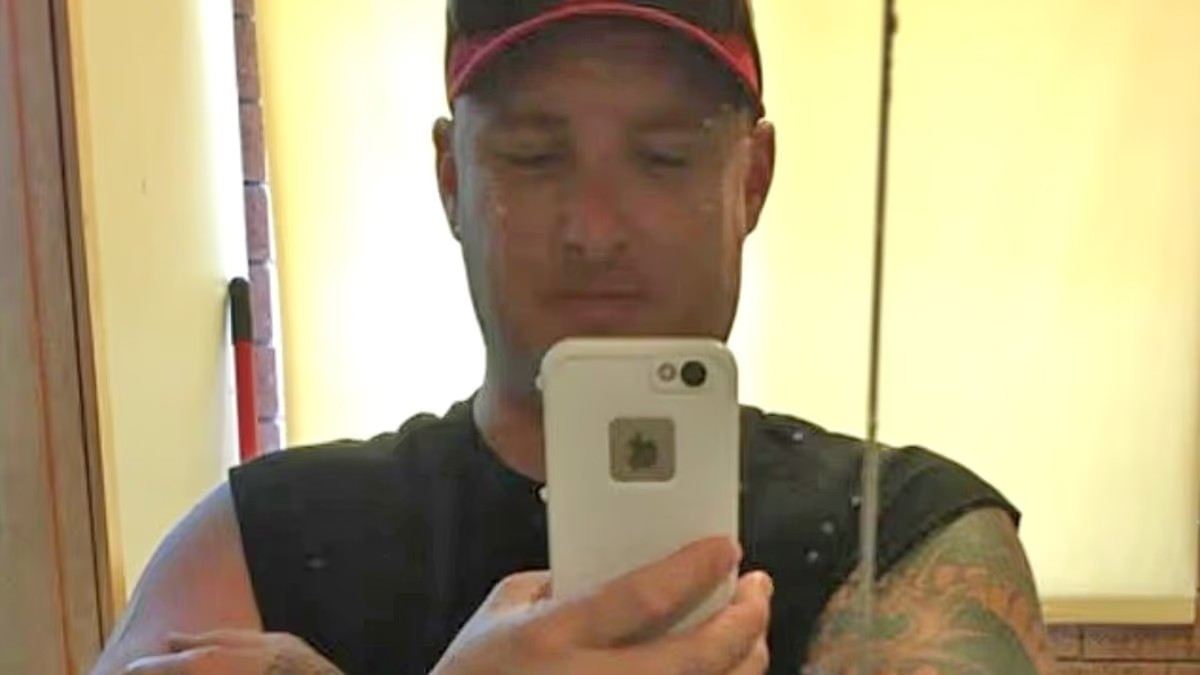

A Supreme Court of Victoria judge has granted bail to a man accused of murdering his mother-of-three neighbour, citing serious concerns about his deteriorating health while in custody.
Melonie McKay, 53, a mother and grandmother, died after being struck on Seston Street in Reservoir, north Melbourne, in February, leaving her family devastated.
On Wednesday, her neighbour Luke Rainey, 44, was released on bail despite facing a murder charge over her death.
‘Take care of yourself,’ Justice Rita Incerti told Rainey as he was released from prison.
‘And hopefully the treatment will be administered in much better circumstances than what you have experienced today.’
Crown prosecutor Cara Foot had strongly opposed the bail application, arguing Rainey continued to pose an unacceptable risk to the community.
‘The allegation is, of course, exceptionally serious, and our submission is that the case is a strong one,’ she said.
‘We say there is a strong inference that the driving was deliberate.
‘Of additional concern, particularly in relation to the unacceptable-risk issue, is the applicant’s previous history.’

Luke Rainey, 44, has been granted bail despite being charged with murder.
The court heard Rainey had an extensive criminal record involving family violence and driving offences, although he had never previously breached bail conditions.
‘We say that history, although some of it is dated, points to significant difficulties managing anger and controlling his emotions when faced with disputes that, on their face, appear relatively minor,’ Ms Foot said.
Much of the alleged incident was recorded by CCTV, while one of Ms McKay’s children also witnessed what happened, the court heard.
No motive was put forward for the alleged attack, but Ms Foot argued the evidence indicated Rainey’s intention was clear.
Rainey’s barrister, Sandra Wendlandt, however, submitted that the circumstances raised genuine questions about her client’s intent.
The court heard Rainey cooperated with police after the alleged attack, including identifying the locations of CCTV cameras around the neighbourhood.
‘Although he has a lengthy criminal history, including traffic and violence-related offences, he has not breached bail conditions,’ Ms Wendlandt said.
Rainey was diagnosed in custody with rapidly progressive interstitial lung disease, the court heard.
Without proper treatment, the illness would be fatal, it was told.
While in prison, Rainey has needed continuous supplementary oxygen and hospital treatment lasting several days each month.
MORE STORY: Marco Rubio Addresses Dirty Bomb Threat and Prospects of Trump-Kim Meeting

Justice Rita Incerti expressed concern about the welfare of the accused while he remained behind bars

Melbourne mother-of-three Melonie McKay was allegedly struck and killed in her driveway
Rainey spent about three months in hospital after becoming critically ill, including periods in intensive care and an induced coma, the court heard.
Since returning to custody, he has continued to require oxygen and has regularly been admitted to St Vincent’s Hospital for intravenous medication. Those stays have lasted between three and 11 days, even though the same treatment would generally be provided through half-day outpatient appointments in the community.
Ms Wendlandt said Rainey’s imprisonment had become considerably more difficult because he depended on oxygen around the clock, had less access to outdoor recreation, faced a greater risk of infection and had reportedly experienced occasional difficulties obtaining oxygen.
The court also heard Rainey had only recently appeared before a court over an assault involving another woman.
‘Most recently, there was an assault of a female, for which I understand you were sentenced to a good behaviour bond, with the matter adjourned,’ Justice Incerti said.
‘There are at least 16 incidents in which you have perpetrated family violence against your former domestic partner, your son and your daughter.
‘However, I note there is no current family violence order in place today, and the rest of your criminal history has developed over a considerable period.’
The judge said Rainey’s past offending included ‘anger’, ‘threats’ and various forms of ‘reckless conduct’.

Police tape covered a ute at the property after a crime scene was established
‘And that conduct extends across a fairly long period of time,’ the judge said.
‘You have struggled in the past with your conduct and behaviour while living in the community.
‘At the heart of this application is what is described as your special vulnerability, which in your case is, unfortunately, your physical health and illness.’
Justice Incerti ultimately found that Rainey’s illness satisfied the demanding test for exceptional circumstances and granted him bail.
‘You have a very serious illness that has developed relatively recently, and I imagine it has had a catastrophic effect on your health,’ she said.
The judge noted that Rainey’s condition would be fatal without treatment and said the risk of infection in custody was ‘very serious and much more serious than for someone who did not have your illness’.
Rainey was due to travel directly from prison to St Vincent’s Hospital, where doctors would begin a more appropriate treatment plan.
He is expected to return to court later this month.


