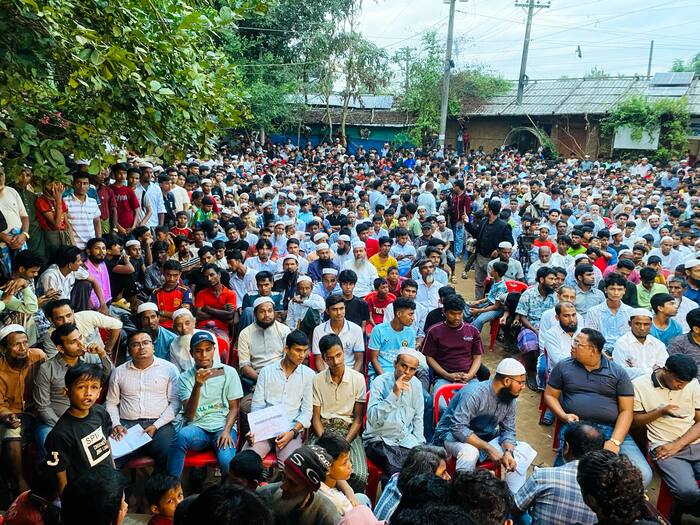


COX’S BAZAR – Hundreds of Rohingya refugees in Bangladesh gathered before a large screen at their sprawling camp in Cox’s Bazar, watching news from the Netherlands as the U.N.’s top court ruled that Myanmar committed genocide against the Rohingya minority during a brutal 2017 military operation.
For many, Thursday’s historic verdict represented a “small victory” and offered a glimmer of hope that they might one day return safely to their homes in Myanmar, just across the border from Bangladesh.
Some said they would not feel “fully satisfied” until that happens.
The landmark judgment found Myanmar responsible for genocide against its ethnic Rohingya population. It marked the first time the court had ruled that a state committed genocide.
The Hague-based International Court of Justice also ordered Myanmar’s military-backed government to ensure the Rohingya can return safely, provide reparations to Rohingya Muslims and prosecute those suspected of taking part in the genocide.
Still, questions remain over how much of the ruling can be enforced. The court’s decisions are final and legally binding, but it has no direct mechanism to compel compliance beyond referring violations to the U.N. Security Council.
There was no immediate response to the ruling from Myanmar’s delegation in The Hague or from the government in Myanmar.
At the Cox’s Bazar refugee camp, Rohingya refugees shared their hopes and concerns with The Associated Press.
Mohammad Rofik, a Rohingya community leader, called the verdict “a victory” because it acknowledged the genocide and the suffering of the minority in the Buddhist-majority country. But he stressed that the ruling was “not an end” to their ordeal.
“Justice has started,” Rofik said, adding that the Rohingya still have “a long way to go.”
For Sayed Ullah, another Rohingya community leader, the decision was also a historic recognition of the Rohingya as a distinct ethnic group.
“Myanmar denies the existence of the Rohingya, but now the (U.N.) court made it clear,” he said.
“The Rohingya have their own distinct culture, their own language, their own land and everything else that defines an ethnic group,” Ullah said. “We, the Rohingya, have all the characteristics of a distinct ethnic group.”
Other refugees responded forcefully, saying the international community must hold Myanmar’s authorities accountable.
“The court has stated and established that genocide was committed against the Rohingya people,” said Mohammad Osman, a Rohingya refugee. “Based on this ruling, the entire Rohingya community is calling on … (the world) to impose severe punishment on Myanmar.”
In August 2017, Myanmar’s military launched what it described as a clearance campaign in Rakhine state after an attack by a Rohingya insurgent group. The operation prompted accusations that security forces carried out mass killings and rapes and burned thousands of homes.
The Hague-based court said evidence showed that Myanmar forces killed about 10,000 Rohingya. Under the 1948 Genocide Convention, the court had to determine whether there was an intent to destroy the Rohingya “in whole or in part” to establish that genocide had occurred.
About 1.2 million Rohingya refugees now live in Bangladesh, most of them in crowded camps across Cox’s Bazar district. They face harsh conditions, including fire risks, infectious diseases, monsoon landslides, inadequate sanitation and strict limits on their ability to work.
Bangladesh has urged the international community to help facilitate the refugees’ repatriation.
___
Associated Press writer Julhas Alam in Dhaka, Bangladesh, contributed to this report.


