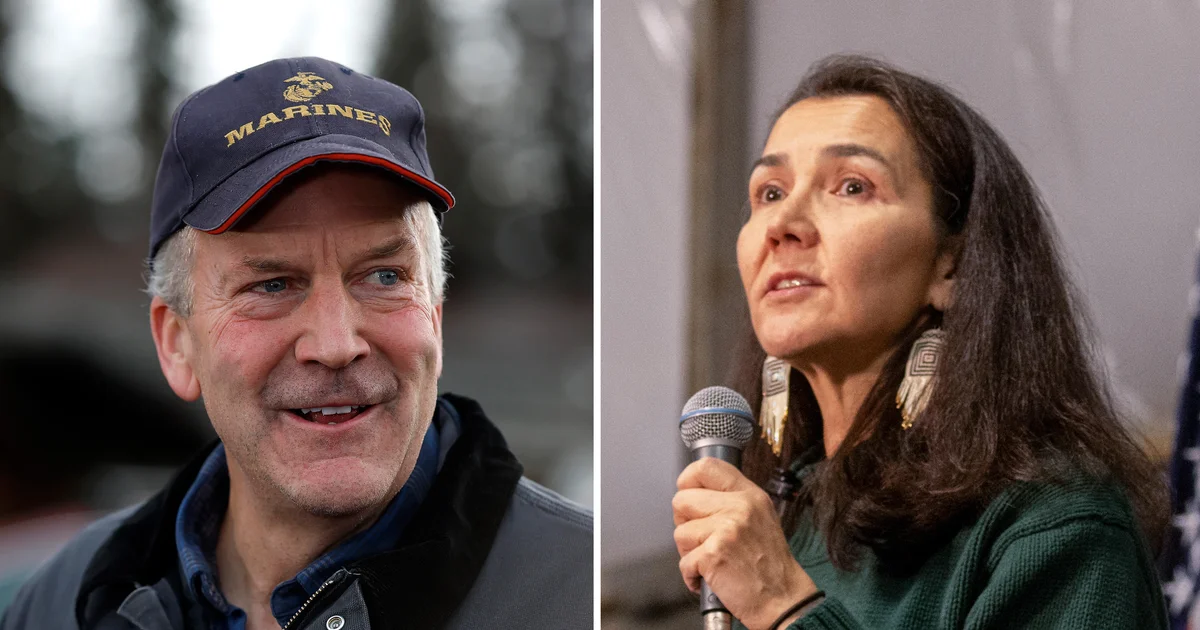

The Trump administration on Thursday moved to effectively withdraw its lawsuit challenging the certification of Democrat Mary Peltola’s victory in Alaska’s U.S. Senate race, ending a widely criticized effort by President Trump to keep one of his political opponents from taking office.
The case focused on the appearance of a second candidate sharing the same name as the incumbent, Republican Sen. Dan Sullivan. The Alaska Supreme Court had already ruled that the second Sullivan’s candidacy was lawful and that he could remain on the ballot. Earlier this month, a federal judge in Alaska dismissed the Trump administration’s lawsuit.
State attorneys, despite Alaska’s Republican control, also challenged the administration’s position, describing the case as legally “meritless” and filing papers supporting its dismissal. On Thursday, the administration asked an appeals court to declare the matter moot, two days after the election was resolved.
In a filing, Justice Department lawyers asked the 9th U.S. Circuit Court of Appeals to vacate the lower court’s dismissal—effectively wiping away the loss—and then throw out the case on procedural grounds. The department argued that the court “should hold that this case is moot, vacate the underlying order, and remand for dismissal on that ground.”
“The United States therefore reluctantly acknowledges that there no longer exists any means of ‘determin[ing] whether votes cast for Daniel J. Sullivan were meant to be cast for Senator Sullivan,’” Associate Attorney General Stanley E. Woodward wrote in the filing.
The move followed Peltola’s decisive victory, which made her the Democrats’ 56th senator and gave the party its ninth Senate pickup in a midterm rout. Peltola received more votes than the other candidate, Dan J. Sullivan.
Responding to the filing, Peltola said the election’s outcome should allow the state to move ahead. “Now that the election is over and the voters sent a very clear message about the direction they want our state to go in, I’m eager to move forward and get to work on behalf of all Alaskans,” she said.
FIND OUT MORE: Richard Sherman’s Wife Ashley Moss: Her Business Ventures in 2026
The Justice Department filed the lawsuit at Trump’s request, arguing that Peltola’s victory should not be certified until investigators could determine whether voters had been confused by the second Sullivan’s presence on the ballot. The administration did not explain how such an inquiry could be conducted given the secrecy of voting.
The lawsuit came before The New York Times published texts and other documents that appeared to indicate Peltola’s campaign helped recruit a retired schoolteacher from the small fishing community of Petersburg. He appeared on the ballot as Daniel J. Sullivan Jr., without a party affiliation, distinguishing him from the senator, who was listed as a Republican and the incumbent. Dan J. Sullivan has repeatedly said he ran independently, while Peltola denied having any role and said she was “not interested in tricking voters.”
Trump also called for Peltola to face prosecution over the alleged scheme, while federal investigators descended on Alaska ahead of Election Day. Decoy candidates such as the second Sullivan have featured in American politics for decades. Trump’s allies have used similar tactics, although such efforts have occasionally resulted in criminal charges.
Alaska Republican Gov. Mike Dunleavy separately ordered an investigation into Peltola’s campaign after the Times report was published. Before Election Day, the Justice Department’s top prosecutor in Alaska described the reporting as “troubling.”
The case marked at least the second instance since the Nov. 3 election in which the Justice Department sought to abandon a prominent lawsuit involving state election procedures.
Only days after Democrats captured control of Congress and scored major victories in gubernatorial and state legislative races, the Justice Department asked to dismiss a lawsuit aimed at stopping California officials from counting approximately 20,000 ballots. The Trump administration claimed the ballots were cast by suspected noncitizens, but election officials disputed the underlying data and said the government’s list included numerous U.S. citizens.


