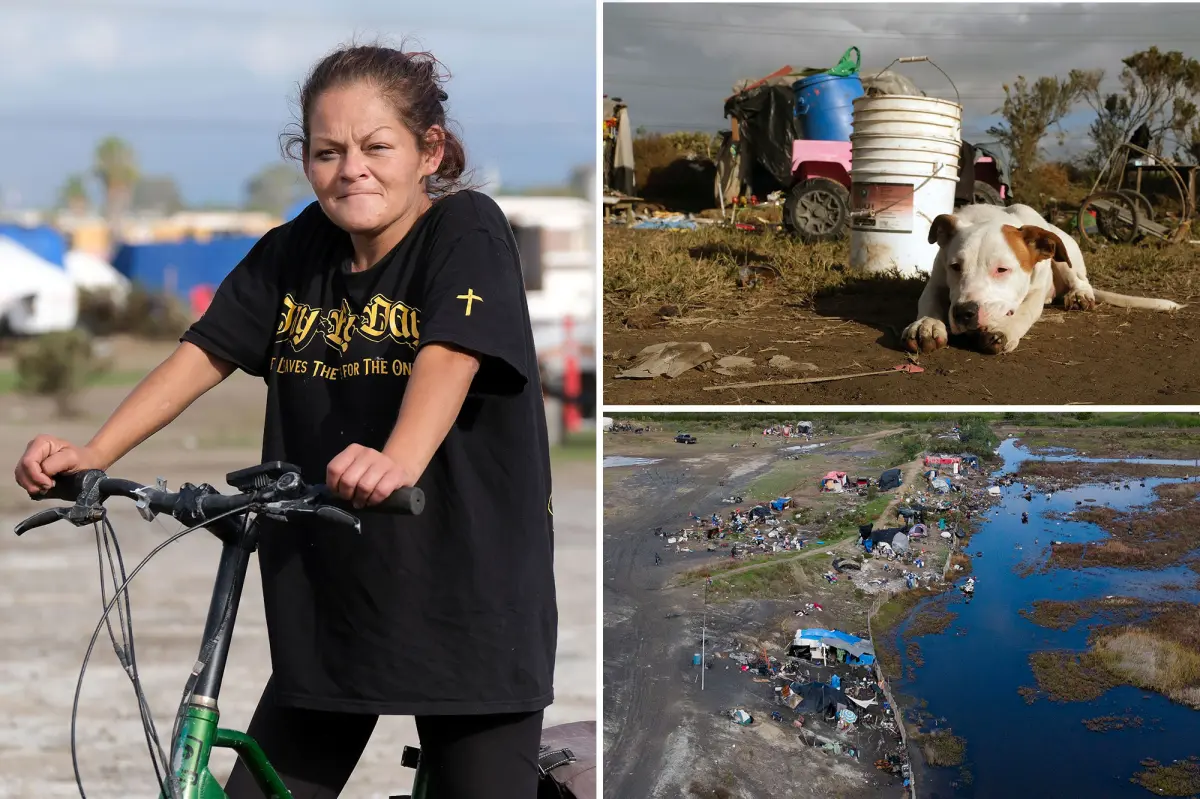

Dozens of unhoused people have made their homes at a radioactive waste site in an otherwise scenic Southern California beach community, refusing to leave despite official orders and warnings about cancer-linked contaminants beneath the ground.
Roughly 135 people, including children, are living in tents, cars and recreational vehicles at the former Halaco Engineering Company smelting and recycling facility in Oxnard. Heavy metals and radioactive isotopes are reportedly escaping from the dry, contaminated soil and entering the surrounding air.
On Oct. 30, Oxnard officials ordered residents to leave the 11-acre property by Nov. 16. Yet when the California Post visited the site that day, the encampment was still occupied — and residents said they had no intention of moving.
“I’m going to stand my ground for sure,” said Maria Fuller, 51, who lives at the site. “We’re not bothering anybody. I can’t tell any difference from the radioactive stuff.”
Fuller shares a makeshift shelter with her dog, George. Built from discarded tarps and pieces of wood, it includes a sleeping area, a small kitchen with a gas stove, a bathtub filled with water carried in by hand and a plastic basin for washing clothes.
By the standards of the encampment, Fuller’s setup is comparatively comfortable. The former industrial property lies only a few hundred yards inland from Ormond Beach, in an industrial section bordering a nature preserve. A dirt road leads into the marshy area, though heavy rain can wash it out.
About half of the people living there stay in tents like Fuller’s, while the rest use RVs or cars. The site has no power or sewer connections, leaving residents to dispose of waste in ditches and buckets. A well supplies water, which Fuller and others say they boil before using.
The property carries the odor of industrial pollution, and officials say the soil is hazardous. Environmental Protection Agency reports state that the ground contains buried industrial waste tainted with lead, mercury, arsenic and ammonia, along with radioactive thorium and radium.
According to the EPA, exposure to the contaminants could contribute to lung, stomach and kidney cancers, brain damage, heart disease, birth defects and other serious health problems.
“We’re all worried about human health risk,” EPA consultant Karmen King told residents during a 2022 town hall meeting, according to an agency transcript.
The contamination was left behind after Halaco shut down in 2006 following a bankruptcy filing two years earlier, the EPA said. Federal officials declared the property an emergency in 2007 and placed it that year on the Superfund list, which covers some of the country’s most contaminated sites.
The EPA has carried out limited work at the property, but much of the cleanup remains in the planning phase. The agency is expected to unveil its latest proposals for the site to the public early next year.
The Halaco property is privately owned, including by members of the Haack family, heirs to the family business. Although the land is fenced, people living at the encampment have cut openings to enter.
John Haack, whom the EPA identified as one of the owners, did not respond to a request for comment.
Several residents attribute persistent coughing and other illnesses to the dust, and some put on masks when strong winds sweep through the area. Still, for many, the immediate need for shelter outweighs fears that long-term exposure could slowly make them sick.
“I’ve been out here for years and I’m fine,” Fuller said. “For most people here, there’s nowhere else to go.”
The tents are set in a loose circle around a central area, where residents use two rusted cars as targets while hitting golf balls. Others pass the time throwing footballs, riding bicycles or using four-wheelers. Many people at the encampment leave during the day for work.
SEE ALSO: Damien Murphy Gets 32 Years for Fresno Voluntary Manslaughter
Fuller said residents look after one another. She and a friend recently counted the people living on the property. If a fire breaks out, she said, neighbors respond quickly to contain it. Residents also share food and supplies, while people caught stealing are asked to leave.
Outreach workers with the Ventura County Believe Center estimate that about half of the residents struggle with addiction and that most face mental health challenges. Even so, people living there said serious violence is uncommon.
“We’re pretty much like family here,” said Bailee Hope, 32, who lives in a truck with her boyfriend. “We’re helping each other through a rough time, and that’s what family does.”
The Halaco property has attracted unhoused residents for more than a decade. Oxnard officials tried to clear the site in 2017 and again in 2021. The city’s official homeless population in 2026 stood at 532, marking three consecutive years of decline.
Residents and officials say the encampment grew sharply about six weeks ago, after police cleared roughly 80 homeless-owned RVs from a nearby street. Many of those displaced moved to the more isolated Halaco property.
Authorities later posted a notice warning that the RVs amounted to a “public nuisance” and violated a city ordinance prohibiting people from using vehicles as dwellings.
As of Monday, however, residents were still at the site. Oxnard Deputy City Manager Katie Casey said the city had not been granted authorization to remove trespassers, despite receiving numerous complaints about the encampment.
“The city regularly receives calls from adjacent property owners and requests for public safety services at the Halaco site,” Casey said.
Doug Partello, a local homeless advocate, described the area as “extremely dangerous” because of the toxic dust and criminal activity, including prostitution and drug dealing. “This is a place that’s not fit for human habitation,” he said.
Oxnard City Councilman Aaron Starr said the city’s response to homelessness has become a game of “whack-a-mole,” with people establishing new camps whenever authorities clear an old one. He supports enforcing a camping ban that, he believes, would make the city less attractive to encampments.
“As long as California is willing to tolerate people being in homeless encampments, we’re going to continue to have them,” Starr said.
Bryan MacDonald, a former city councilman who testified before Congress in 2015 in support of cleaning up Halaco, said the property has remained contaminated partly because removing and transporting radioactive material would be prohibitively expensive.
MacDonald said the most serious threat may come from radiation released when the soil is disturbed. “Would I live on the site there? Probably not,” he said.
He also said persuading residents to leave would be difficult without offering realistic alternatives. “It’s one thing to move people out of an area where they shouldn’t be living, but you have to offer them alternatives to make it palatable to them,” MacDonald said. “Otherwise, they just don’t want to go.”
Bradley Arend, a Ventura County Believe Center outreach volunteer who works with residents at Halaco, said housing in Oxnard is beyond the reach of many people there. The city’s average home price is about $775,000.
“The majority of them work and want a permanent place to live, but it’s just not affordable for them,” Arend said. “They’re doing what they can to be out of the elements.”
KEEP READING: Inside Ventia’s Day From Hell as EAP Is Let Off the Hook


