Washington — The Pentagon has published another collection of UFO records, including a government contractor’s proposal for a fortified underground vault intended to hold “exotic material or tissue” as well as recovered “hardware.”
The proposal is one of 43 files made public in the eighth release of documents concerning unidentified flying objects, now commonly referred to as UAPs. Most of the material dates to the 1950s and comes from the Air Force and CIA, although the collection also includes reports from more recent encounters.
What’s in the new UFO files?
The July 2009 report was prepared by Bigelow Aerospace Advanced Space Studies, or BAASS, under a Defense Intelligence Agency initiative examining possible future aerospace threats. Congress backed the program after then-Sen. Harry Reid pushed for its creation.
According to the 538-page report, BAASS believed it needed “a highly secure underground vault” capable of storing “hardware and biological samples” obtained from companies, private individuals and groups, including sources in Brazil. The planned facility was to be built in Nevada.
“It was recognized by the BAASS administrator that there was no highly secure facility at BAASS to store exotic material or tissue that the organization could obtain,” the report stated. The administrator therefore developed plans for an underground installation at Bigelow Aerospace’s site in North Las Vegas.
The proposed complex would sit beneath 15 to 20 feet of soil and include a 5,000-square-foot vault enclosed by three-foot-thick walls and protected by a heavy steel door.
The report also said that any buildings or structures visible above ground would be “extensively camouflaged.”
There is no public evidence that the vault was ever constructed. Later BAASS reports released by the Pentagon do not refer to the project. Several months after the proposal was written, a Defense Intelligence Agency official concluded that BAASS’s work had “limited value.” The Pentagon program ended in 2012, while Bigelow Aerospace, the company’s parent, dismissed its entire workforce in 2020.
A version of the BAASS report surfaced online last year. Friday’s publication marks the first time the Pentagon has officially released the document.
EXPLORE MORE: Princeton Neuroscience Ph.D. Student Eva Yi Xie Detained by ICE
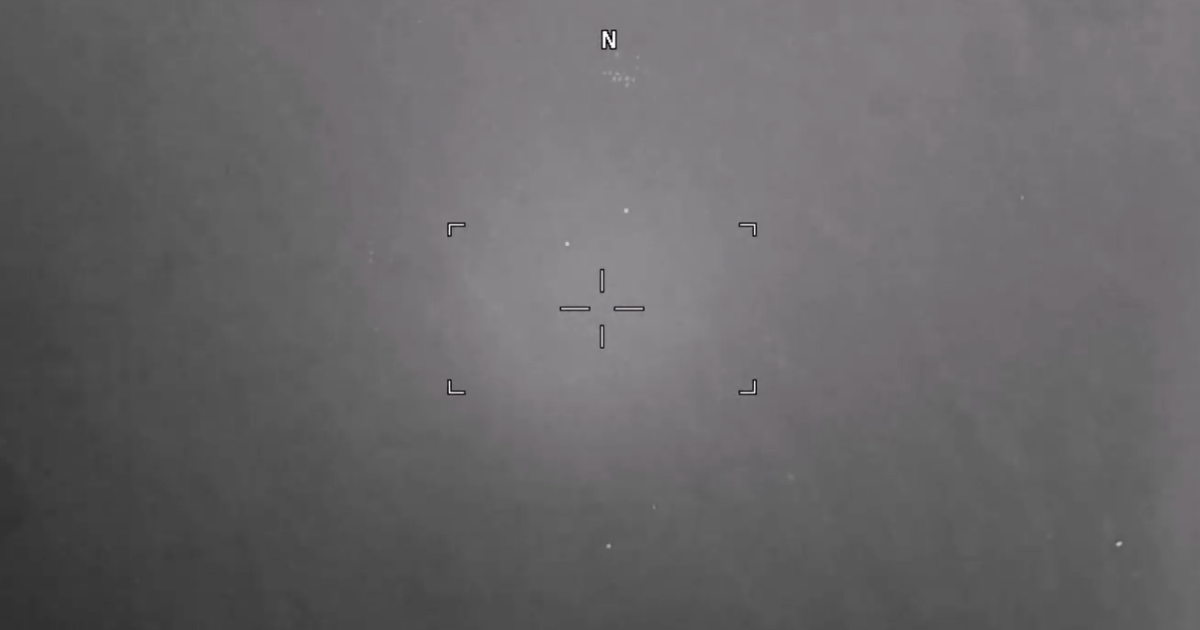
The latest batch also contains reports and video from more recent UAP incidents. Three clips recorded by military personnel and sent to the Pentagon’s All-domain Anomaly Resolution Office show bright white points moving across the frame.
A separate report examines unusual readings recorded by a civilian air-surveillance radar in 2023. The system detected eight objects over a span of 84 seconds, at altitudes ranging from 55,000 to 70,000 feet.
Pentagon 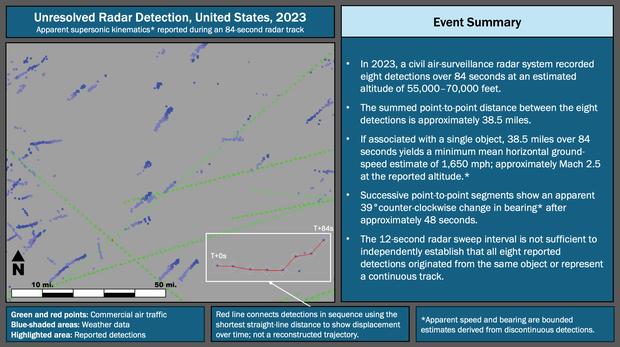
“If the detections were associated with a single continuous track, their cumulative point-to-point displacement would be approximately 38.5 miles, yielding a minimum mean horizontal ground-speed estimate of 1,650 mph,” the Pentagon said.
However, the accompanying slide cautions that the available information was “not sufficient” to prove the eight radar returns came from one object.
Among the historical records released Friday is a 1953 account from Clarence “Kelly” Johnson, Lockheed’s chief engineer and the future designer of the U-2 and SR-71 spy aircraft. Johnson reported seeing a dark, elliptical object remain motionless against a “gold and red” sunset sky while he was at his California ranch.
“I wondered why this one object was so dark, considering that the sun was behind it. I immediately thought that some aircraft had made an intense smoke trail; so I studied the object closely. It was apparent, after my first few seconds of consideration, that the outline of this object did not change,” Johnson wrote.
Johnson said he observed the object with binoculars before it suddenly departed in “a long shallow climb.” Around the same time, a Lockheed test crew flying offshore reported pursuing what appeared to be “a very large flying wing,” which eventually diminished to “a mere speck.”
An Air Force assessment included with the report classified the sighting as a lenticular cloud.