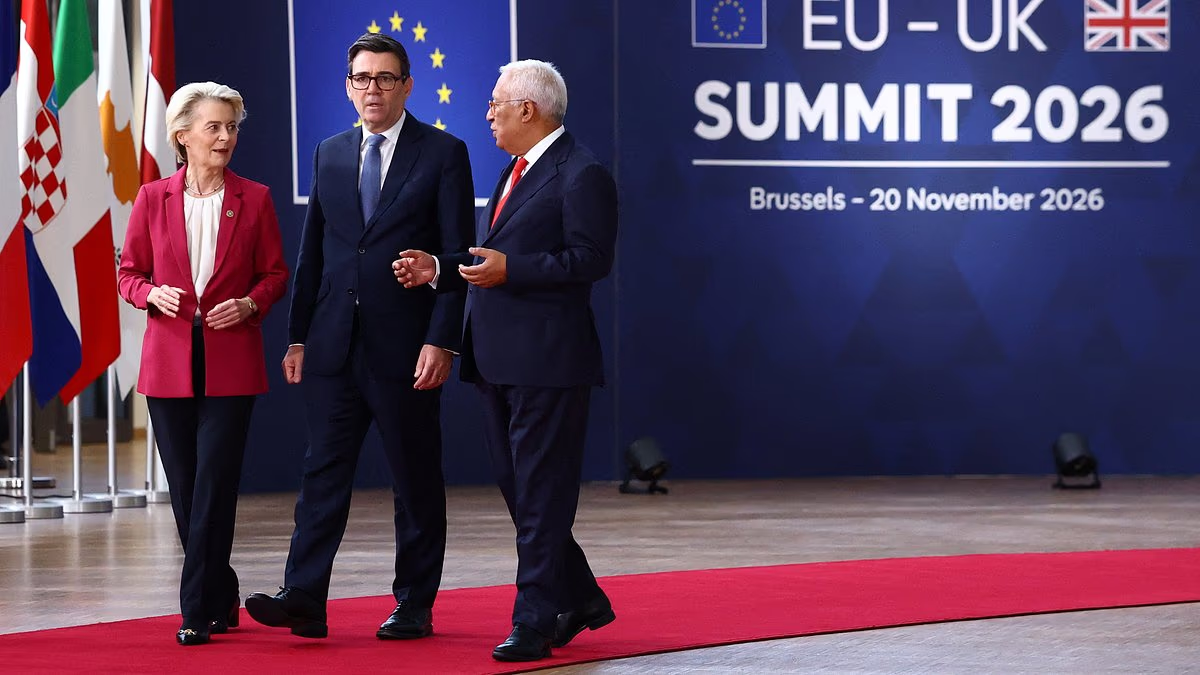

Andy Burnham is facing renewed criticism over his EU agreement after it emerged that the full text may not be published for several days.
The PM described his Brexit ‘reset’ as a ‘win-win’ at a summit on Friday, despite concerns that he has made significant concessions in return for limited trade benefits.
The bloc has also indicated that the package may only proceed if the UK agrees within six months to reduce tuition fees for European students. Universities have warned that the move could cost £570million.
Kemi Badenoch asked this morning why no legal details of the agreements between the UK and EU had yet been published. So far, only a joint political statement and several ‘explainers’ have been released.
Government sources said officials were aiming to publish the text on Wednesday. However, with Mr Burnham expected to make a statement to the Commons tomorrow afternoon, MPs may be forced to question him before they know precisely what has been agreed.
The Tory leader said: ‘What has Burnham agreed and what is he not telling us?’
Unresolved issues include whether the provisions on food standards and emissions trading are linked, as well as how the tuition-fee negotiations will be concluded.
It also remains unclear whether the UK would face financial penalties for withdrawing from the agreement, something both the Conservatives and Reform have pledged to do if they enter government.

Andy Burnham described his Brexit ‘reset’ as a ‘win-win’ at a Brussels summit on Friday, but the EU has suggested the package may depend on resolving the student tuition-fee issue within six months

Kemi Badenoch said today: ‘Something isn’t right here. The summit is over, but we still haven’t seen any treaty text.’
Mrs Badenoch said today: ‘Something isn’t right here. The summit is over, but we still haven’t seen any treaty text.
‘That is unusual because a political statement is not legally binding. Yet the Government is acting as though the deal has been finalised while keeping Parliament and the public unaware of the actual terms.
‘What has Burnham agreed and what is he not telling us?
‘Andy Burnham needs to come clean to Parliament on Monday about precisely what he has agreed with Brussels.
‘Ed Miliband claimed yesterday that we would not have to pay money to Brussels, but the political agreement states clearly that a new British “financial contribution” will be required.
‘Meanwhile, it appears the EU has the UK under pressure over tuition fees, and we will spend the next six months arguing about the issue before Labour capitulates again.
‘Andy Burnham has the wrong priorities. He should be tackling the crippling interest rates on Plan 2 student loans, not asking British taxpayers to subsidise Europeans studying at our world-class universities.’
Government insiders noted that the text of the UK-EU Trade and Cooperation Agreement signed by Boris Johnson was not published until two days after it had been agreed. However, that deal was concluded on Christmas Eve.
Brussels is seeking equal tuition-fee treatment for European students, reducing their charges from as much as £38,000 a year to £9,970 in England and Wales, and potentially to zero in Scotland.
The higher education sector estimates that extending those benefits could cost £570million. Universities have warned that fees may ultimately need to rise, or that taxpayers could be required to cover the shortfall.
Some EU experts have criticised the bloc’s leadership for prioritising the concession, claiming that many Eurocrats send their children to be educated in the UK.
Universities today warned that the proposal could have a considerable impact on their finances.
Professor Dame Sally Mapstone, vice-chancellor of St Andrews, said that ‘unless we sort out the important financial practicalities of this, the unintended consequences for higher education in the UK could be considerable’.
She told the Sunday Times: ‘I would urge the Government to use these six months to act practically and pragmatically, rather than simply politically.
‘It is positive to see a welcome being extended to EU students, and we would support that.
‘But what has not been explicitly addressed is the cost of educating those students, which we estimate at around £15,000 a year.’
Professor Duncan Ivison, vice-chancellor of the University of Manchester, said closer UK-EU relations were a ‘good thing’, but stressed that tuition fees remained an issue because ‘there is a cost’ involved.
He told the BBC: ‘If nothing was done to compensate universities or provide additional funding, we estimate that £500million would be taken out of the higher education sector at a time when it is already under considerable pressure.’
He also warned that competition between EU and British students could emerge, saying it was ‘not clear we’d be able to increase the number of places’.
The Russell Group of research-intensive universities has estimated that equalising tuition fees could cost the sector £570million, while other estimates have put the potential impact even higher.
Meanwhile, the Conservatives warned that linking the UK to the EU’s emissions trading system, or ETS, would lead to ‘significant increases’ in already high gas and fuel bills.
Mrs Badenoch’s party estimates that higher petrol and diesel prices could add an average of £6 to the cost of filling a Volkswagen Polo, equivalent to about £156 a year.
A household using 15,000 kWh of gas—the amount typically consumed by a larger home—could see around £125 added to its annual bills.
Shadow energy secretary Andrew Bowie said: ‘Labour is signing us up to a deal that allows Brussels to push up household bills while making us pay for the privilege.
‘Affordable energy must come first. These excessive carbon taxes and levies imposed by the EU will only send bills higher.
‘We do not want Britain tied to the EU’s carbon trading scheme and would scrap it in government.’
But a Government spokesman said: ‘These figures are completely wrong.
‘Without our emissions agreement—a deal sought by industry—£6.5billion of UK exports would be exposed to EU taxes.

Theresa May has urged Andy Burnham to ‘move on’ rather than plunge the UK into chaos with an attempt to rejoin the EU
‘Leading British businesses have welcomed the agreement, saying it will reduce costs and benefit consumers. This is clearly a major boost for businesses and the British people.’
The Government said the ETS agreement, scheduled to take effect in 2028, would add around £3.8billion a year to the economy by 2040 by protecting UK exports to the EU from carbon taxes.
Mr Burnham’s negotiations with the EU on food standards, emissions and youth mobility were thrown into uncertainty on Friday after the last-minute dispute over tuition fees.
Brussels officials suggested to journalists that the other elements of the agreement might not proceed without a resolution on tuition fees. A briefing reportedly circulated to European ambassadors also indicated that the remaining measures could be delayed in those circumstances.
Foreign Secretary Ed Miliband insisted yesterday that the agreement would go ahead regardless of the tuition-fee negotiations.
He told the BBC it was ‘absolutely clear’ that the deal was not conditional, adding: ‘The dates are set out in 2028, when these measures are coming in. We are introducing legislation in Parliament, so definitely.’
Legislation is expected to be presented to Parliament this week.


